

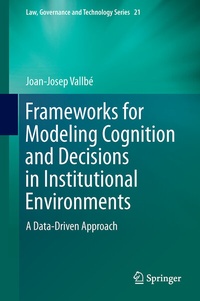
Frameworks for Modeling Cognition and Decisions in Institutional Environments
Description

This book deals with the theoretical, methodological, and empirical implications of bounded rationality in the operation of institutions. It focuses on decisions made under uncertainty, and presents a reliable strategy of knowledge acquisition for the design and implementation of decision-support systems. Based on the distinction between the inner and outer environment of decisions, the book explores both the cognitive mechanisms at work when actors decide, and the institutional mechanisms existing among and within organizations that make decisions fairly predictable.
While a great deal of work has been done on how organizations act as patterns of events for (boundedly) rational decisions, less effort has been devoted to study under which circumstances organizations cease to act as such reliable mechanisms. Through an empirical strategy on open-ended response data from a survey among junior judges, the work pursues two main goals. The first one is to explore the limits of "institutional rationality" of the Spanish lower courts on-call service, an optimal scenario to observe decision-making under uncertainty. The second aim is to achieve a better understanding of the kind of uncertainty under which inexperienced decision-makers work. This entails exploring the demands imposed by problems and the knowledge needed to deal with them, making this book also a study on expertise achievement in institutional environments.
This book combines standard multivariate statistical methods with machine learning techniques such as multidimensional scaling and topic models, treating text as data. Doing so, the book contributes to the collaboration between empirical social scientific approaches and the community of scientists that provide the set of tools and methods to make sense of the fastest growing resource of our time: data.
More details
Other editions
Additional editions
Person
Joan-Josep Vallbé is a political scientist. He works with social and computer scientists, urban designers, and legal professionals, on how to model, measure, and analyze the interaction between citizens and variation in their environment. Change may occur in micro-level contexts such as problem spaces in choice situations or in macro-level phenomena such as metropolitan growth or the regulatory environment. His recent affiliations include the University of Barcelona, and the Institute for Information Law (IViR) at the University of Amsterdam.
Content
Foreword; Pompeu Casanovas and Pablo Noriega.- Acknowledgements.- 1 Introduction.- Part I Foundations.- 2 Decisions and organizations.- 3 Bounded rationality and organizations.- Part II Data Analysis.- 4 Empirical context.- 5 Representing organizational uncertainty.- 6 Conclusions and further work.- Index.
