

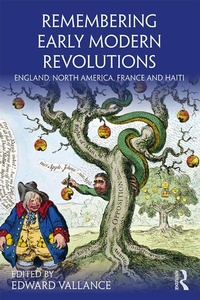
Remembering Early Modern Revolutions
England, North America, France and Haiti
1st Edition
Published on 8. October 2018
234 pages
978-0-429-79649-4 (ISBN)
Description

Remembering Early Modern Revolutions is the first study of memory in relation to the major revolutions of the early modern period. Beginning with the English revolutions of the seventeenth century (1642-60 and 1688-9), this book also explores the American, French and Haitian revolutions.
Through addressing these events collectively, this volume demonstrates the interconnectedness of these revolutions in the contemporary mind and highlights the importance of invoking the memory of prior revolutions in order both to warn of the dangers of revolution and to legitimate radical political change. It also unpicks the different ways in which these events were presented and their memory utilised, uncovering the importance of geographical and temporal contexts to the processes of remembering and forgetting.
Examining both personal and collective remembrance and exploring both private recollection and public commemoration, Remembering Early Modern Revolutions uncovers the rich and powerful memory of revolution in the Atlantic world and is ideal for students and teachers of memory in the early modern period.
Through addressing these events collectively, this volume demonstrates the interconnectedness of these revolutions in the contemporary mind and highlights the importance of invoking the memory of prior revolutions in order both to warn of the dangers of revolution and to legitimate radical political change. It also unpicks the different ways in which these events were presented and their memory utilised, uncovering the importance of geographical and temporal contexts to the processes of remembering and forgetting.
Examining both personal and collective remembrance and exploring both private recollection and public commemoration, Remembering Early Modern Revolutions uncovers the rich and powerful memory of revolution in the Atlantic world and is ideal for students and teachers of memory in the early modern period.
Reviews / Votes
'Edward Vallance has assembled a very interesting collection of essays that range widely in time and space. Together they explore the role of scholars and wider publics in shaping the memory of revolution; how those memories help shape the experience and understanding of subsequent events; and how those experiences of later revolutions in turn contribute to re-shaping the memory of earlier events. They offer important reflections on the history and historiography of each of these sets of events, on the construction and mutation of public memory more broadly, and on recent arguments about the nature of 'revolution' as a general historical phenomenon.'Michael Braddick, The University of Sheffield, UK.
'The afterlives of revolutions have been somewhat neglected by historians, and the very idea that they had significant legacies has sometimes been challenged. As this fascinating collection demonstrates, however, it is important to recognise how the past could exert an influence on people's imaginations for decades and even centuries, helping to structure, guide and constrain human thought and action. What emerges are the myriad ways in which meanings evolved and became contested, as these turbulent periods were remembered and forgotten, revived, re-evaluated and re-purposed, and used to reflect on the present as well as on the future, not to mention translated into different contexts, simplified and mythologised. This all makes for intriguing and thought-provoking reading.'
Jason Peacey, University College London, UK
More details
Series
Edition
1. Auflage
Language
English
Place of publication
London
United Kingdom
Publishing group
Taylor & Francis Ltd
Target group
College/higher education
File size
1,76 MB
ISBN-13
978-0-429-79649-4 (9780429796494)
Copyright in bibliographic data and cover images is held by Nielsen Book Services Limited or by the publishers or by their respective licensors: all rights reserved.
Schweitzer Classification
Other editions
Additional editions
Book
09/2018
1st Edition
Routledge
€215.77
Shipment within 10-20 days
Book
09/2018
1st Edition
Routledge
€63.00
Shipment within 10-20 days
Person
Edward (Ted) Vallance is Professor of Early Modern British Political Culture at the University of Roehampton, London, UK. His previous publications include A Radical History of Britain (2009), The Glorious Revolution (2006) and Revolutionary England and the National Covenant (2005). He has also co-edited two volumes with Harold Braun: Contexts of Conscience (2004) and The Renaissance Conscience (2011).
Content
Introduction: revolution, time and memory; Chapter 1: Remembering the good old cause; Chapter 2: Commemorating the English Revolution: local deliverance and thanksgiving; Chapter 3: Remembering the regicide in an Age of Revolutions: the case of Mark Noble; Chapter 4: 'A total contradiction to every principle laid down at the time of the Revolution': American revolutionaries and the Glorious Revolution; Chapter 5: Settlers among empires: conquest and the American Revolution; Chapter 6: How the American Revolution earned its Independence; Chapter 7: Reliving the French Revolution through Gouverneur Morris's diary; an American perspective from behind the scenes rediscovered; Chapter 8: Reviving the memory of James Harrington (1611-77) in revolutionary France: Henry and Aubin's translations in the year III of the French republic; Chapter 9: Communist and neo-Babouvist readings of the Enlighenment and the French Revolution; Chapter 10: The Haitian Revolution and the myth of the republic: Louis Joseph Janvier's revisionist history; Chapter 11: Haiti's Fete Nationale: A revolutionary site of memory; Afterword
