

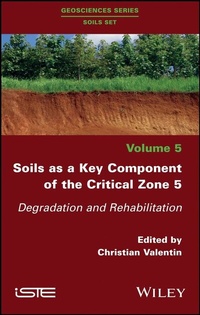
Soils as a Key Component of the Critical Zone 5
Degradation and Rehabilitation
1st Edition
Published on 28. November 2018
272 pages
978-1-119-57307-4 (ISBN)
Description

One third of the world's soils have already been degraded. The burden on the land continues to grow under the combined pressures of demography, urbanization, artificialization and mining, and there are increased demands on agricultural land: changing dietary preferences, land speculation, as well as new demands for agroenergy, fiber, green chemistry, and more. Resulting issues such as soil crusting, water and wind erosion, soil salinization and soil acidity therefore constitute a major threat.
The authors of this book present the main processes and factors of soil degradation, different ways to prevent it and methods of rehabilitation. The book also deals with the origin and processes of metallic and organic soil pollution as well as methods of phytoremediation and restoration. It is one of the few books to explore the issue of soil artificialization and urban soil management and to highlight how agricultural and urban waste can be used to amend and fertilize cultivated soils.
More details
Other editions
Additional editions
Book
11/2018
1st Edition
Wiley-ISTE
€164.50
Shipment within 3-4 weeks
Content
- Cover
- Half-Title Page
- Title Page
- Copyright Page
- Contents
- Foreword
- 1. The State and Future of Soils
- 1.1. Soils as a key component of the critical zone
- 1.1.1. Definitions
- 1.1.2. Soil functions and services
- 1.1.3. Soil and land degradation, desertification
- 1.2. The difficult assessment of the state and kinetics of soil degradation or enhancement
- 1.2.1. Global assessment
- 1.2.2. Forms of degradation
- 1.2.3. Main factors of soil degradation
- 1.2.4. What's the trend: degradation spiral or U-curve?
- 1.2.5. The necessity for monitoring mechanisms
- 1.3. Conservation, restoration, rehabilitation and compensation
- 1.3.1. Definitions
- 1.3.2. Implementation
- 1.3.3. Concept of neutrality in terms of land degradation
- 1.4. Conclusions
- 1.5. References
- 2. Soil Surface Crusting of Soiland Water Harvesting
- 2.1. Surface conditions and surface crusts
- 2.2. Crust types and formation processes
- 2.2.1. Structural crusts
- 2.2.2. Gravel crusts
- 2.2.3. Erosion crusts
- 2.2.4. Depositional crusts
- 2.2.5. Saline crusts and efflorescence
- 2.2.6. Biological soil crusts (or Biocrusts)
- 2.3. Crusting factors and principles for improving aggregate stability
- 2.3.1. Soils
- 2.3.2. Rain
- 2.3.3. Slope
- 2.3.4. Cover
- 2.3.5. Agricultural practices
- 2.4. Consequences of surface crusting
- 2.4.1. Hydrological: Hortonian flow
- 2.4.2. Ecological: example of the tiger bush
- 2.4.3. Agronomic: water harvesting
- 2.5. Conclusions
- 2.6. References
- 3. Erosion and Principles of Soil Conservation
- 3.1. Definitions
- 3.2. The importance of erosion
- 3.2.1. On a global scale
- 3.2.2. Effects of erosion
- 3.3. Processes and factors
- 3.3.1. Splash detachment
- 3.3.2. Sheet erosion (also called inter-rill erosion)
- 3.3.3. Linear erosion
- 3.3.4. Mass movements
- 3.3.5. Tillage erosion
- 3.3.6. Wind erosion
- 3.4. Erosion: a question of scale
- 3.4.1. Space scales
- 3.4.2. Time scales
- 3.4.3. Space scales
- 3.4.4. Particulate and soluble transport
- 3.4.5. Aeolian dust
- 3.5. Modeling
- 3.5.1. Statistical approaches
- 3.5.2. Physically based models
- 3.5.3. Hybrid models
- 3.6. Principles of soil conservation
- 3.6.1. Field level: limiting detachment
- 3.6.2. Catchment scale: slowing runoff and promoting deposition
- 3.7. Population density, economic contexts and public policies
- 3.8. Conclusions
- 3.9. References
- 4. Soil Acidity and Acidification
- 4.1. Acidity
- 4.2. Definitions of acidification and its evolution
- 4.3. Illustration: long-term theoretical evolution of the acidity of a limestone loess
- 4.4. Acidifying processes
- 4.5. Involvement of large biogeochemical cycles in soil acidification
- 4.5.1. Nitrogen cycle
- 4.5.2. Carbon cycle
- 4.5.3. Absorption of cations/anions by plants
- 4.5.4. Acid or alkaline deposits
- 4.5.5. Other cycles: P, S, Fe, Mn
- 4.6. Neutralization of acidification
- 4.7. Biogeography of acidity
- 4.8. Physical and biological consequences of soil acidity
- 4.9. References
- 5. Soil Salinization andManagement of Salty Soils
- 5.1. Introduction
- 5.2. Natural salty environments
- 5.2.1. Salts, dissolved particulate entities
- 5.2.2. Typical landscapes
- 5.2.3. Continuous movement of salts
- 5.2.4. Ecosystemic services
- 5.3. Characterization and functioning of salty soils
- 5.3.1. Diagnosis of the degree of salinization
- 5.3.2. Intrinsic physical-chemical processes
- 5.3.3. Chemical concentration and evolution pathways of soil water
- 5.3.4. Mineralogy of saline efflorescences
- 5.4. Typology of salty soils
- 5.4.1. Soil characteristics
- 5.4.2. Vertical distribution of salinity
- 5.4.3. Spatial distribution of salinity
- 5.4.4. Classification of salty soils
- 5.4.5. Worldwide distribution of salty soils
- 5.5. Secondary soil salinization
- 5.5.1. Anthropogenic input of salts in soils
- 5.5.2. Salinization of irrigated systems
- 5.5.3. Control of salts in irrigation
- 5.5.4. Use of non-conventional waters
- 5.6. Agricultural development of salty soils
- 5.6.1. Historical context
- 5.6.2. Effects of salty soil water on plants
- 5.6.3. Agronomic solutions
- 5.6.4. Macroeconomic solutions
- 5.6.5. Social and political solutions
- 5.7. Conclusions
- 5.8. References
- 6. Metal Pollution
- 6.1. General information
- 6.1.1. Definitions: trace elements
- 6.1.2. Risks and hazards: exposure and transfer routes
- 6.1.3. Different forms and locations of trace elements in soils
- 6.1.4. Measurement and estimation methods available
- 6.1.5. How should the pollution level of soil be assessed?
- 6.2. Famous polluted sites (France)
- 6.2.1. Metaleurop at Noyelles-Godault
- 6.2.2. Mortagne-du-Nord
- 6.2.3. Pierrelaye plain (polymetallic pollution)
- 6.3. Locally polluted sites and diffuse contamination
- 6.3.1. Pole treatment site polluted by copper in podzol context
- 6.3.2. Soil contamination by sewage sludge
- 6.3.3. Copper contamination in vineyard soils
- 6.3.4. Copper and zinc soil contamination from repeated spreading of pig manure
- 6.3.5. Atmospheric deposition of lead since antiquity
- 6.3.6. Metal nanoparticules
- 6.4. Impacts of metal pollution
- 6.4.1. Bioand phytoavailability - absorption routes
- 6.4.2. Mobility
- 6.4.3. Mobility and bioavailability estimation
- 6.4.4. The importance of soil properties for speciation, bioavailability and mobility
- 6.5. What should be done about metal polluted soils?
- 6.5.1. Strategies without treatment
- 6.5.2. Stripping polluted horizons
- 6.5.3. In situ immobilization and phytoremediation
- 6.5.4. An example: the Maatheide-Lommel site (Belgium)
- 6.6. References
- Recommended references
- 7. Organic Pollution and Soil Rehabilitation
- 7.1. Organic pollution: its origins and diversity
- 7.2. Origin and distribution of PAHs in soils
- 7.3. Characteristics, properties and toxicity of PAHs
- 7.4. Fate and impact of organic pollution in soils: tools and approaches
- 7.4.1. Sorption of PAHs in soils
- 7.4.2. Bioavailable form and ageing of PAH contamination in soils
- 7.4.3. Biodegradation and the microorganisms involved
- 7.5. Fate of PAHs in the plant rhizosphere
- 7.6. Remediation techniques: limitations and constraints
- 7.7. From remediation to restoration
- 7.8. Conclusions
- 7.9. References
- 8. Urban Soils: Artificialization and Management
- 8.1. Introduction
- 8.2. Soil urbanization
- 8.2.1. History and origin of urban soils
- 8.2.2. Artificialization and sealing
- 8.3. Soil characteristics in urban areas
- 8.3.1. Typology of urban soils
- 8.3.2. The properties of artificialized urban soils
- 8.4. Urban soil classification and mapping
- 8.4.1. Classification
- 8.4.2. Mapping
- 8.5. Fertile soils for vegetated areas
- 8.5.1. Reconstituted soils
- 8.5.2. The particular case of aggregate structural soil
- 8.5.3. Soils built from the "waste" from cities
- 8.6. Conclusions
- 8.6.1. The "brown belt"
- 8.6.2. Urban soil value and protection
- 8.7. References
- 9. Recycling Organic Waste Productsin a Tropical Context
- 9.1. Definition, typology and main characteristics of organic waste products
- 9.1.1. Definition of organic waste products and associated issues
- 9.1.2. Typology of organic waste products
- 9.2. Analytical characterizations of organic waste products
- 9.2.1. Chemical elements of agronomic interest (C, N, P, K)
- 9.2.2. Specific analyses of organic properties
- 9.2.3. Organic and metallic trace contaminants
- 9.3. Agricultural interests and environmental risks
- 9.3.1. Fertilizing aspects of organic waste products
- 9.3.2. Amending aspects of organic waste products
- 9.3.3. Metallic, organic and biological contaminants
- 9.3.4. Other environmental impacts
- 9.4. Examples of recycling organic waste products in tropical contexts
- 9.4.1. In weakly intensified systems
- 9.4.2. In intensive systems
- 9.5. References
- List of Authors
- Index
- Other titles from iSTE in Earth Systems - Environmental Sciences
- EULA
