

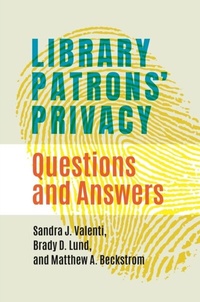
Library Patrons' Privacy
Questions and Answers
1st Edition
Published on 11. January 2022
168 pages
978-1-4408-7411-6 (ISBN)
Description

A quick, easy-to-read synthesis of theory, guidelines, and evidence-based research, this book offers timely, practical guidance for library and information professionals who must navigate ethical crises in information privacy and stay on top of emerging privacy trends.
Emerging technologies create new concerns about information privacy within library and information organizations, and many information professionals lack guidance on how to navigate the ethical crises that emerge when information privacy and library policy clash. What should we do when a patron leaves something behind? How do we justify filtering internet access while respecting accessibility and privacy? How do we balance new technologies that provide anonymity with the library's need to prevent the illegal use of their facilities?
Library Patrons' Privacy presents clear, conversational, evidence-based guidance on how to navigate these ethical questions in information privacy. Ideas from professional organizations, government entities, scholarly publications, and personal experiences are synthesized into an approachable guide for librarians at all stages of their career. This guide, designed by three experienced LIS scholars and professionals, is a quick and enjoyable read that students and professionals of all levels of technical knowledge and skill will find useful and applicable to their libraries.
Emerging technologies create new concerns about information privacy within library and information organizations, and many information professionals lack guidance on how to navigate the ethical crises that emerge when information privacy and library policy clash. What should we do when a patron leaves something behind? How do we justify filtering internet access while respecting accessibility and privacy? How do we balance new technologies that provide anonymity with the library's need to prevent the illegal use of their facilities?
Library Patrons' Privacy presents clear, conversational, evidence-based guidance on how to navigate these ethical questions in information privacy. Ideas from professional organizations, government entities, scholarly publications, and personal experiences are synthesized into an approachable guide for librarians at all stages of their career. This guide, designed by three experienced LIS scholars and professionals, is a quick and enjoyable read that students and professionals of all levels of technical knowledge and skill will find useful and applicable to their libraries.
More details
Edition
1. Auflage
Language
English
Place of publication
United States
Publishing group
Bloomsbury Publishing Plc
Target group
Children/juvenile
ISBN-13
978-1-4408-7411-6 (9781440874116)
Copyright in bibliographic data and cover images is held by Nielsen Book Services Limited or by the publishers or by their respective licensors: all rights reserved.
Schweitzer Classification
Other editions
Additional editions
Sandra J. Valenti | Brady D. Lund | Matthew A. Beckstrom
Library Patrons' Privacy
Questions and Answers
Book
01/2022
Libraries Unlimited Inc
€74.20
Shipment within 10-20 days
Persons
Sandra J. Valenti is Assistant Professor in the School of Library and Information Management at Emporia State University, USA.
Brady D. Lund is Assistant Professor in the Department of Information Science at the University of North Texas, USA.
Matthew A. Beckstrom is Systems Manager/Librarian at the Lewis and Clark Library in Helena, MT, USA.
Brady D. Lund is Assistant Professor in the Department of Information Science at the University of North Texas, USA.
Matthew A. Beckstrom is Systems Manager/Librarian at the Lewis and Clark Library in Helena, MT, USA.
Content
Acknowledgments
Introduction: The Importance of Evidence-Based Practice in Information Policy
Part IGetting Our Boots on the Ground: The Dirty Work of Patron Privacy1
ONEMissing/Unattended Items in the Library
TWOPatron Records and the Anonymous Checkout
THREEPhotography and Video Recording within the Library and Social Media Policy
FOURWhen Escalation Must Result in Calling the Police
Part IILibraries and Basic Computer Privacy63
FIVELooking over Your Shoulder (Literally and Figuratively)
SIXPrivacy and Security in the Virtual Library Environment
Part IIIEmerging Technologies: Where Are We Going (and What Should We Do about It)?87
SEVENTracking Your Web Use
EIGHTHow Public Computer Network Usage May Pose a Threat
NINELetting Your Library Get Stuck in the Dark Web
Glossary139
Additional Resources
Index
Introduction: The Importance of Evidence-Based Practice in Information Policy
Part IGetting Our Boots on the Ground: The Dirty Work of Patron Privacy1
ONEMissing/Unattended Items in the Library
TWOPatron Records and the Anonymous Checkout
THREEPhotography and Video Recording within the Library and Social Media Policy
FOURWhen Escalation Must Result in Calling the Police
Part IILibraries and Basic Computer Privacy63
FIVELooking over Your Shoulder (Literally and Figuratively)
SIXPrivacy and Security in the Virtual Library Environment
Part IIIEmerging Technologies: Where Are We Going (and What Should We Do about It)?87
SEVENTracking Your Web Use
EIGHTHow Public Computer Network Usage May Pose a Threat
NINELetting Your Library Get Stuck in the Dark Web
Glossary139
Additional Resources
Index
