

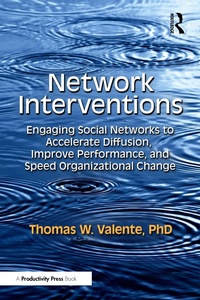
Network Interventions
Engaging Social Networks to Accelerate Diffusion, Improve Performance, and Speed Organizational Change
Published on 25. November 2025
194 pages
978-1-040-45074-1 (ISBN)
Description

Social networks are important sources of influence on many personal, organizational, community, and societal behaviors. Network interventions (NIs) are purposeful and planned efforts to use social networks or social network data to generate social influence, accelerate behavior change, improve performance or quality, and/or achieve desirable outcomes among individuals, communities, organizations, or populations.
This book is designed to be a guide or primer on how to use the powerful and formal set of mathematical and computational tools developed in the network analysis field to engage individuals, communities, organizations, and/or populations to bring about change. This change can be the spread of information, culture changes, attitude shifts, or accelerating adoption of new behaviors. It is designed to inform medical and public health professionals who are often tasked with promoting behaviors that improve health or prevent disease at the individual, organizational, community, regional, and/or national levels. It is also designed to be a book useful when the chief medical officer of a hospital or medical care organization turns to a colleague and says, "[O]ur rate of handwashing (or insert X) is too low and we need to increase that." The colleague can then offer a copy of this book, which provides a wide-ranging set of options on how to achieve such changes. It can also be applied to non-healthcare organizations and settings whenever someone wants to bring about cultural or behavioral change. Some of these options, such as network-identified opinion leaders, have considerable evidence, while others have none. The robust evidence base for NIs provides the basis for this book, with the goal of providing practical guidance to enable more widespread use of them.
The book focuses on how to actively harness the influence of networks to engage people and organizations in behavior change efforts and improve the development and delivery of interventions.
Thomas W. Valente, PhD is Professor in the Department of Population and Public Health Sciences, Keck School of Medicine, University of Southern California, Los Angeles, CA, USA.
This book is designed to be a guide or primer on how to use the powerful and formal set of mathematical and computational tools developed in the network analysis field to engage individuals, communities, organizations, and/or populations to bring about change. This change can be the spread of information, culture changes, attitude shifts, or accelerating adoption of new behaviors. It is designed to inform medical and public health professionals who are often tasked with promoting behaviors that improve health or prevent disease at the individual, organizational, community, regional, and/or national levels. It is also designed to be a book useful when the chief medical officer of a hospital or medical care organization turns to a colleague and says, "[O]ur rate of handwashing (or insert X) is too low and we need to increase that." The colleague can then offer a copy of this book, which provides a wide-ranging set of options on how to achieve such changes. It can also be applied to non-healthcare organizations and settings whenever someone wants to bring about cultural or behavioral change. Some of these options, such as network-identified opinion leaders, have considerable evidence, while others have none. The robust evidence base for NIs provides the basis for this book, with the goal of providing practical guidance to enable more widespread use of them.
The book focuses on how to actively harness the influence of networks to engage people and organizations in behavior change efforts and improve the development and delivery of interventions.
Thomas W. Valente, PhD is Professor in the Department of Population and Public Health Sciences, Keck School of Medicine, University of Southern California, Los Angeles, CA, USA.
More details
Language
English
Place of publication
London
United Kingdom
Publishing group
Taylor & Francis Ltd
Target group
Professional and scholarly
Illustrations
6 Tables, black and white; 8 Line drawings, black and white; 8 Illustrations, black and white
File size
2,03 MB
ISBN-13
978-1-040-45074-1 (9781040450741)
Copyright in bibliographic data and cover images is held by Nielsen Book Services Limited or by the publishers or by their respective licensors: all rights reserved.
Schweitzer Classification
Other editions
Additional editions
Thomas W. Valente
Network Interventions
Engaging Social Networks to Accelerate Diffusion, Improve Performance, and Speed Organizational Change
Book
approx. 11/2025
1st Edition
Productivity Press
€58.20
Not yet published
Thomas W. Valente
Network Interventions
Engaging Social Networks to Accelerate Diffusion, Improve Performance, and Speed Organizational Change
Book
approx. 11/2025
1st Edition
Productivity Press
€207.30
Not yet published
Person
Thomas W. Valente, PhD, is a Professor in the Department of Population and Public Health Sciences, Keck School of Medicine, at the University of Southern California. He is the author of Social Networks and Health: Models, Methods, and Applications; Evaluating Health Promotion Programs; Network Models of the Diffusion of Innovations; and over 250 articles and chapters on social networks, behavior change, and program evaluation. Valente uses social network analysis, health communication, and mathematical models to implement and evaluate health promotion programs designed to prevent tobacco and substance abuse, unintended fertility, STD/HIV infections, physician behavior, and policy diffusion.
He is currently working on specifications for analyzing network models of diffusion and contagion with the R package NetdiffuseR. Valente is also well-known for his work networks for intervention and implementation. Valente is the director of the USC Center for Applied Network Analysis. He has received the numerous national and international awards as well as teaching and mentoring ones. Valente earned his BS in Mathematics from the University of Mary Washington, his MS in Mass Communication from San Diego State University, and his PhD from the Annenberg School for Communication at USC. From 1991 to 2000 he was a faculty member at the Bloomberg School of Public Health at Johns Hopkins University. He is a consultant in the private sector working with pharmaceutical companies and organization change managers.
He is currently working on specifications for analyzing network models of diffusion and contagion with the R package NetdiffuseR. Valente is also well-known for his work networks for intervention and implementation. Valente is the director of the USC Center for Applied Network Analysis. He has received the numerous national and international awards as well as teaching and mentoring ones. Valente earned his BS in Mathematics from the University of Mary Washington, his MS in Mass Communication from San Diego State University, and his PhD from the Annenberg School for Communication at USC. From 1991 to 2000 he was a faculty member at the Bloomberg School of Public Health at Johns Hopkins University. He is a consultant in the private sector working with pharmaceutical companies and organization change managers.
Content
Chapter 1: Introduction: Why Network Interventions? Chapter 2: Social Network Analysis and Behavior Change. Chapter 3: Network Interventions. Chapter 4: Selecting an Intervention. Chapter 5: Evidence for NI Effectiveness. Chapter 6: Networks for Program Implementation. Chapter 7: Implementation and Evaluation Issues in the Field. Chapter 8: Getting Network Data. Chapter 9: Reflections. Appendix A: Glossary. References
