

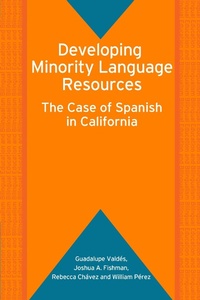
Developing Minority Language Resources
The Case of Spanish in California
1st Edition
Published on 4. July 2006
344 pages
978-1-85359-899-9 (ISBN)
Description

This book documents ongoing language shift to English among Latino professionals in California 67% of which studied Spanish formally in high school and 54% of which studied Spanish in college. Taking into account the recommendations about the teaching of Spanish as a heritage language made by these professionals, the book then describes current instructional practices used in the teaching of Spanish as an academic subject at the high school and university levels to "heritage" language students who, although educated entirely in English, acquired Spanish at home as their first language. The suggestions made by the Professionals concentrated almost exclusively on Spanish language maintenance (e.g., making cultural/historical connections; showing relevance and significance of language to students' lives, teaching other subjects in Spanish, teaching legal, medical, business terms in Spanish). The study of goals currently guiding instruction for heritage speakers of Spanish at both the high school and the college levels, on the other hand, raise questions about the potential contribution of educational institutions to the maintenance and retention of Spanish among the current Spanish-speaking population of California.
Reviews / Votes
This new volume makes an invaluable contribution at theoretical, pedagogical and practical levels to better understanding heritage language education. -- Jeffrey Bale, Arizona State University * Language Policy (2008) 7 * This extremely well-written, well-documented, and highly focused anthology provides the reader with a comprehensive, up-to-date set of essays on the most important issues related to the development of minority language resources in California with regard to Spanish. This volume belongs in the personal library of any professional interested in bilingual education and bilingualism. -- Frank Nuessel, University of Louisville * Language Problems and Language Planning 32:1 * In general, Valdes et al. offer a very informative and detailed account of the socio-political situation of Spanish in California. Particularly interesting is the rich historical context they provide to help readers grasp the complexity of US language ideology and policy as it relates to current anti-Spanish sentiment in certain segments of the American population. The book succeeds admirably in raising awareness about the importance and urgency of maintaining Spanish and other heritage languages in the USA. -- Silvina Montrul University of Illinois at Urbana-Champaign * Second Language Research 24/04/2008 * Developing Minority Language Resources makes a valuable contribution, not only to the ongoing discussion about bilingualism and the pedagogy of foreign language instruction, but also to the national conversation about the role of immigrants in American society. It will be of good use to many readers in many disciplines. -- Kareen L Gervasi, California State University, USA * Spanish in Context 9:1 (2012) *More details
Series
Language
English
Place of publication
Bristol
United Kingdom
Publishing group
Channel View Publications Ltd
Target group
Professional and scholarly
Edition type
Digital original
ISBN-13
978-1-85359-899-9 (9781853598999)
Copyright in bibliographic data and cover images is held by Nielsen Book Services Limited or by the publishers or by their respective licensors: all rights reserved.
Schweitzer Classification
Other editions
Additional editions
Guadalupe Valdes | Joshua A. Fishman | Rebecca Chavez
Developing Minority Language Resources
The Case of Spanish in California
Book
07/2006
Multilingual Matters
€43.20
Shipment within 10-20 days
Guadalupe Valdes | Joshua A. Fishman | Rebecca Chavez
Developing Minority Language Resources
The Case of Spanish in California
Book
07/2006
Multilingual Matters
€136.60
Shipment within 10-20 days
Persons
Guadalupe Valdes is the Bonnie Katz Tenenbaum Professor of Education and Professor of Spanish and Portuguese at Stanford University. Much of her work has focused on the English-Spanish bilingualism of Latinos in the United States and on discovering and describing how two languages are developed, used, and maintained by individuals who become bilingual in immigrant communities. Valdes' recent work includes two books entitled: Learning and not Learning English (Teachers College Press, 2001) and Expanding Definitions of Giftedness: Young Interpreters of Immigrant Background (Lawrence Erlbaum,2003). Two other books include: Bilingualism and Testing: A Special Case of Bias (Ablex Publishing Co.,1994) and Con respeto: Bridging the distance between culturally diverse families and schools (Teachers College Press, 1996).
Joshua A. Fishman is the Distinguished University Research Professor of Social Sciences, Emeritus (Ferkauf Graduate School of Psychology, Yeshiva University, Albert Einstein College of Medicine Campus Bronx, NY 10461); Visiting Professor and Visiting Scholar, School of Education, Applied Linguistics and Department of Linguistics, Stanford University; Adjunct Professor of Multilingual and Multicultural Education, School of Education, New York University; and Visiting Professor of Linguistics, City University of New York, Graduate Center.
Rebecca M. Chavez received a Masters degree in Language, Learning and Policy at the Stanford University School of Education. Her research interests include work-place language acquisition programs and their impact upon employee moral, language rights and institutional liases, and language as it affects access to information, legal services and effective representation within the U.S. legal system. She is currently pusuing a law degree at the University of California, Davis.
William Perez, Ph.D. is currently an Assistant Professor of Education at Claremont Graduate University. His research examines psychological and social processes that are a direct result of immigration such as cultural brokering, sense of family obligation, acculturation and biculturalism and their relationship to academic engagement among immigrant adolescents. In a parallel line of work, he has also studied how Latino adolescents' experiences with discrimination and social stereotypes influences their academic identities. A third line of work has examined how immigrant Latino youth come to develop a sense of ethnic identity and how this sense of identity is related to educational outcomes.
Joshua A. Fishman is the Distinguished University Research Professor of Social Sciences, Emeritus (Ferkauf Graduate School of Psychology, Yeshiva University, Albert Einstein College of Medicine Campus Bronx, NY 10461); Visiting Professor and Visiting Scholar, School of Education, Applied Linguistics and Department of Linguistics, Stanford University; Adjunct Professor of Multilingual and Multicultural Education, School of Education, New York University; and Visiting Professor of Linguistics, City University of New York, Graduate Center.
Rebecca M. Chavez received a Masters degree in Language, Learning and Policy at the Stanford University School of Education. Her research interests include work-place language acquisition programs and their impact upon employee moral, language rights and institutional liases, and language as it affects access to information, legal services and effective representation within the U.S. legal system. She is currently pusuing a law degree at the University of California, Davis.
William Perez, Ph.D. is currently an Assistant Professor of Education at Claremont Graduate University. His research examines psychological and social processes that are a direct result of immigration such as cultural brokering, sense of family obligation, acculturation and biculturalism and their relationship to academic engagement among immigrant adolescents. In a parallel line of work, he has also studied how Latino adolescents' experiences with discrimination and social stereotypes influences their academic identities. A third line of work has examined how immigrant Latino youth come to develop a sense of ethnic identity and how this sense of identity is related to educational outcomes.
Content
Contents
Acknowledgements
Introduction
Chapter 1: The Acquisition, Maintenance, and Recovery of Heritage Languages: An "American Tragedy" or "New Opportunity" - Joshua A. Fishman
Chapter 2: 300- Plus Years of Heritage Language Education in the United States - Joshua A. Fishman
Chapter 3: The Spanish Language in California - Guadalupe Valdes
Chapter 4: The Use of Spanish by Latino Professionals in California - Joshua A. Fishman, Guadalupe Valdes , Rebecca Chavez, William Perez
Chapter 5: The Foreign Language Teaching Profession and the Challenges of Developing Language Resources - Guadalupe Valdes
Chapter 6 Secondary Spanish Heritage Programs in California - Joshua A. Fishman, Guadalupe Valdes , Rebecca Chavez, William Perez
Chapter 7 Post- Secondary Spanish Heritage Programs in California - Joshua A. Fishman, Guadalupe Valdes , Rebecca Chavez, William Perez
Chapter 8 The Teaching Of Heritage Languages: Lessons from California - Guadalupe Valdes
Chapter 9 Imagining Linguistic Pluralism in the USA - Joshua A. Fishman
Methodological Appendix: References
Acknowledgements
Introduction
Chapter 1: The Acquisition, Maintenance, and Recovery of Heritage Languages: An "American Tragedy" or "New Opportunity" - Joshua A. Fishman
Chapter 2: 300- Plus Years of Heritage Language Education in the United States - Joshua A. Fishman
Chapter 3: The Spanish Language in California - Guadalupe Valdes
Chapter 4: The Use of Spanish by Latino Professionals in California - Joshua A. Fishman, Guadalupe Valdes , Rebecca Chavez, William Perez
Chapter 5: The Foreign Language Teaching Profession and the Challenges of Developing Language Resources - Guadalupe Valdes
Chapter 6 Secondary Spanish Heritage Programs in California - Joshua A. Fishman, Guadalupe Valdes , Rebecca Chavez, William Perez
Chapter 7 Post- Secondary Spanish Heritage Programs in California - Joshua A. Fishman, Guadalupe Valdes , Rebecca Chavez, William Perez
Chapter 8 The Teaching Of Heritage Languages: Lessons from California - Guadalupe Valdes
Chapter 9 Imagining Linguistic Pluralism in the USA - Joshua A. Fishman
Methodological Appendix: References
