

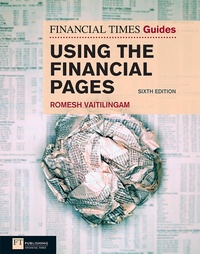
FT Guide to Using the Financial Pages
Description

This thorough reference guide to reading and really understanding the financial pages shows you where to look for information and how to make best use of it. Designed for a range of users, from corporate managers to individual investors, it shows you how to assess and evaluate information so as to benefit your investing and saving strategies and better understand economic indicators and financial jargon.
Financial Guide to Using the Financial Pages uses real examples from the financial newspapers, case studies of businesses, company reports and electronic information.
This new edition has been fully updated with new features, including:
- A wider range of examples of financial information.
- References at the end of each chapter, rather than at the end of the book.
- Online and 'new media' references incorporated throughout the book
- More discussion on financial regulation and governmental bodies.
- A glossary of financial terms.
More details
Other editions
Additional editions
Person
Romesh Vaitilingam is a media consultant and writer. He is the author of numerous articles and several successful titles in finance, including The Financial Times Guide to Using Economics and Economic Indicators. As a specialist in translating economic and financial concepts into everyday language, Romesh has advised a number of top management consultancies, as well as various UK government agencies. His work also involves media consultancy for the international economic research community.
Content
Foreword
Introduction
The sixth edition
Acknowledgements
Part 1: Identifying the players
1 Investors 2 Companies 3 Financial institutions 4 Governments
Part 2: Interpreting the markets
5 Stocks and shares: the UK equity markets 6 Indices and aggregates: market indicators 7 NYSE and Nasdaq: the US equity markets 8 European equities: stock markets in the eurozone and beyond 9 Other international equities: emerging stock markets and world indices 10 Trusts and funds: the managed money markets 11 Bonds and gilts: the international capital markets 12 Cash and currency: the foreign exchange and money markets 13 Futures and options: the derivatives markets 14 Primary products: the commodities markets
Part 3: Understanding the economies
15 UK economic indicators 16 The European economy: market integration and monetary union 17 The world economy: trade, growth and international institutions
Part 4: Beyond the financial pages
18 Company and investor lives: the key performance indicators (by Ken Langdon) 19 Sources of information: a brief guide
Glossary Appendix 1: The key ratios guide Appendix 2: The key indices guide Index
