

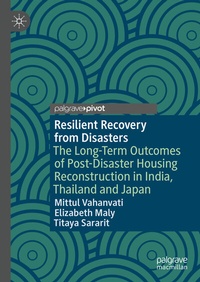
Resilient Recovery from Disasters
Description

This book is a call to action for housing recovery policymakers and practitioners to leverage foresight and planning capacities to achieve long-term resilience. For human societies to thrive in a rapidly changing climate and uncertain future, it is essential to learn about factors that can catalyse systemic change through disaster recovery processes. This book identifies key factors in housing recovery that meets housing rights of the most vulnerable, as well as help leapfrog to resilience strengthening of housing, its residents and institutions. To capture diverse experiences of stakeholders in various economies, socio-cultural, technical and political contexts, the authors draw from six cases of post-disaster housing reconstruction and rehabilitation projects from larger recovery programs, from three Asian countries - India, Thailand and Japan. This book identifies both unique and common findings. It is an essential resource for disaster recovery and housing practitioners, policymakers, students and researchers.
More details
Other editions
Additional editions
Persons
Mittul Vahanvati is a co-lead of the Climate Change Transformations research program and a Senior Lecturer in Sustainability and Urban Planning discipline at RMIT University in Melbourne, Australia. Her research focusses on the complex relationship between housing recovery after disasters and community resilience, to uphold housing as human right, with enhanced resilience.
Elizabeth Maly is an Associate Professor at the International Research Institute of Disaster Science, Tohoku University, in Sendai Japan. With the theme of people-centered housing recovery, her research interests are community-based housing recovery and temporary, transitional and permanent housing provision within reconstruction - including policy, process and housing form - that support successful life recovery for disaster-affected people.
Titaya Sararit is an Assistant Professor and Deputy Dean for Academic Affairs and Research at the Faculty of Architecture, Chiang Mai University, Thailand. She received her PhD in the field of Architecture at Kobe University, Japan. Her research interests are housing recovery, temporary shelter for local community, community-based design and long-term recovery after floods, earthquakes, and tsunamis in Thailand.
Content
Chapter 1: A changing development geography intertwined with disasters, housing recovery and resilience.- Chapter 2: Indian case studies.- Chapter 3: Thailand case studies.- Chapter 4: Japan case studies.- Chapter 5: Cross-cultural insights from long-term analysis of housing recovery.
