

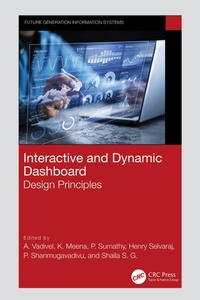
Interactive and Dynamic Dashboard
Design Principles
1st Edition
Published on 31. December 2024
302 pages
978-1-040-25928-3 (ISBN)
Description

The text comprehensively discusses the representation of visual data and design principles of interactive and dynamic dashboards. It further covers the theoretical concept of inference and machine learning algorithms for making the concepts clear to the reader. The book illustrates important topics such as data testing a parametric hypothesis, data testing a non-parametric hypothesis, exploratory data analysis, outlier detection and interpretation.
This book:
Covers various data analysis tools such as KNIME, RapidMiner, Rstudio, Grafana, and Redash
Discusses the theoretical concept of inference and machine learning algorithms for designing dynamic dashboards
Presents statistical modelling techniques with an emphasis on pattern mining, and pattern relationships
Explains the problem of efficient retrieval of similar time series in large databases to enrich the knowledge of the readers to effectively handle various real-time datasets
Illustrates dimensionality reduction techniques such as principal component analysis, linear discriminant analysis, singular value decomposition, and piecewise vector quantized approximation
It is primarily written for senior undergraduates, graduate students, and academic researchers in the fields of electrical engineering, electronics and communications engineering, computer science and engineering, and information technology.
This book:
Covers various data analysis tools such as KNIME, RapidMiner, Rstudio, Grafana, and Redash
Discusses the theoretical concept of inference and machine learning algorithms for designing dynamic dashboards
Presents statistical modelling techniques with an emphasis on pattern mining, and pattern relationships
Explains the problem of efficient retrieval of similar time series in large databases to enrich the knowledge of the readers to effectively handle various real-time datasets
Illustrates dimensionality reduction techniques such as principal component analysis, linear discriminant analysis, singular value decomposition, and piecewise vector quantized approximation
It is primarily written for senior undergraduates, graduate students, and academic researchers in the fields of electrical engineering, electronics and communications engineering, computer science and engineering, and information technology.
More details
Series
Edition
1. Auflage
Language
English
Place of publication
London
United Kingdom
Publishing group
Taylor & Francis Ltd
Target group
College/higher education
Professional and scholarly
Illustrations
20 Tables, black and white; 59 Line drawings, black and white; 117 Halftones, black and white; 176 Illustrations, black and white
ISBN-13
978-1-040-25928-3 (9781040259283)
Copyright in bibliographic data and cover images is held by Nielsen Book Services Limited or by the publishers or by their respective licensors: all rights reserved.
Schweitzer Classification
Other editions
Additional editions

Book
approx. 07/2026
1st Edition
CRC Press
€66.00
Not yet published
Book
12/2024
1st Edition
CRC Press
€176.40
Shipment within 10-20 days

Book
12/2024
CRC Press
Unfortunately, price unknown
Available (delivery time upon request)
Persons
A. Vadivel received his master's degree in science from NITT. He pursued Masters in Technology and Doctorate of Philosophy from Indian Institute of Technology (IIT), Kharagpur, India. He had 13 years of Technical Experience in Network Engineering & Instrumentation Engineering in IIT-Kharagpur, and sixteen years of teaching experience. Currently he is working as Professor in Department of Artificial Intelligence and Data Science, GITAM School of Technology, GITAM University, Bengaluru, India. He has published papers in more than 120 international journals and conferences. His Research areas are Content-Based Image and Video Retrieval, Multimedia Information Retrieval from Distributed Environment, Medical Image Analysis, Object Tracking in Motion Video and Cognitive Science. He has received Young Scientist Award by Department of Science and Technology, Govt. of India in 2007, Indo-US Research Fellow Award by Indo-US Science and Technology Forum in 2008. Obama-Singh Knowledge Initiative Award in 2013. Under his guidance, five PhD were awarded, and five PhD scholars are pursuing their degree. He is recognized as research supervisor for GITAM University, National Institute of Technology (NIT), Trichy. He has four Indian patents to his credit.
K Meena received her PhD from Manonmaniam Sundaranar University in 2014. She completed her M.E degree in CSE and B.E degree in ECE from Manonmaniam Sundaranar University in the year 2009 and 2002 respectively. She had 20 years of teaching experience in various reputed organizations. Currently, she is working as Professor in the Department of Computer Science and Engineering, GITAM School of Technology, GITAM University, Bengaluru, India. She has published papers in more than 110 international journals and conferences. Her research areas are Biometrics, Machine learning for information retrieval, Computer vision, and Medical Data Analysis. Under her guidance, four PhD were awarded, and five PhD scholars are pursuing their degree. She is recognized as research supervisor for GITAM University, Vel Tech University and Anna University. She has 6 Indian Patents and 1 Australian Patents to her credit.
P. Sumathy received her master's degree and bachelor's degree from Bharathidasan University, Trichy She received her PhD from Gandhigram Rural Institute (Deemed to be University), Dindugal. She had 18 years of teaching experience in various reputed organizations. Currently she is working as Assistant Professor of Computer Science Engineering and Applications, Bharathidasan University. She has published papers in more than 70 international journals and conferences. Her Research areas are Content-Based Image and Video Retrieval, Multimedia Information Retrieval from Distributed Environment, Object Tracking in Motion Video and Cognitive Science. Under her guidance, two PhD were awarded, and five PhD scholars are pursuing their degree. She is recognized as research supervisor for Bharathidasan University.
Henry Selvaraj working as Professor in the Department of Electrical and Computer Engineering, University of Nevada, Las Vegas, USA. His research interests include Logic Synthesis, Digital Design, Programmable Devices, Artificial Intelligence, Multiple Valued Functions, Digital Signal Processing, Bio-medical Image Processing, Networks, Path Planning and Object Tracker in Video Sequence. He has 36 years of teaching and research experience. He guided five research scholars in various domains such as Artificial Intelligence, Digital design and video analytics.
P. Shanmugavadivu is currently the Professor and Head, Department of Computer Science and Applications, at The Gandhigram Rural Institute (Deemed to be University), and is involved in Teaching, Research, and Extension. She has 31 years of Academic experience and 22 years of research experience. Her research areas include Medical Image Analysis, Healthcare Analytics, Parallel Computing, Software Engineering and Content-Based Image Retrieval. Under her guidance, TEN PhDs were awarded; presently EIGHT Ph.D. scholars are pursuing their degree. She has published 51 research articles in International Journals and 87 International/National Conferences and 19 book chapters. She has authored two research books and three edited volumes. She serves as an Editorial Board Member of two Journals. She is sanctioned with funded major research projects of UGC, DST, ICMR and PMMMNMTT for an outlay of Rs.2.39 Cr. She serves as the coordinator for her department's funding schemes, under UGC-SAP DRS-I (Rs.40 Lakhs) and DST-FIST (Rs.45 Lakhs).
Shaila S.G. is a Professor and Chairperson for the Data Science Program in the Department of Computer Science & Engineering. She earned her PhD in Computer Science from National Institute of Technology, Tiruchirapalli, Tamil Nadu for her thesis on "Multimedia Information Retrieval in Distributed System". She has 17 years of experience in teaching & research in the concerned field. She has worked for Central Power Research Institute as a Trainee Engineer. Later, she worked as a Junior Research Fellow for a project funded by Dept. of Science and Technology (DST), India for a period of 3 years. She has also worked in Indo-US collaborated project in a Student Exchange program for "Obama-Singh Knowledge Initiative Program" in the University of Nevada (UNLV), Las Vegas, United States. She is a certified IBM trainer for the Business Intelligence. Her research areas are Data mining, Information Retrieval, Image Processing and Computational Neuroscience. She has published more than 45 research articles in reputed Journals and Conferences, books and book chapters. She has 11 Indian Patents and 2 Australian Patents.
K Meena received her PhD from Manonmaniam Sundaranar University in 2014. She completed her M.E degree in CSE and B.E degree in ECE from Manonmaniam Sundaranar University in the year 2009 and 2002 respectively. She had 20 years of teaching experience in various reputed organizations. Currently, she is working as Professor in the Department of Computer Science and Engineering, GITAM School of Technology, GITAM University, Bengaluru, India. She has published papers in more than 110 international journals and conferences. Her research areas are Biometrics, Machine learning for information retrieval, Computer vision, and Medical Data Analysis. Under her guidance, four PhD were awarded, and five PhD scholars are pursuing their degree. She is recognized as research supervisor for GITAM University, Vel Tech University and Anna University. She has 6 Indian Patents and 1 Australian Patents to her credit.
P. Sumathy received her master's degree and bachelor's degree from Bharathidasan University, Trichy She received her PhD from Gandhigram Rural Institute (Deemed to be University), Dindugal. She had 18 years of teaching experience in various reputed organizations. Currently she is working as Assistant Professor of Computer Science Engineering and Applications, Bharathidasan University. She has published papers in more than 70 international journals and conferences. Her Research areas are Content-Based Image and Video Retrieval, Multimedia Information Retrieval from Distributed Environment, Object Tracking in Motion Video and Cognitive Science. Under her guidance, two PhD were awarded, and five PhD scholars are pursuing their degree. She is recognized as research supervisor for Bharathidasan University.
Henry Selvaraj working as Professor in the Department of Electrical and Computer Engineering, University of Nevada, Las Vegas, USA. His research interests include Logic Synthesis, Digital Design, Programmable Devices, Artificial Intelligence, Multiple Valued Functions, Digital Signal Processing, Bio-medical Image Processing, Networks, Path Planning and Object Tracker in Video Sequence. He has 36 years of teaching and research experience. He guided five research scholars in various domains such as Artificial Intelligence, Digital design and video analytics.
P. Shanmugavadivu is currently the Professor and Head, Department of Computer Science and Applications, at The Gandhigram Rural Institute (Deemed to be University), and is involved in Teaching, Research, and Extension. She has 31 years of Academic experience and 22 years of research experience. Her research areas include Medical Image Analysis, Healthcare Analytics, Parallel Computing, Software Engineering and Content-Based Image Retrieval. Under her guidance, TEN PhDs were awarded; presently EIGHT Ph.D. scholars are pursuing their degree. She has published 51 research articles in International Journals and 87 International/National Conferences and 19 book chapters. She has authored two research books and three edited volumes. She serves as an Editorial Board Member of two Journals. She is sanctioned with funded major research projects of UGC, DST, ICMR and PMMMNMTT for an outlay of Rs.2.39 Cr. She serves as the coordinator for her department's funding schemes, under UGC-SAP DRS-I (Rs.40 Lakhs) and DST-FIST (Rs.45 Lakhs).
Shaila S.G. is a Professor and Chairperson for the Data Science Program in the Department of Computer Science & Engineering. She earned her PhD in Computer Science from National Institute of Technology, Tiruchirapalli, Tamil Nadu for her thesis on "Multimedia Information Retrieval in Distributed System". She has 17 years of experience in teaching & research in the concerned field. She has worked for Central Power Research Institute as a Trainee Engineer. Later, she worked as a Junior Research Fellow for a project funded by Dept. of Science and Technology (DST), India for a period of 3 years. She has also worked in Indo-US collaborated project in a Student Exchange program for "Obama-Singh Knowledge Initiative Program" in the University of Nevada (UNLV), Las Vegas, United States. She is a certified IBM trainer for the Business Intelligence. Her research areas are Data mining, Information Retrieval, Image Processing and Computational Neuroscience. She has published more than 45 research articles in reputed Journals and Conferences, books and book chapters. She has 11 Indian Patents and 2 Australian Patents.
Content
1. Bibliometric analysis on Visual Data Analysis and Dynamic Dashboard tools: A literature review. 2. Visual Data Analysis and Inference through Dimensionality Reduction Techniques. 3. Visual Data Analysis of temperature, ground water level, precipitation for Climate-Driven Socio-Economic Prediction. 4. AI-Based Online Interview Bot with an Interactive Dashboard. 5. Visualizing Food Quality and Safety: A Dynamic Dashboard Approach with Near-Infrared Imaging and Machine Learning. 6. Interactive Dashboard and 3D visualization using t-SNE Dimensionality Reduction Technique. 7. Dynamic Dashboard Creation for Sales Trends and Optimize Pricing Strategies. 8. Scaling Up the Business with The Aid of Power Query Tool. 9. Interactive Visualization Techniques for Thermal Imaging Analysis in Ophthalmology: Comparative Insights and Future Directions. 10. Mind Scan: Dynamic Brain Cancer Detection Dashboard with MRI Imaging. 11. Interactive and Dynamic Stock Market Dashboard. 12. Performance Analysis of Hierarchical Clustering and High-Dimensional Clustering Algorithms on Network IDS Benchmark Datasets using Interactive Dynamic Dashboard. 13. Breaking Boundaries: The Next Frontier in Skin Cancer Detection with Multi-Scale Deep Learning and Transfer Learning. 14. Nourish Net: Machine Learning Innovations in Food Recognition and Calorie Monitoring. 15. Comprehensive Study of Coral Reef Assessment and Colour Correction using Deep Learning.
