

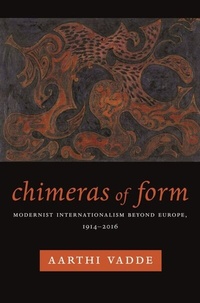
Chimeras of Form
Modernist Internationalism Beyond Europe, 1914-2016
1st Edition
Published on 3. December 2018
288 pages
978-0-231-54256-2 (ISBN)
Description

In the years following World War I, the "international" emerged as a distinct scale of political and cultural focus. Internationalisms proliferated in kind as writers and thinkers sought to imagine modes of cooperation that would balance transnational solidarities with national sovereignty. While so-called political realists across the twentieth century have regarded such attempts as wishful thinking, Aarthi Vadde argues that the negotiation of wishing and thinking is at the very heart of internationalism. In Chimeras of Form, she shows why modernist literary form is essential to understanding the aspirational and analytical force of internationalism in and beyond Europe.
Major writers such as Rabindranath Tagore, James Joyce, Claude McKay, George Lamming, Michael Ondaatje, and Zadie Smith use modernist strategies to reshape how readers think about the cohesion and interrelation of political communities in the wake of empire. Vadde lucidly explains how their formal experiments with the novel, short story, poetry, and political essay contribute to and sometimes even anticipate debates in postcolonial theory and cosmopolitanism. She reads Joyce's use of asymmetrical narratives as a way to ask questions about international camaraderie, and demonstrates how the "plotless" works of McKay and Lamming upturn ideas of citizenship and diasporic alienation. Her analysis of twenty-first-century writers Smith and Shailja Patel shows how ongoing conflicts around migration, displacement, and global economic inequality link modernist, postcolonial, and contemporary traditions of literature. Vadde brings these traditions together to reveal the dual nature of internationalism as an ambition, possibly a chimeric one, and an actual political discourse vital to understanding our present moment.
Major writers such as Rabindranath Tagore, James Joyce, Claude McKay, George Lamming, Michael Ondaatje, and Zadie Smith use modernist strategies to reshape how readers think about the cohesion and interrelation of political communities in the wake of empire. Vadde lucidly explains how their formal experiments with the novel, short story, poetry, and political essay contribute to and sometimes even anticipate debates in postcolonial theory and cosmopolitanism. She reads Joyce's use of asymmetrical narratives as a way to ask questions about international camaraderie, and demonstrates how the "plotless" works of McKay and Lamming upturn ideas of citizenship and diasporic alienation. Her analysis of twenty-first-century writers Smith and Shailja Patel shows how ongoing conflicts around migration, displacement, and global economic inequality link modernist, postcolonial, and contemporary traditions of literature. Vadde brings these traditions together to reveal the dual nature of internationalism as an ambition, possibly a chimeric one, and an actual political discourse vital to understanding our present moment.
All prices
More details
Other editions
Additional editions
Book
12/2016
Columbia University Press
€68.09
Shipment within 10-20 days
Person
Aarthi Vadde is the Andrew W. Mellon Assistant Professor of English at Duke University.
Content
Acknowledgments
Introduction: Chimeras of Form
1. Autotranslations: Rabindranath Tagore's Internationalism in Circulation
2. Alternating Asymmetry: International Solidarity and Self-Deception in James Joyce's Dubliners and "Cyclops"
3. Stories Without Plots: The Nomadic Collectivism of Claude McKay and George Lamming
4. Archival Legends: National Myth and Transnational Memory in the Works of Michael Ondaatje
5. Root Canals: Zadie Smith's Scales of Injustice
Epilogue: Migritude-The Re-mediated Work of Art and Art's Mediating Work
Notes
Bibliography
Index
Introduction: Chimeras of Form
1. Autotranslations: Rabindranath Tagore's Internationalism in Circulation
2. Alternating Asymmetry: International Solidarity and Self-Deception in James Joyce's Dubliners and "Cyclops"
3. Stories Without Plots: The Nomadic Collectivism of Claude McKay and George Lamming
4. Archival Legends: National Myth and Transnational Memory in the Works of Michael Ondaatje
5. Root Canals: Zadie Smith's Scales of Injustice
Epilogue: Migritude-The Re-mediated Work of Art and Art's Mediating Work
Notes
Bibliography
Index

