

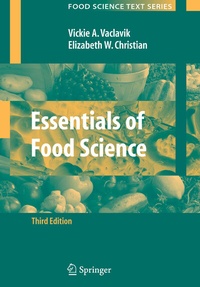
Essentials of Food Science
Description

Knowledge of food science is applicable to all persons, in diverse college majors. This text is designed with a user-friendly approach to Food Science for the non-major.
This text reviews an Introduction to Food Components - quality and water. Next it addresses carbohydrates - including starches, pectins and gums, breads and pasta, vegetables and fruits. Then proteins - meats, poultry, fish, beans, eggs, milk and milk products are presented. Following proteins are fats and emulsions. Then sugars and sweeteners, and baked products, the latter of which builds upon basic food component knowledge.
Various aspects of Food Production are examined, including food safety, preservation and processing, food additives and packaging. Government regulation and labeling complete the chapter information.
New in this edition are "Culinary Alerts!" scattered throughout chapters. Their inclusion allow the reader to more easily apply text information to cooking applications. Also new are the Appendices, which cover the following:
- Biotechnology. Genetically Modified Organisms (GMO's)
- Functional foods
- Nutraceuticals
- Phytochemicals
- Medical foods
- USDA Food Pyramid
- Food Label Heath Claims
- Research Chefs Association - certification as a culinary scientist and more
Using a multidisciplinary approach, Essentials of Food Science, Third Edition combines food chemistry, food technology, and food preparation applications into one single source of information.
Reviews / Votes
From the reviews of the third edition:
"This new edition . contains updates on 'food commodities, optimizing quality, laws, and food safety,' includes discussions on RFID (radio-frequency identification) tags and transfats, and incorporates the revised USDA food pyramid. This basic volume has most of the needed information and features helpful glossaries . . Summing Up: Recommended. Lower-division undergraduates through professionals; technical program students." (J. M. Jones, CHOICE, Vol. 45 (11), 2008)
More details
Other editions
New editions
Additional editions
Persons
Vickie A. Vaclavik is an assistant professor, and registered dietitian at The University of Texas Southwestern Medical Center at Dallas, in the Department of Clinical Nutrition. She instructs in Food Science, and Management and Foodservice Operations, as well as in a portion of the community practice component of Nutrition Education. She also instructs in Nutrition at the Dallas County Community College, and works with a local Culinary Arts Associates Degree program. She has taught for over 20 years. As well, she has written Food Science texts and a computer module on food safety.
Elizabeth W. Christian is an adjunct faculty member of the Texas Woman's University's Department of Nutrition & Food Sciences.
