

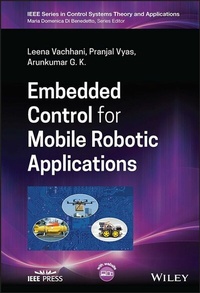
Embedded Control for Mobile Robotic Applications
1st Edition
Published on 3. August 2022
176 pages
978-1-119-81239-5 (ISBN)
Description

An all-in-one resource for designing and implementing embedded control in mobile robotics
In Embedded Control for Mobile Robotic Applications, a distinguished trio of researchers delivers an authoritative and fulsome resource for understanding embedded control and robotics. The book includes coverage of a variety of embedded platforms, their use in controller implementation, stability analyses of designed controllers, and two new approaches for designing embedded controllers.
The authors offer a full chapter on Field-Programmable-Gate-Array (FPGA) architecture development for controller design that is perfect for both practitioners and students taking robotics courses and provide a companion website that includes MATLAB codes for simulation and embedded platform-specific code for mobile robotic applications (in Embedded C and Verilog).
The two approaches discussed by the authors--the top-down methodology and the bottom-up methodology--are of immediate practical utility to both practicing professionals in the field and students studying control applications and mobile robotics. The book also offers:
* A thorough introduction to embedded control, including processor, IC, and design technology, as well as a discussion of limitations in embedded control design
* Comprehensive explorations of the bottom-up and top-down methods, including computations using CORDIC, interval arithmetic, sliding surface design, and switched nonlinear systems
* Practical discussions of generic FPGA architecture design, including Verilog, PID controllers, DC motors and Encoder, and a systematic approach for designing architecture using FSMD
* In-depth examinations of discrete-time controller design, including the approximation to discrete-time transfer function and embedded implementation stability
Perfect for practitioners working in embedded control design and control applications in robotics, Embedded Control for Mobile Robotic Applications will also earn a place in the libraries of academicians, researchers, senior undergraduate students, and graduate students in these fields.
In Embedded Control for Mobile Robotic Applications, a distinguished trio of researchers delivers an authoritative and fulsome resource for understanding embedded control and robotics. The book includes coverage of a variety of embedded platforms, their use in controller implementation, stability analyses of designed controllers, and two new approaches for designing embedded controllers.
The authors offer a full chapter on Field-Programmable-Gate-Array (FPGA) architecture development for controller design that is perfect for both practitioners and students taking robotics courses and provide a companion website that includes MATLAB codes for simulation and embedded platform-specific code for mobile robotic applications (in Embedded C and Verilog).
The two approaches discussed by the authors--the top-down methodology and the bottom-up methodology--are of immediate practical utility to both practicing professionals in the field and students studying control applications and mobile robotics. The book also offers:
* A thorough introduction to embedded control, including processor, IC, and design technology, as well as a discussion of limitations in embedded control design
* Comprehensive explorations of the bottom-up and top-down methods, including computations using CORDIC, interval arithmetic, sliding surface design, and switched nonlinear systems
* Practical discussions of generic FPGA architecture design, including Verilog, PID controllers, DC motors and Encoder, and a systematic approach for designing architecture using FSMD
* In-depth examinations of discrete-time controller design, including the approximation to discrete-time transfer function and embedded implementation stability
Perfect for practitioners working in embedded control design and control applications in robotics, Embedded Control for Mobile Robotic Applications will also earn a place in the libraries of academicians, researchers, senior undergraduate students, and graduate students in these fields.
More details
Other editions
Additional editions
Book
10/2022
1st Edition
Wiley-Blackwell
€120.50
Shipment within 15-20 days
L. Vachhani
Embedded Control for Mobile Robotic Applications
Software
08/2022
Wiley
€162.74
Article exhausted; check different version
Persons
Leena Vachhani, Professor, Indian Institute of Technology Bombay, Mumbai, India. Leena Vachhani received the Ph.D. degree from IIT Madras, Chennai, India, in 2009. Since Dec, 2009 she has been with the Systems and Control Engineering Group of IIT Bombay, Mumbai, India. Her research interests include hardware/software codesign for mobile robots, sensors for robotic tasks, robot motion planning algorithms, multiagent mapping and patrolling applications.
Pranjal Vyas, Advanced Remanufacturing Technology Center, Agency of Science, Technology and Research, (A*STAR), Singapore. Pranjal Vyas received his Ph.D. in Systems and Control Engineering at Indian Institute of Technology Bombay, India in 2017. His research interests include mobile robotics, real time embedded systems, sensors for robotic tasks, robot motion planning algorithms, computer vision and machine learning.
Arunkumar G. K. is a Research Scholar with the Indian Institute of Technology Bombay, Mumbai, India. His research is focused on robotic path planning algorithms and multi-robot systems.
Pranjal Vyas, Advanced Remanufacturing Technology Center, Agency of Science, Technology and Research, (A*STAR), Singapore. Pranjal Vyas received his Ph.D. in Systems and Control Engineering at Indian Institute of Technology Bombay, India in 2017. His research interests include mobile robotics, real time embedded systems, sensors for robotic tasks, robot motion planning algorithms, computer vision and machine learning.
Arunkumar G. K. is a Research Scholar with the Indian Institute of Technology Bombay, Mumbai, India. His research is focused on robotic path planning algorithms and multi-robot systems.
Content
- Cover
- Title Page
- Copyright
- Contents
- Preface
- Acknowledgments
- Acronyms
- Introduction
- About the Companion Website
- Chapter 1 Embedded Technology for Mobile Robotics
- 1.1 Embedded Control System
- 1.2 Mobile Robotics
- 1.2.1 Robot Model for 2D Motion
- 1.2.1.1 Generic Model
- 1.2.1.2 Unicycle Model
- 1.2.1.3 Differential-Drive Mobile Robot or DDMR
- 1.2.1.4 Front Wheel Steering Robot or FWSR
- 1.2.1.5 Chained form of Unicycle
- 1.2.1.6 Single Integrator Model of Unicycle
- 1.2.1.7 Discrete-time Unicycle Model
- 1.2.2 Robot Model for 3D Motion
- 1.2.2.1 Quadcopter - An Aerial Vehicle
- 1.2.2.2 Six-Thrusters Configuration - An Underwater Vehicle
- 1.3 Embedded Technology
- 1.3.1 Processor Technology
- 1.3.2 IC Technology
- 1.4 Commercially Available Embedded Processors
- 1.4.1 Microprocessor
- 1.4.2 Microcontroller
- 1.4.3 Field Programmable Gate Arrays (FPGA)
- 1.4.4 Digital Signal Processor
- 1.5 Notes and Further Readings
- Chapter 2 Discrete-time Controller Design
- 2.1 Transfer Function for Equivalent Discrete-time System
- 2.2 Discrete-time PID Controller Design
- 2.3 Stability in Embedded Implementation
- 2.3.1 Sampling
- 2.3.2 Quantization
- 2.3.3 Processing Time
- 2.4 Notes and Further Readings
- Chapter 3 Embedded Control and Robotics
- 3.1 Transformations
- 3.1.1 2D Transformations
- 3.1.2 3D Transformations
- 3.2 Collision Detection and Avoidance
- 3.2.1 Vector Field Histogram (VFH)
- 3.2.2 Curvature Velocity Technique (CVM)
- 3.2.3 Dynamic Window Approach (DWA)
- 3.3 Localization
- 3.4 Path Planning
- 3.4.1 Potential Field Path Planning
- 3.4.2 Graph-based Path Planning
- 3.4.2.1 Dijkstra's Algorithm
- 3.4.2.2 A* Algorithm
- 3.4.2.3 Rapidly-exploring Random Trees (RRT) Algorithm
- 3.5 Multi-agent Scenarios
- 3.6 Notes and Further Readings
- Chapter 4 Bottom-up Method
- 4.1 Computations Using CORDIC1
- 4.1.1 Coordinate Transformation
- 4.1.1.1 Cartesian to Polar Coordinates Conversion
- 4.1.1.2 Polar to Cartesian Coordinate Conversion
- 4.1.2 Exponential and Logarithmic Functions
- 4.2 Interval Arithmetic2
- 4.2.1 Basics of Interval Arithmetic
- 4.2.2 Inclusion Function and Inclusion Tests
- 4.3 Collision Detection Using Interval Technique3
- 4.4 Free Interval Computation for Collision Avoidance4
- 4.4.1 Illustration for Detecting Collision and Computing Free interval
- 4.5 Notes for Further Reading
- Chapter 5 Top-Down Method
- 5.1 Robust Controller Design
- 5.1.1 Basic Definitions
- 5.1.2 State Feedback Control
- 5.1.3 Sliding-Mode Control
- 5.1.4 Sliding Surface Design for Position Stabilization in 2D
- 5.1.5 Position Stabilization for a Vehicle in 3D
- 5.1.6 Embedded Implementation
- 5.2 Switched Nonlinear System
- 5.2.1 Swarm Aggregation as a Switched Nonlinear System
- 5.2.1.1 Free Subsystem s1
- 5.2.1.2 Engaged Subsystem s2
- 5.2.2 Embedded Implementation
- 5.3 Notes and Further Readings
- Chapter 6 Generic FPGA Architecture Design
- 6.1 FPGA Basics and Verilog
- 6.2 Systematic Approach for Designing Architecture Using FSM
- 6.2.1 PID Controller Architecture
- 6.2.2 Sliding-Mode Controller Architecture
- 6.3 FPGA Implementation
- 6.4 Parallel Implementation of Multiple Controllers
- 6.5 Notes and Further Readings
- Chapter 7 Summary
- Bibliography
- Index
- Books in the IEEE Press Series on Control SystemsTheory and Applications
- EULA
