

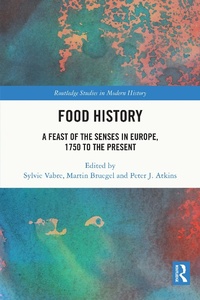
Food History
A Feast of the Senses in Europe, 1750 to the Present
1st Edition
Published on 17. May 2021
230 pages
978-1-000-39096-4 (ISBN)
Description

This pioneering book elevates the senses to a central role in the study of food history because the traditional focus upon food types, quantities, and nutritional values is incomplete without some recognition of smell, touch, sight, hearing, and taste.
Eating is a sensual experience. Every day and at every meal the senses of smell, touch, sight, hearing, and taste are engaged in the acts of preparation and consumption. And yet these bodily acts are ephemeral; their imprint upon the source material of history is vestigial. Hitherto historians have shown little interest in the senses beyond taste, and this book fills that research gap. Four dimensions are treated:
* Words, Symbols and Uses: Describing the Senses - an investigation of how specific vocabularies for food are developed.
* Industrializing the Senses - an analysis of the fundamental change in the sensory qualities of foods under the pressure of industrialization and economic forces outside the control of the household and the artisan producer.
* Nationhood and the Senses - an exploration of how the combination of the senses and food play into how nations saw themselves, and how food was a signature of how political ideologies played out in practical, everyday terms.
* Food Senses and Globalization - an examination of links between food, the senses, and the idea of international significance. Putting all of the senses on the agenda of food history for the first time, this is the ideal volume for scholars of food history, food studies and food culture, as well as social and cultural historians.
Putting all of the senses on the agenda of food history for the first time, this is the ideal volume for scholars of food history, food studies and food culture, as well as social and cultural historians.
Eating is a sensual experience. Every day and at every meal the senses of smell, touch, sight, hearing, and taste are engaged in the acts of preparation and consumption. And yet these bodily acts are ephemeral; their imprint upon the source material of history is vestigial. Hitherto historians have shown little interest in the senses beyond taste, and this book fills that research gap. Four dimensions are treated:
* Words, Symbols and Uses: Describing the Senses - an investigation of how specific vocabularies for food are developed.
* Industrializing the Senses - an analysis of the fundamental change in the sensory qualities of foods under the pressure of industrialization and economic forces outside the control of the household and the artisan producer.
* Nationhood and the Senses - an exploration of how the combination of the senses and food play into how nations saw themselves, and how food was a signature of how political ideologies played out in practical, everyday terms.
* Food Senses and Globalization - an examination of links between food, the senses, and the idea of international significance. Putting all of the senses on the agenda of food history for the first time, this is the ideal volume for scholars of food history, food studies and food culture, as well as social and cultural historians.
Putting all of the senses on the agenda of food history for the first time, this is the ideal volume for scholars of food history, food studies and food culture, as well as social and cultural historians.
More details
Series
Edition
1. Auflage
Language
English
Place of publication
London
United Kingdom
Publishing group
Taylor & Francis Ltd
Target group
College/higher education
Product notice
Reflowable
Illustrations
2 Tables, black and white; 1 Line drawings, black and white; 15 Halftones, black and white; 16 Illustrations, black and white
ISBN-13
978-1-000-39096-4 (9781000390964)
Copyright in bibliographic data and cover images is held by Nielsen Book Services Limited or by the publishers or by their respective licensors: all rights reserved.
Schweitzer Classification
Other editions
Additional editions
Sylvie Vabre | Martin Bruegel | Peter J. Atkins
Food History
A Feast of the Senses in Europe, 1750 to the Present
Book
01/2023
1st Edition
Routledge
€63.20
Shipment within 10-20 days
Sylvie Vabre | Martin Bruegel | Peter J. Atkins
Food History
A Feast of the Senses in Europe, 1750 to the Present
Book
05/2021
1st Edition
Routledge
€206.30
Shipment within 15-20 days
Persons
Sylvie Vabre is Associate Professor in Modern History at Toulouse Jean Jaures University, France. She is President of the International Commission for Research into European Food History. Her PhD, Le sacre du roquefort - l'emergence d'une industrie agroalimentaire fin XVIIIe siecle-1925, was published in 2015. Her researches and teaching are dedicated to consumer history, business history and the history of local food productions.
Martin Bruegel is an historian at the Institut de la Recherche pour l'Agriculture, l'Alimentation et l'Environnement (INRAE), Centre Maurice-Halbwachs, Paris, France. He wrote Farm, Shop, Landing. The Rise of a Market Society in the Hudson Valley (2002) and edited A Cultural History of Food in the Age of Empire (2016).
Peter J. Atkins is Emeritus Professor of Geography at the University of Durham, UK. His principal interest over several decades has been food history, with particular reference to perishable foodstuffs. He is the author of Liquid Materialities: a History of Milk, Science and the Law (2010) and A History of Uncertainty: Bovine Tuberculosis in Britain, 1850 to the Present (2016).
Martin Bruegel is an historian at the Institut de la Recherche pour l'Agriculture, l'Alimentation et l'Environnement (INRAE), Centre Maurice-Halbwachs, Paris, France. He wrote Farm, Shop, Landing. The Rise of a Market Society in the Hudson Valley (2002) and edited A Cultural History of Food in the Age of Empire (2016).
Peter J. Atkins is Emeritus Professor of Geography at the University of Durham, UK. His principal interest over several decades has been food history, with particular reference to perishable foodstuffs. He is the author of Liquid Materialities: a History of Milk, Science and the Law (2010) and A History of Uncertainty: Bovine Tuberculosis in Britain, 1850 to the Present (2016).
Content
1. Introduction: European food history and the senses 1
SYLVIE VABRE, MARTIN BRUEGEL AND PETER J. ATKINS
2. An equation of the senses? A puzzle in food historiography 8
MARTIN BRUEGEL
PART I
Words, symbols and uses: Describing the senses 23
3. The elevation of taste and the senses in the work of Grimod de La Reyniere (18th-early 19th century) 25
YUKA SAITO
4. Last but not least: How the cheese board came to crown the French meal (18th-20th century) 39
SYLVIE VABRE
5. A tactile dinner party: The Futurist Cookbook and the multisensory experience of food 51
AGATA STRONCIWILK
PART II
Industrializing the senses 65
6. The industrialization of the senses: British cheese, 1750 to the present 67
PETER J. ATKINS
7. The sense of reform, a reform of the senses? Belgian working-class diets, 1886-1905 79
FLORE GUIOT
8. 'The machine known as the human being': Food, the sense of taste and a modernizing Finland 92
RITVA KYLLI
9. Hidden from view: The art of suggestion on canned food labels in the 20th century 104
RITA D'ERRICO
PART III
Nationhood and the senses 119
10. Sausages, pork delicacies and take-away meals: How German butcher immigrants introduced new tastes and new ways of buying food in 19th century industrial Great Britain 121
KARL-HEINZ WUESTNER
11. Gendering taste in interwar Romania 134
RALUCA PARFENTIE
12. Full shelves of memories: Sensory memory of food and nutrition in the Czech lands before 1989 145
MARTIN FRANC
13. The palette of tastes in late Soviet home cooking 157
MARIA KAPKAN
PART IV
Food senses and globalization 171
14. The construction of planetary taste: Balsamic vinegar of Modena in the age of globalization 173
STEFANO MAGAGNOLI
15. The 'offensive' and 'abominable' Spanish garlic: American and Spanish empires in their fight for Cuba (circa 1840-1870s) 186
ILARIA BERTI
16. Experiencing cannibalism: Sensory knowledge of cannibalism from 1770 to the end of the 19th century 199
NICOLAS CAMBON
SYLVIE VABRE, MARTIN BRUEGEL AND PETER J. ATKINS
2. An equation of the senses? A puzzle in food historiography 8
MARTIN BRUEGEL
PART I
Words, symbols and uses: Describing the senses 23
3. The elevation of taste and the senses in the work of Grimod de La Reyniere (18th-early 19th century) 25
YUKA SAITO
4. Last but not least: How the cheese board came to crown the French meal (18th-20th century) 39
SYLVIE VABRE
5. A tactile dinner party: The Futurist Cookbook and the multisensory experience of food 51
AGATA STRONCIWILK
PART II
Industrializing the senses 65
6. The industrialization of the senses: British cheese, 1750 to the present 67
PETER J. ATKINS
7. The sense of reform, a reform of the senses? Belgian working-class diets, 1886-1905 79
FLORE GUIOT
8. 'The machine known as the human being': Food, the sense of taste and a modernizing Finland 92
RITVA KYLLI
9. Hidden from view: The art of suggestion on canned food labels in the 20th century 104
RITA D'ERRICO
PART III
Nationhood and the senses 119
10. Sausages, pork delicacies and take-away meals: How German butcher immigrants introduced new tastes and new ways of buying food in 19th century industrial Great Britain 121
KARL-HEINZ WUESTNER
11. Gendering taste in interwar Romania 134
RALUCA PARFENTIE
12. Full shelves of memories: Sensory memory of food and nutrition in the Czech lands before 1989 145
MARTIN FRANC
13. The palette of tastes in late Soviet home cooking 157
MARIA KAPKAN
PART IV
Food senses and globalization 171
14. The construction of planetary taste: Balsamic vinegar of Modena in the age of globalization 173
STEFANO MAGAGNOLI
15. The 'offensive' and 'abominable' Spanish garlic: American and Spanish empires in their fight for Cuba (circa 1840-1870s) 186
ILARIA BERTI
16. Experiencing cannibalism: Sensory knowledge of cannibalism from 1770 to the end of the 19th century 199
NICOLAS CAMBON
