

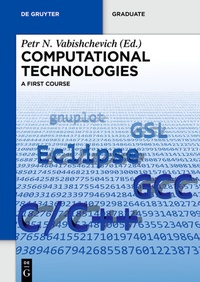
Computational Technologies
Description

In this book we describe the basic elements of present computational technologies that use the algorithmic languages C/C++. The emphasis is on GNU compilers and libraries, FOSS for the solution of computational mathematics problems and visualization of the obtained data.
At the beginning, a brief introduction to C is given with emphasis on its easy use in scientific and engineering computations. We describe the basic elements of the language, such as variables, data types, executable statements, functions, arrays, pointers, dynamic memory and file management. After that, we present some observations on the C++ programming language. We discuss the issues of program compiling, linking, and debugging. A quick guide to Eclipse is also presented in the book. The main features for editing, compiling, debugging and application assembling are considered. As examples, we solve the standard problems of computational mathematics: operations with vectors and matrices, linear algebra problems, solution of nonlinear equations, numerical differentiation and integration, interpolation, initial value problems for ODEs and so on. Finally, basic features of computational technologies are illustrated with model problems. All programs are implemented in C/C++ with using the GSL library. Gnuplot is employed to visualize the results of computations.
More details
Other editions
Additional editions
Person
Content
- Intro
- Contents
- Preface
- Introduction
- 1 An introduction to C
- 1.1 Syntax
- 1.2 Constants and variables
- 1.3 Expressions and operators
- 1.4 Statements
- 1.5 Arrays
- 1.6 Pointers
- 1.7 Functions
- 1.8 Structures
- 1.9 Input/output
- 1.10 Program structure
- 2 C++ programming basics
- 2.1 Enhanced features
- 2.2 Classes
- 2.3 Function and operator overloading
- 2.4 Inheritance
- 2.5 Input/output
- 2.6 Standard libraries
- 3 GCC distilled
- 3.1 General information
- 3.2 Available documentation
- 3.3 Compilation workflow
- 3.4 Compiling a C/C++ program
- 3.5 Libraries and linking programs
- 3.6 Debugging
- 3.7 The make utility
- 4 The Eclipse IDE in a nutshell
- 4.1 The Eclipse architecture and GUI
- 4.2 Working with projects
- 4.3 Editing a source code
- 4.4 Debugging applications
- 5 The GSL scientific library
- 5.1 Preliminaries
- 5.2 Functions and constants
- 5.3 Combinatorics
- 5.4 Linear algebra
- 5.5 Numerical differentiation and integration
- 5.6 Cauchy problem for systems of ODEs
- 5.7 Solution of equations
- 5.8 Interpolation and approximation of functions
- 5.9 Fast Fourier transforms and Chebyshev approximations
- 6 Visualization of computed data
- 6.1 Basics
- 6.2 Data handling
- 6.3 Data interpolation
- 6.4 Using styles
- 6.5 Graph decoration
- 7 Mathematical modeling
- 7.1 Approximation of experimental data
- 7.2 Predator-prey system
- 7.3 Water infiltration
- 7.4 Torsion of cylindrical bars
- Bibliography
- Index
