

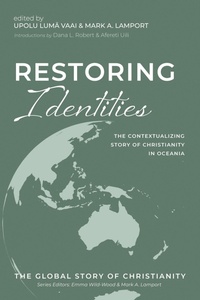
Restoring Identities
The Contextualizing Story of Christianity in Oceania
Published on 3. November 2023
312 pages
978-1-6667-2097-6 (ISBN)
Description

In a sense, Oceania can be considered a microcosm of World Christianity. Within this region are many of the same observable trends on the global level that impact Christian life, faith, and witness. The geography of Oceania--the "liquid continent"--is unique. Christianity arrived in Australia and New Zealand in the late eighteenth century via British colonial powers. Indigenous Aboriginal peoples, Torres Strait Islanders, and Maori peoples were dispossessed of land, property, rights, and dignity. Christianity grew by migration and conversion (not always voluntary), and over time became tightly intertwined with culture. In the twentieth century, rapid secularization moved Christianity into the private sphere, and by 2020 Christian affiliation had dropped from 97 percent to 57 percent. However, the history of Christianity in the Pacific Islands--Melanesia, Micronesia, and Polynesia--is quite different. Christianity arrived via Protestant and Catholic missionaries between the fifteenth and nineteenth centuries and grew substantially in the twentieth century largely due to indigenous Christian efforts. Islanders brought Christianity to neighboring islands, indigenous theologies developed, and churches gradually separated from their Western mission founders. One of the great "success stories" of World Christianity is Papua New Guinea, which grew from just 4 percent Christian in 1900 to 95 percent in 2020. However, growth is never the entire story. Violence against women is endemic in Papua New Guinea and is often combined with accusations of witchcraft. An estimated 59 percent of women have experienced physical or sexual violence in their lifetime (and 48 percent in the last year). As Christianity continues its shift to the global South, it becomes increasingly critical to heed the experiences, perspectives, and theologies of Christians, particularly women, in the Pacific Islands.
More details
Other editions
Additional editions
Book
11/2023
Cascade Books
€52.90
Shipment within 3-4 weeks
Persons
Upolu Luma Vaai serves as principal of the Pacific Theological College (Fiji) and professor of theology and ethics. His recent co-edited volumes include reSTORYing the Pasifika Household (2023), Methodist Revolutions (2022), and Transformative Spiritualities for the Ecumenical Pilgrimage of Justice (2022).
Mark A. Lamport has for forty years been a professor at graduate theological schools in the United States and Europe. He is editor of a dozen reference works, including Emerging Theologies from the Global South (2022); Christianity in the Middle East (2020); Encyclopedia of Christianity in the Global South (2018); Encyclopedia of Martin Luther and the Reformation (2017); Encyclopedia of Christianity in the United States (2016); and Encyclopedia of Christian Education (2015).
Mark A. Lamport has for forty years been a professor at graduate theological schools in the United States and Europe. He is editor of a dozen reference works, including Emerging Theologies from the Global South (2022); Christianity in the Middle East (2020); Encyclopedia of Christianity in the Global South (2018); Encyclopedia of Martin Luther and the Reformation (2017); Encyclopedia of Christianity in the United States (2016); and Encyclopedia of Christian Education (2015).
