

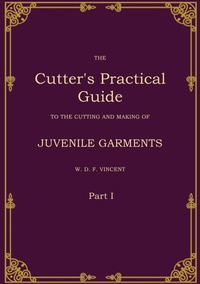
The Cutter's Practical Guide, Part 1
Juvenile Garments
1st Edition
Published on 24. February 2025
122 pages
978-3-7693-4668-8 (ISBN)
Description

The confidence with which this work was first introduced has been well justified by the result - a very large edition having been disposed of. Very rarely, if ever, has a work so comprehensive been published in connection with the art of cutting. Though nominally a work on Juvenile Cutting, it embraces nearly every garment made by tailors.
Besides systems for and treatises on Trousers and Veats, systems for Morning Coats and Dress Coats, it also deals with Military Garments, Liveries, and many other garments, all worked out by a system which has now become well-nigh universally popular, a unique feature of the work being its beautifully engraved illustrations and diagrams. We have had very many indications that the work is highly appreciated by all who have procured it, and many testimonies might be recorded if that were necessary.
This Third Edition has been prepared in all its original completeness. With such a work in their possession, neither the inexperienced student nor the cutter in full practice should have any difficulty producing any of the garments treated and illustrated in this work.
Besides systems for and treatises on Trousers and Veats, systems for Morning Coats and Dress Coats, it also deals with Military Garments, Liveries, and many other garments, all worked out by a system which has now become well-nigh universally popular, a unique feature of the work being its beautifully engraved illustrations and diagrams. We have had very many indications that the work is highly appreciated by all who have procured it, and many testimonies might be recorded if that were necessary.
This Third Edition has been prepared in all its original completeness. With such a work in their possession, neither the inexperienced student nor the cutter in full practice should have any difficulty producing any of the garments treated and illustrated in this work.
More details
Other editions
Additional editions
Book
01/2025
1st Edition
BoD - Books on Demand
€36.00
Shipment within 15-20 days
Person
W.D.F. Vincent began his career as an apprentice with Frederick Cooper in Yeovil. After completing his training, he briefly established his own businesses in Oxford and later in Maidenhead as a clothier and tailor, though neither venture was financially successful.
While in Maidenhead, Vincent won an essay competition on tailoring, which was open to all members of the National Federation of Foremen Tailors, titled "The Great National Work on Trouser Cutting, or Defects in Trousers." He submitted his entry under the pseudonym "Oxonian" and won the first prize. This success led him to secure a position with The Tailor and Cutter magazine.
In the early years, Vincent contributed numerous articles on tailoring methods and techniques to the magazine. However, due to the terms of his employment, these articles were published without attribution to him.
By the 1890s, Vincent became a leading tailoring authority. His books, such as The Cutter's Practical Guide to the Cutting & Making of All Kinds of Trousers, became standard reference work.
By 1917, Vincent referred to himself as a journalist.
The Tailor and Cutter magazine and academy were operated by John Williamson & Co Ltd.
In the 1950s and 1960s, many tailors displayed their Tailor & Cutter Academy Diplomas, signed by W.D.F. Vincent, as the Chairman of Examiners, as a centerpiece in their shop windows. One such example can still be seen on display at the Museum of Welsh Life at St. Fagans in South Wales.
While in Maidenhead, Vincent won an essay competition on tailoring, which was open to all members of the National Federation of Foremen Tailors, titled "The Great National Work on Trouser Cutting, or Defects in Trousers." He submitted his entry under the pseudonym "Oxonian" and won the first prize. This success led him to secure a position with The Tailor and Cutter magazine.
In the early years, Vincent contributed numerous articles on tailoring methods and techniques to the magazine. However, due to the terms of his employment, these articles were published without attribution to him.
By the 1890s, Vincent became a leading tailoring authority. His books, such as The Cutter's Practical Guide to the Cutting & Making of All Kinds of Trousers, became standard reference work.
By 1917, Vincent referred to himself as a journalist.
The Tailor and Cutter magazine and academy were operated by John Williamson & Co Ltd.
In the 1950s and 1960s, many tailors displayed their Tailor & Cutter Academy Diplomas, signed by W.D.F. Vincent, as the Chairman of Examiners, as a centerpiece in their shop windows. One such example can still be seen on display at the Museum of Welsh Life at St. Fagans in South Wales.
