

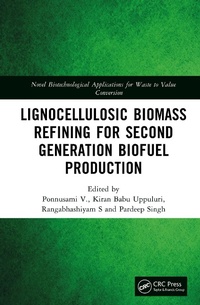
Lignocellulosic Biomass Refining for Second Generation Biofuel Production
1st Edition
Published on 14. July 2023
306 pages
978-1-000-89011-2 (ISBN)
Description

This book compiles research aspects of second-generation (2G) biofuel production derived specifically from lignocellulose biomass using biorefinery methods. It focuses on the valorization of different sources of 2G biofuels and their relative importance. The constituents of lignocelluloses and their potential characteristics different methods of treating lignocellulose, various means of lignocellulose bioconversion, and biofuel production strategies are discussed.
Features:
Describes technological advancements for bioethanol production from lignocellulosic waste
Provides the roadmap for the production and utilization of 2G biofuels
Introduces the strategic role of metabolic engineering in the development of 2G biofuels
Discusses technological advancements, life cycle assessment, and prospects
Explores the novel potential lignocellulosic biomass for 2G biofuels
This book is aimed at researchers and professionals in renewable energy, biofuel, bioethanol, lignocellulose conversion, fermentation, and chemical engineering.
Features:
Describes technological advancements for bioethanol production from lignocellulosic waste
Provides the roadmap for the production and utilization of 2G biofuels
Introduces the strategic role of metabolic engineering in the development of 2G biofuels
Discusses technological advancements, life cycle assessment, and prospects
Explores the novel potential lignocellulosic biomass for 2G biofuels
This book is aimed at researchers and professionals in renewable energy, biofuel, bioethanol, lignocellulose conversion, fermentation, and chemical engineering.
More details
Series
Edition
1. Auflage
Language
English
Place of publication
London
United Kingdom
Publishing group
Taylor & Francis Ltd
Target group
Professional and scholarly
Product notice
Reflowable
Illustrations
20 Tables, black and white; 62 Line drawings, black and white; 5 Halftones, black and white; 67 Illustrations, black and white
ISBN-13
978-1-000-89011-2 (9781000890112)
Copyright in bibliographic data and cover images is held by Nielsen Book Services Limited or by the publishers or by their respective licensors: all rights reserved.
Schweitzer Classification
Other editions
Additional editions
Ponnusami V. | Kiran Babu Uppuluri | Rangabhashiyam S
Lignocellulosic Biomass Refining for Second Generation Biofuel Production
Book
12/2024
1st Edition
CRC Press
€72.90
Shipment within 10-20 days
Ponnusami V. | Kiran Babu Uppuluri | Rangabhashiyam S
Lignocellulosic Biomass Refining for Second Generation Biofuel Production
Book
07/2023
1st Edition
CRC Press
€186.60
Shipment within 10-20 days
Persons
Ponnusami V. is presently working as Associate Dean in the School of Chemical & Biotechnology, SASTRA Deemed University, India. He graduated from A. C. Tech., Anna University and did his doctoral research at SASTRA Deemed University, India. He has rich industrial and academic experience. His research interests include domestic and industrial wastewater treatment, bioconversion of lignocellulose, and bioprocessing. His group is working on photocatalysis, production of renewable fuels, and microbial polysaccharides. He had published over 50 research papers in international journals.
Kiran Babu Uppuluri was awarded his PhD from the Faculty of Chemical Engineering, Andhra University, Visakhapatnam, in 2011. He is currently working as an Associate Professor in the Department of Biotechnology, School of Chemical and Biotechnology, SASTRA Deemed University, Thanjavur. His group is working on the development, modeling, optimization, and intensification of bioprocesses for various biochemicals such as biofuels, therapeutic enzymes, and biopolymers.
Rangabhashiyam S. is currently working as Assistant Professor in the School of Chemical & Biotechnology, SASTRA Deemed University, India. He received his Doctor of Philosophy degree from National Institute of Technology Calicut, India. He has received Post-Doctoral Fellowship from Max Planck Institute for Dynamics of Complex Technical Systems, Germany, received National Post-Doctoral Fellowship from SERB-DST, India, selected as Young Scientist by DST, India for the BRICS Conclave held in Durban, South Africa, and received Hiyoshi Young Leaf Award from Hiyoshi Ecological Services, Hiyoshi Corporation, Japan. His major research interests are bioremediation and wastewater treatment. He is Editorial Board Member in Separation & Purification Reviews; Scientific Reports; Biomass Conversion and Biorefinery; Environmental Management, Associate Editor in International Journal of Environmental Science and Technology, IET Nanobiotechnology, Frontiers in Environmental Chemistry, and Academic Editor of Adsorption Science and Technology. He has published more than 100 papers and also contributed to several book chapters. He is listed in the World's Top 2% Scientists published by Elsevier, Stanford.
Pardeep Singh is presently an Assistant Professor in the Department of Environmental Study, PGDAV College, University of Delhi, New Delhi, India. He obtained his doctorate degree from the Indian Institute of Technology (Banaras Hindu University) Varanasi. He was also selected as Young Scientist by DST, India for the BRICS Conclave held in Durban, South Africa. His research interests include waste management, wastewater treatment, water scarcity, and global climate change. He has published more than 75 research/review papers in international journals in the fields of waste and wastewater treatment/management. He has also edited more than 40 books with various international publishers.
Kiran Babu Uppuluri was awarded his PhD from the Faculty of Chemical Engineering, Andhra University, Visakhapatnam, in 2011. He is currently working as an Associate Professor in the Department of Biotechnology, School of Chemical and Biotechnology, SASTRA Deemed University, Thanjavur. His group is working on the development, modeling, optimization, and intensification of bioprocesses for various biochemicals such as biofuels, therapeutic enzymes, and biopolymers.
Rangabhashiyam S. is currently working as Assistant Professor in the School of Chemical & Biotechnology, SASTRA Deemed University, India. He received his Doctor of Philosophy degree from National Institute of Technology Calicut, India. He has received Post-Doctoral Fellowship from Max Planck Institute for Dynamics of Complex Technical Systems, Germany, received National Post-Doctoral Fellowship from SERB-DST, India, selected as Young Scientist by DST, India for the BRICS Conclave held in Durban, South Africa, and received Hiyoshi Young Leaf Award from Hiyoshi Ecological Services, Hiyoshi Corporation, Japan. His major research interests are bioremediation and wastewater treatment. He is Editorial Board Member in Separation & Purification Reviews; Scientific Reports; Biomass Conversion and Biorefinery; Environmental Management, Associate Editor in International Journal of Environmental Science and Technology, IET Nanobiotechnology, Frontiers in Environmental Chemistry, and Academic Editor of Adsorption Science and Technology. He has published more than 100 papers and also contributed to several book chapters. He is listed in the World's Top 2% Scientists published by Elsevier, Stanford.
Pardeep Singh is presently an Assistant Professor in the Department of Environmental Study, PGDAV College, University of Delhi, New Delhi, India. He obtained his doctorate degree from the Indian Institute of Technology (Banaras Hindu University) Varanasi. He was also selected as Young Scientist by DST, India for the BRICS Conclave held in Durban, South Africa. His research interests include waste management, wastewater treatment, water scarcity, and global climate change. He has published more than 75 research/review papers in international journals in the fields of waste and wastewater treatment/management. He has also edited more than 40 books with various international publishers.
Content
1. Physical and Physicochemical Pretreatment Methods for Lignocellulosic Biomass Conversion 2. Biorefining Processes for Valorization of Lignocellulosic Biomass for Sustainable Production of Value-Added Products 3. Inhibitors and Microbial Tolerance during Fermentation of Biofuel Production 4. The Role of Metabolic Engineering in the Development of 2G Biofuels (Both in Conversion and Fermentation) 5. Fermentation of Hydrolysate Derived from Lignocellulose Biomass toward Biofuels Production 6. Rector Configurations for Thermochemical Conversion of Lignocellulosic Biomass 7. Advanced Pretreatment Process for Lignocellulosic Biomass 8. Ionic Liquids as Solvents for Separation of Biobutanol 9. Intensification in Bioethanol Production and Separation 10. Pervaporation as a Promising Approach for Recovery of Bioethanol 11. Production of High-Performance/Aviation Fuels from Lignocellulosic Biomass 12. Role of Thermophilic Microorganisms and Thermostable Enzymes in 2G Biofuel Production
