

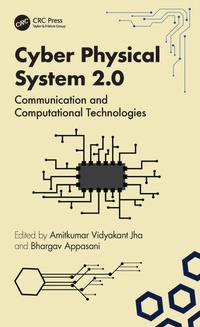
Cyber Physical System 2.0
Communication and Computational Technologies
1st Edition
Published on 16. December 2024
360 pages
978-1-040-25224-6 (ISBN)
Description

The book covers the emerging communication and computational technologies for future cyber-physical systems and discusses the security of in-vehicle communication protocols using automotive embedded systems, presenting an in-depth analysis across various domains, such as manufacturing, transportation, health-care, and smart cities.
This book:
Discusses how communication and computing co-design provides dynamic adaptability and centralized control.
Presents the convergence of physical and digital realities within the metaverse and multiverse, setting the stage for the future of cyber-physical-social systems (CPSS).
Presents emerging communication and computational technologies, such as 6G, software-defined networking, cloud computing, blockchain, artificial intelligence, machine learning, virtual reality, and blockchain, for the design and implementation of cyber-physical systems.
Explores advanced topics such as security and privacy in industrial CPS, strategies for protecting serial industrial networks, and enhancing firmware update security in automotive systems.
It is primarily written for senior undergraduates, graduate students, and academic researchers in the fields of electrical engineering, electronics and communication engineering, computer science and engineering, and information technology.
This book:
Discusses how communication and computing co-design provides dynamic adaptability and centralized control.
Presents the convergence of physical and digital realities within the metaverse and multiverse, setting the stage for the future of cyber-physical-social systems (CPSS).
Presents emerging communication and computational technologies, such as 6G, software-defined networking, cloud computing, blockchain, artificial intelligence, machine learning, virtual reality, and blockchain, for the design and implementation of cyber-physical systems.
Explores advanced topics such as security and privacy in industrial CPS, strategies for protecting serial industrial networks, and enhancing firmware update security in automotive systems.
It is primarily written for senior undergraduates, graduate students, and academic researchers in the fields of electrical engineering, electronics and communication engineering, computer science and engineering, and information technology.
More details
Edition
1. Auflage
Language
English
Place of publication
London
United Kingdom
Publishing group
Taylor & Francis Ltd
Target group
College/higher education
Professional and scholarly
Illustrations
18 Tables, black and white; 50 Line drawings, black and white; 39 Halftones, black and white; 89 Illustrations, black and white
ISBN-13
978-1-040-25224-6 (9781040252246)
Copyright in bibliographic data and cover images is held by Nielsen Book Services Limited or by the publishers or by their respective licensors: all rights reserved.
Schweitzer Classification
Other editions
Additional editions
Amitkumar V. Jha | Bhargav Appasani
Cyber Physical System 2.0
Communication and Computational Technologies
Book
approx. 07/2026
1st Edition
CRC Press
€77.00
Not yet published
Amitkumar V. Jha | Bhargav Appasani
Cyber Physical System 2.0
Communication and Computational Technologies
Book
12/2024
1st Edition
CRC Press
€231.60
Shipment within 10-20 days

Amitkumar V. Jha | Bhargav Appasani
Cyber Physical System 2.0
Communication and Computational Technologies
Book
12/2024
CRC Press
Unfortunately, price unknown
Available (delivery time upon request)
Persons
Amitkumar V. Jha received his MTech degree from the Indian Institute of Industrial Technology, Guwahati, India, and his PhD degree from the Kalinga Institute of Industrial Technology (KIIT), Bhubaneswar, India. He has working as an assistant professor at KIIT since 2015. He has authored more than 50 articles in international journals and conference proceedings. He has also authored four book chapters. He has edited a book titled Metamaterials for Microwave and Terahertz Applications: Absorbers, Sensors and Filters, which is available at DOI. 10.52305/APHY8244. His research interests include smart grid, communication network, optimization, etc. He is a reviewer of several journals, such as e-Prime, IEEE Access, IEEE System Journal, IEEE IoT, Wireless Personal Communication, International Journal of Electrical Power and Energy Systems, Energies, Mathematics, etc., and he is the editor of the Journal of Computer Networks and Communications. He is also a member of many professional organizations, such as the Indian Science Congress, the International Association of Engineers, the World Leadership Academy, etc.
Bhargav Appasani received his PhD (Engg.) degree from Birla Institute of Technology, Mesra, India. He is currently an associate professor with the School of Electronics Engineering, KIIT University, Bhubaneswar, India. He has published more than 140 articles in international journals and conference proceedings. He has also published six book chapters with reputed international publishers. He has also authored a book with a publication of international repute and is currently editing two more books. He also has a patent filed to his credit. He is an academic editor of the Journal of Electrical and Computer Engineering (Hindawi) and a reviewer for IEEE Transactions on Smart Grid, IEEE Transactions on Antennas and Propagation, and IEEE Access. Dr. Appasani has taught many courses, such as machine learning, data structure algorithm, microwave, control system, etc., for several years. His research interests include optimization, AI, metamaterials, communication systems, etc.
Bhargav Appasani received his PhD (Engg.) degree from Birla Institute of Technology, Mesra, India. He is currently an associate professor with the School of Electronics Engineering, KIIT University, Bhubaneswar, India. He has published more than 140 articles in international journals and conference proceedings. He has also published six book chapters with reputed international publishers. He has also authored a book with a publication of international repute and is currently editing two more books. He also has a patent filed to his credit. He is an academic editor of the Journal of Electrical and Computer Engineering (Hindawi) and a reviewer for IEEE Transactions on Smart Grid, IEEE Transactions on Antennas and Propagation, and IEEE Access. Dr. Appasani has taught many courses, such as machine learning, data structure algorithm, microwave, control system, etc., for several years. His research interests include optimization, AI, metamaterials, communication systems, etc.
Content
1. Introduction to Cyber Physical Systems 2.0: Evolution, Technologies, and Challenges. 2. Communication and Computing Co-design under Imperfect Channel Conditions for Control and Scheduling in CPS 2.0. 3. Software-Defined Networking in Cyber-Physical Systems: Benefits, Challenges, and Opportunities. 4. Toward Future Metasystems: From Today's CPS to Tomorrow's Cyber-Physical-Social Systems in the Emerging Metaverse. 5. Healthcare Cyber-Physical System for Smart Cities: Implementation, Challenges and Solution. 6. Enabling Smart Manufacturing Through Cloud Computing and Cyber-Physical Systems. 7. An open architecture for Cyber-physical systems 2.0 from a holonic perspective for application in sustainable manufacturing. 8. AI model generation methodology and software architecture for CPS 2.0 manufacturing systems. 9. Cyber-Physical System Formulations for Health Monitoring-Informed Bridge Infrastructure Assets. 10. Security and Privacy in Industrial Cyber-Physical Systems: Concerns, Challenges, and Countermeasures. 11. Strategies for Protecting Serial (Non-IP) Industrial Networks in Cyber-Physical Systems 2.0. 12. Enhancing the Security of Firmware Over-the-Air Updates in Automotive Cyber-Physical System. 13. Advanced Computational Techniques for Improving Resilience of Critical Energy Infrastructure under Cyber-Physical Attacks.
