

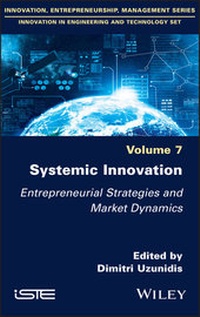
Systemic Innovation
Entrepreneurial Strategies and Market Dynamics
1st Edition
Published on 22. September 2020
288 pages
978-1-119-77938-4 (ISBN)
Description

INNOVATION IN ENGINEERING AND TECHNOLOGY SET Coordinated by Dimitri Uzunidis
Systemic innovation is based on business networks and new business models in a global economy integrated by flows of knowledge, capital, and goods. The authors of this book consider the theory that innovations act as systems based on multi-actor interactions. Innovation is contextualized to demonstrate in what capacity a company or an entrepreneur can innovate.
The book details the management of scientific, technical and cognitive resources, the relationships between R&D partners, the creativity and the rules that allow a market and a company to innovate.
This contextualization, associated with entrepreneurial strategy, leads to systemic innovation. This book analyzes some key sectors of the economy that are knowledge-intensive and rapidly changing: transport and communications, defense, information technology, artificial intelligence, and the environment.
Systemic innovation is based on business networks and new business models in a global economy integrated by flows of knowledge, capital, and goods. The authors of this book consider the theory that innovations act as systems based on multi-actor interactions. Innovation is contextualized to demonstrate in what capacity a company or an entrepreneur can innovate.
The book details the management of scientific, technical and cognitive resources, the relationships between R&D partners, the creativity and the rules that allow a market and a company to innovate.
This contextualization, associated with entrepreneurial strategy, leads to systemic innovation. This book analyzes some key sectors of the economy that are knowledge-intensive and rapidly changing: transport and communications, defense, information technology, artificial intelligence, and the environment.
More details
Other editions
Additional editions
Book
12/2020
1st Edition
Wiley-ISTE
€164.50
Article exhausted; check different version
Person
Dimitri Uzunidis is a Professor of Political Economy and the Honorary President of the Innovation Research Network in France. He has directed and edited several journals and collections on the study of innovation and paradigmatic change. As a specialist in change, he provides expertise for various international organizations.
Content
- Cover
- Title Page
- Copyright Page
- Contents
- General Introduction: Systemic Innovations and Transformation of Organizational Models
- Chapter 1 Enterprise Through the Lens of Agility, Creativity and Monitoring Method Combinations
- 1.1. Introduction
- 1.2. Agility and its manifesto
- 1.3. Agility and the design process
- 1.4. Agility and creativity
- 1.5. Agility and decision-making
- 1.6. Innovation-oriented agile monitoring
- 1.7. Conclusion
- 1.8. References
- Chapter 2 Science Fiction: A Strategic Approach for Innovative Organizations
- 2.1. Introduction
- 2.2. Science fiction, a futuristic fantasy for engineers and innovators
- 2.2.1. The scientific imagination behind major discoveri
- 2.2.2. Examples: virtual reality and the conquest of Mars
- 2.3. Science fiction and creativity: new approaches
- 2.3.1. Design fiction, a method for stimulating creativity
- 2.3.2. Science fiction prototyping
- 2.4. Towards a theory of technotypes
- 2.4.1. Utopian technologies and the technological utopianism of American culture
- 2.4.2. Technotypes, structures of the technical imaginary
- 2.5. Conclusion
- 2.6. References
- Chapter 3 The Management of Inventive Knowledge: From Inventive Intellectual Corpus to Innovation
- 3.1. Introduction
- 3.2. From knowledge capital to knowledge management
- 3.3. Knowledge-based knowledge management
- 3.4. The knowledge capital and the inventive intellectual corpus
- 3.4.1. Knowledge capital
- 3.4.2. The inventive intellectual corpus and the dematerialized knowledge object
- 3.4.3. The inventive intellectual corpus at the heart of innovation
- 3.5. The virtuous cycle of knowledge management
- 3.6. The MASK method
- 3.6.1. MASK II: Analysis of knowledge capital
- 3.6.2. MASK I: Capitalization of knowledge capital
- 3.6.3. MASK III: Sharing the knowledge capital
- 3.6.4. MASK IV: Evolution of the knowledge capital
- 3.7. Illustrations with real cases from "economic reality"
- 3.7.1. Strategic analysis and capitalization: the case of IRSN
- 3.7.2. Transfer: the case of Sonatrach
- 3.7.3. Innovation: the case of ONERA
- 3.8. Conclusion
- 3.9. References
- Chapter 4 Evolution of Firms Trajectories and Innovation: Knowledge Capital and Financial Opportunities
- 4.1. Introduction
- 4.2. Technological and firms trajectories
- 4.2.1. Technological paradigms and trajectories: first definitions
- 4.2.2. Paradigms, regimes and trajectories: empirical studies
- 4.2.3. The firm's trajectory or evolutionary path
- 4.3. The formation of trajectories: knowledge capital and financial opportunities
- 4.3.1. Dynamic capabilities and knowledge capital
- 4.3.2. The collective dimension of trajectories and its consequences
- 4.3.3. Financial opportunities, firm evolution and technical change
- 4.4. Conclusion
- 4.5. References
- Chapter 5 From Shared Inventions to Competitive Innovations: Networks and Enterprise Automation Strategies
- 5.1. Introduction
- 5.2. Applications of recent concepts in automation: social dynamics, shared inventions and competitive innovations
- 5.2.1. Shared inventions.
- 5.2.2. Competitive innovations
- 5.2.3. Social dynamics
- 5.2.4. What coherences are there between shared inventions and competitive innovations?
- 5.3. "Phase 1" automation: machine inventions, networks of inventors and jobs
- 5.3.1. The discoveries of these shared inventions
- 5.3.2. Networks and shared inventions
- 5.4. Phase 2 automation: innovations and sets of machines, networks and work dimensions
- 5.4.1. Automation and changes in work
- 5.5. Conclusion
- 5.6. References
- Chapter 6 Technologies and Inter-industrial Collaborations: A Patent Analysis
- 6.1. Introduction
- 6.2. Method: the co-patent multigraph
- 6.3. Data and descriptive statistics
- 6.4. A structural look at R&D cooperation: results and discussion
- 6.5. Conclusion
- 6.6. Appendix
- 6.7. References
- Chapter 7 Technological Change and Environmental Transition: Lessons from the Case of the Automobile
- 7.1. Introduction
- 7.2. Encountering a major technological limit: the environmental limitation
- 7.2.1. Technological system dynamics
- 7.2.2. Nature and forms of the environmental limit
- 7.3. The irruption of the environmental limit as a determining/dominant factor in technological change: the case of automotive ...
- 7.3.1. The environmental limit of the automotive system
- 7.3.2. Corrective action of a social, fiscal and regulatory nature
- 7.3.3. Forms and stages of technological change in road transport
- 7.4. The environmental limit as a factor of a major technological change
- 7.4.1. Nature and actions of environmental limits
- 7.4.2. Generation of a new change regime
- 7.5. Conclusion
- 7.6. References
- Chapter 8 The Transformation of Defense Innovation Systems: Knowledge Bases, Disruptive Technologies and Operational Capabilities
- 8.1. Introduction
- 8.2. The evolution of knowledge bases: duality and complexity
- 8.2.1. Dual-use technology
- 8.2.2. Knowledge complexity and scientific intensity
- 8.3. The disruptive impact of technology: artificial intelligence and autonomous systems
- 8.3.1. AI: definitions and sources of legitimacy
- 8.4. The transformation of military capabilities: network-centric warfare and multi-domain C2
- 8.4.1. First step: network-centric warfare (NCW)
- 8.4.2. Second step: multi-domain command and control (MDC2)
- 8.5. Conclusion
- 8.6. References
- Chapter 9 Nanotechnologies and Business Intelligence: Challenges of Information Valorization and Knowledge Creation
- 9.1. Introduction
- 9.2. Overview of nanotechnology and its economic and technical potential
- 9.2.1. Understanding nanotechnology
- 9.2.2. The challenges of nanotechnology
- 9.2.3. The limits of nanotechnology
- 9.3. Business intelligence
- 9.3.1. History and definition of business intelligence
- 9.3.2. Information at the heart of business intelligence12
- 9.4. Business intelligence and nanotechnology
- 9.4.1. Examples: quantum computers, RFID chips
- 9.4.2. Nanotechnology in industry
- 9.4.3. What are the limits and stakes?
- 9.5. Conclusion
- 9.6. References
- Chapter 10 When Innovation Innovates: How Artificial Intelligence Challenges the Patent System
- 10.1. Introduction
- 10.2. Definitions and evolution over time of AI technologies
- 10.3. The difficult issue of the patentability of AI
- 10.3.1. The patent subject-matter eligibility of AI technologies
- 10.3.2. Who should be listed as the inventor?
- 10.3.3. Liability for patent infringement by AI
- 10.4. AI patents in light of economic theory
- 10.4.1. The rationale for granting patents
- 10.4.2. AI patents, incremental inventions and legal implications
- 10.5. Conclusion
- 10.6. References
- Chapter 11 Conflicting Standards and Innovation in Energy Transition
- 11.1. Introduction: a change of culture
- 11.2. Green innovations and standardization
- 11.2.1. Regulatory quality defined on the basis of a relationship between standards and innovation
- 11.2.2. Another multi-level management: sovereignty and innovation
- 11.3. The conflict of standards: globalization, sovereignty and democracy
- 11.3.1. Acting solely through taxation?
- 11.3.2. Acting solely through local and regional authorities?
- 11.3.3. The conflict of standards: Europe and the United States
- 11.4. The energy transition: a natural experiment
- 11.5. Conclusion
- 11.6. References
- List of Authors
- Index
- Other titles from ISTE in Innovation, Entrepreneurship and Management
- EULA
