

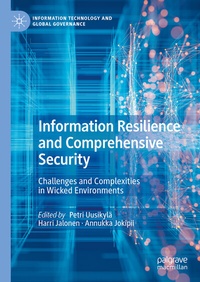
Information Resilience and Comprehensive Security
Description

Changes in the global environment, the complexity of decision-making, and the new role of social media have challenged the operating models and practices of traditional crisis preparedness and security of supply. In a knowledge society context, securing the continuous flow of information and communication on different platforms is a huge challenge, and the role of information resilience is more crucial than ever. Bringing together leading specialists from many fields on information resilience, this book examines how to ensure the undisturbed flow of information, the functionality of information and communications networks, and reliable and secure information content in all circumstances, both from an individual and societal viewpoint. The book address issues around information resilience from the standpoint of management, national security, misinformation, social media, and commercial actors. It will appeal to scholars and students of public policy, disaster management, security studies and governance, as well as practitioners.
Chapters 1 and 12 are licensed under the terms of the Creative Commons Attribution 4.0 International License (http://creativecommons.org/licenses/by/4.0/). For further details see license information in the chapter
More details
Other editions
Additional editions
Persons
Petri Uusikylä is Research Director at the University of Vaasa, Finland and a Docent at the University of Eastern Finland.
Harri Jalonen
is Professor of Social and Health Management at the University of Vaasa, Finland.
Annukka Jokipii
is Professor of Accounting at the University of Vaasa, Finland.
Content
Introduction.- Harri Jalonen, Petri Uusikylä & Annukka Jokipii. Part I: Resilience and Preparedness .- 1. Anticipating Crisis and Enhancing Resilience David Omand.- 2. The Comprehensive Resilience Ecosystem and Hybrid Threads Hanna Smith.- 3. Navigating Complexity: Resilience Strategies for Safeguarding Information in the Context of National Security and Preparedness Christian Fjäderp.- 4. Critical Infrastructure Resilience as a Shared Policy Response of NATO and the EU Eero Kytömaa.- 5. Entropy of State Power: The impacts of the battle to control artificial intelligence Valtteri Vuorisalo.- Part II: Complexity, Governance and Legislation.- 6. Toward an Emergent System of Governance.- Petri Uusikylä & Harri Jalonen et al.- 7. Increasing Resilience through Coordination and Collaboration Paul Barnes.- 8. Smart Regulation as a Tool for Improved Information Resilience.- Anssi Keinänen & Harriet Lonka.- Part III: Counterforces and Detection to Disinformation .- 9. Counterforces to and Detection of Disinformation.- Teija Sederholm et al.- 10. Alternative Narratives and Counter-Terrorism in the Arc of Instability Olli Ruohomäki.- Part IV: Information Resilience and Collective Agency .- 11. Relational Approach to Information Resilience - Processual Characteristics of Social Becomings A mong Citizen Groups During the COVID19 Crisis Valdemar Kallunki et al.- 12. Network of Risk Perceptions.- Jan-Erik Johanson, Alisa Puustinen & Oliver Saal.- 13. Collective Informational Capacity of the Civil Society Shaping Societal Resilience Pasi Mäenpää, Henrietta Grönlund & Maija Faehnle.- 14. Conclusions Annukka Jokipii, Harri Jalonen & Petri Uusikylä.
