

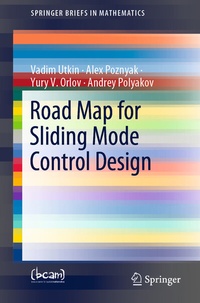
Road Map for Sliding Mode Control Design
Description

This book is devoted to control of finite and infinite dimensional processes with continuous-time and discrete time control, focusing on suppression problems and new methods of adaptation applicable for systems with sliding motions only. Special mathematical methods are needed for all the listed control tasks. These methods are addressed in the initial chapters, with coverage of the definition of the multidimensional sliding modes, the derivation of the differential equations of those motions, and the existence conditions. Subsequent chapters discusses various areas of further research. The book reflects the consensus view of the authors regarding the current status of SMC theory. It is addressed to a broad spectrum of engineers and theoreticians working in diverse areas of control theory and applications. It is well suited for use in graduate and postgraduate courses in such university programs as Electrical Engineering, Control of Nonlinear Systems, and Mechanical Engineering.
Reviews / Votes
"This book surveys the basic ideas of sliding mode control (SMC) theory. The main design principles are discussed and investigated, and their application to a wide range of problems is analyzed. The authors explicitly recognize that the scientific arsenal accumulated in the theory of SMC during more than 50 years offers such a wide range of both problem statements and solution methods that any attempt to prepare a state-of-the-art survey paper would hardly be successful." (Maria Letizia Corradini, Mathematical Reviews, June, 2022)More details
Other editions
Additional editions
Persons
Alexander Poznyak graduated from Moscow Physical Technical Institute (MPhTI) in 1970. He earned PhD and Doctor of Science degrees from the Institute of Control Sciences of the Russian Academy of Sciences in 1978 and 1989, respectively. From 1973 to 1993 he served first as a researcher and then as leading researcher at this institute, before accepting a post as full professor (3-F) at the Center for Research and Advanced Studies of the National Polytechnic Institute (CINVESTAV-IPN) in Mexico, where for 8 years he was head of the Automatic Control Department. He has been the supervisor for 43 PhD theses. He has published more than 240 papers in di?erent international journals and 14 books. His areas of interest are robust nonlinear deterministic and stochastic control, identi?cation theory, Markov processes, and game theory with economics applications.
Yury Orlov is a Professor in the Electronics and Telecommunication Department, Scienti?c Research and Advanced Studies Center of Ensenada, Mexico. His research interests lie in the analysis and synthesis of discontinuous as well as time delay and distributed parameter systems. He has authored or co-authored about 250 journal and conference papers in the above areas as well as ?ve monographs. He is an Associate Editor of IEEE Transactions on Control Systems Technology, of the International Journal of Robust and Nonlinear Control, and of the IMA Journal of Mathematical Control and Information.
Andrey Polyakov received his PhD in Systems Analysis and Control from Voronezh State University in 2005. Until 2010 he was an Associate Professor with this university. In 2007-8, Dr. Polyakov worked at CINVESTAV-PIN in Mexico. From 2010 to 2013 he was a lead researcher of the Institute of Control Sciences of the Russian Academy of Sciences, and he then joined INRIA, Lille, France. His main research interests include robust and nonlinear control. He has authored or co-authored more than 150 papers.
