

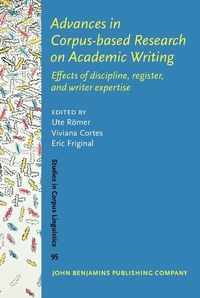
Advances in Corpus-based Research on Academic Writing
Effects of discipline, register, and writer expertise
1st Edition
Published on 20. February 2020
364 pages
978-90-272-6145-8 (ISBN)
Description

This volume showcases some of the latest research on academic writing by leading and up-and-coming corpus linguists. The studies included in the volume are based on a wide range of corpora spanning first and second language academic writing at different levels of writing expertise, containing texts from a variety of academic disciplines (and sub-disciplines) and of different academic registers. Particularly novel aspects of the collection are the inclusion of research that combines rhetorical moves with multi-dimensional analysis, studies that cover both fixed and variable phraseological items (lexical bundles, phrase-frames, constructions), and work that is based on corpora of English as an academic lingua franca. Going beyond merely summarizing their findings, the authors also discuss what their research means for academic writing practice and pedagogical settings. The volume will be of interest to researchers, students, and teachers who would like to expand their knowledge of how academic writing functions and what it looks like in a variety of contexts.
More details
Other editions
Additional editions
Ute Roemer-Barron | Viviana Cortes | Eric Friginal
Advances in Corpus-based Research on Academic Writing
Effects of discipline, register, and writer expertise
Book
02/2020
John Benjamins Publishing Co
€123.30
Shipment within 10-15 days
Content
- Intro
- Advances in Corpus-based Research on Academic Writing
- Editorial page
- Title page
- Copyright page
- Table of contents
- Introduction: Advances in corpus-based research on academic writing
- Acknowledgements
- References
- Part I. Focus on writer expertise and nativeness status
- A corpus-based study of academic word use in EFL student writing
- 1. Introduction
- 2. Background
- 2.1 Linguistic variation in university registers
- 2.2 Academic vocabulary
- 2.3 The English as a Foreign Language (EFL) context
- 3. Methodology
- 3.1 The corpus
- 3.2 Analytical procedures
- 4. Findings
- 4.1 Courses
- 4.2 Assignments
- 5. Discussion
- 6. Conclusion, implications and limitations
- References
- Appendix A. Sample assignments
- Appendix B. Text extracts
- Give constructions in Korean EFL learner writing
- 1. Introduction
- 2. Literature review
- 2.1 Constructions of the verb give
- 2.2 Contrastive corpus studies and L1 influence in corpus studies
- 2.3 The current study
- 3. Method
- 3.1 Corpora
- 3.2 Data extraction
- 3.3 Data analysis
- 4. Findings
- 4.1 Constructions and frequencies
- 4.2 In-depth analysis of ditransitive constructions
- 4.3 L1 influence found in collocations and idiosyncratic usage
- 5. Conclusions
- 5.1 Limitations
- 5.2 Future directions
- References
- A corpus-based exploration of constructions in written academic English as a lingua franca
- 1. Introduction
- 2. Literature review
- 2.1 A brief overview of written academic ELF research
- 2.2 Corpus-based phraseology and Construction Grammar
- 2.3 The current study
- 3. Data and method
- 3.1 Corpora used
- 3.2 Analysis
- 4. Results
- 4.1 KFW exploration 1: Of
- 4.2 KFW exploration 2: In
- 4.3 Construction candidates with KFWs in and of
- 4.4 KFW exploration 3: On
- 5. Discussion and conclusion
- 5.1 Core constructions of written academic ELF
- 5.2 Limitations and future directions
- References
- The influence of sources on first-year composition L1 student writing: A multi-dimensional analysis
- 1. Introduction
- 2. Literature review
- 3. Method
- 3.1 Participants and setting
- 3.2 Instruments and materials
- 3.3 Procedures
- 3.4 Analysis
- 4. Results and discussion
- 4.1 Dimension 1: Source-based concept density vs. Prompt-based freewriting
- 4.2 Dimension 2: Impersonal extension of source-based concepts
- 4.3 Dimension 3: Source text deixis
- 5. General discussion
- 6. Limitations
- 7. Conclusion
- References
- Appendix A. Prompts
- Appendix B. Word list variables
- Appendix C. Full factor loading table
- Students' use of lexical bundles: Exploring the discipline and writing experience interface
- 1. Introduction
- 2. Literature review
- 2.1 Lexical bundles
- 2.2 Lexical bundles in academic discourse
- 2.3 Students' use of lexical bundles
- 3. Methods
- 3.1 Lexical bundles in medical research articles
- 3.2 Corpora
- 3.3 Data collection
- 4. Results
- 4.1 Use of all bundles
- 4.2 Use of research-oriented bundles
- 4.3 Use of text-oriented bundles
- 5. Discussion
- 6. Conclusion
- References
- Part II. Focus on disciplinary variation
- Combining rhetorical move analysis with multi-dimensional analysis: Research writing across disciplines
- 1. Introduction
- 1.1 Move analysis
- 1.2 Investigating the linguistic characteristics of moves
- 1.3 Multi-dimensional analyses of moves
- 2. The ISURA corpus: Design, compilation, and move annotation
- 2.1 Design and compilation
- 2.2 Development of the IMRD/C move/step framework
- 2.3 Annotating the ISURA corpus for moves and steps
- 3. Applying MD analysis to the move-annotated ISURA corpus: Methods
- 3.1 Preparing the move-annotated ISURA corpus for analysis: Text segmentation and tagging
- 3.2 Obtaining rates of occurrence for linguistic features: Adapting to a specialized domain and short texts
- 3.3 Conducting the statistical analyses
- 3.4 Calculating dimension scores and interpreting dimensions
- 4. Dimensions of variation across rhetorical moves
- 4.1 Dimension 1: Interpretation and expansion vs. simple reportage
- 4.2 Dimension 2: Abstraction / Overt empiricism
- 4.3 Dimension 3: Procedural narration
- 4.4 Dimension 4: Interpreting results vs. informational density
- 5. Applying and evaluating the MD analysis of moves
- 5.1 Evaluation of the dimensions and process
- 5.2 Implications and applications
- Acknowledgements
- References
- Appendix A. Scree plot for Principal Components Analysis
- Lexical bundles across disciplines: A look at consistency and variability
- 1. Introduction
- 2. Methods
- 3. Results and discussion
- 3.1 Bundles shared across disciplines
- 3.2 Bundles with a productive variable slot
- 3.3 Nuanced meanings of variable slot fillers
- 3.4 Pedagogical applications
- 4. Conclusion
- References
- Lexical bundles as reflections of disciplinary norms in Spanish and English literary criticism, history, and psychology research
- 1. Introduction
- 2. Review of related literature
- 2.1 LBs and their connection to argumentation in disciplines
- 2.2 Lexicogrammatical features and their connection to argumentation
- 3. Data and methodology
- 3.1 Corpus
- 3.2 LB identification
- 3.3 Statistical analysis
- 4. Results
- 4.1 Preliminary study: Replicating MacDonald's study of sentence subjects
- 4.2 Main study: Subcorpus-level differences at the formulaic language level
- 5. Discussion
- 5.1 "Facts": The most frequent epistemic bundles in all disciplines
- 5.2 Further expressions of epistemicity in psychology writing
- 5.3 Equivalent phenomenal bundles in all disciplines
- 5.4 History-specific phenomenal bundles
- 5.5 Psychology-specific phenomenal bundles
- 6. Conclusion
- References
- Adjectives as nominal pre-modifiers in chemistry and applied linguistics research articles
- 1. Introduction
- 2. Methods
- 3. Results and discussion
- 3.1 NP lexical similarities
- 3.2 Types of attributive adjectives and their NP function
- 3.3 NP size and NP sequence frequency
- 4. Conclusion
- References
- The use of lexical patterns in engineering: A corpus-based investigation of five sub-disciplines
- 1. Introduction
- 1.1 Multiword sequences in discipline-specific texts
- 2. Method
- 2.1 Construction of engineering corpora
- 2.2 Identification of target phrase-frames
- 2.3 Structural and functional analysis of phrase-frames
- 2.4 Overlapping of phrase-frames
- 3. Results and discussion
- 3.1 Distribution and variability of phrase-frames
- 3.2 Structural categories for phrase-frames
- 3.3 Functional categories for phrase-frames
- 3.4 Findings for overlapping PFs
- 4. Pedagogical applications of findings
- 5. Conclusion
- References
- Appendix
- Stance in unpublished student writing: An exploratory study of modal verbs in MICUSP's Physical Science papers
- 1. Introduction
- 2. Studies about stance
- 2.1 Stance in student writing
- 2.2 Modal verbs as stance markers in academic writing
- 3. Methods and materials
- 3.1 Corpus
- 3.2 Data analysis
- 4. Results
- 4.1 Possibility modals
- 4.2 Prediction modals
- 4.3 Necessity modals
- 4.4 Disciplinary variation
- 4.5 Student level
- 4.6 Nativeness
- 4.7 Registers
- 5. Discussion and pedagogical implications
- 6. Future directions
- 7. Conclusion
- References
- Appendix A.
- Modal verbs
- Algorithm
- Appendix B.
- Appendix C.
- Part III. Focus on register variation
- P-frames and rhetorical moves in applied linguistics conference abstracts
- 1. Introduction
- 2. Methodology
- 2.1 Corpus
- 2.2 Procedures
- 3. Results
- 3.1 The distribution of p-frames across the rhetorical move-steps
- 3.2 The association of p-frames with individual rhetorical moves/steps
- 4. Summary and conclusion
- References
- Appendix A. Phrase-Frames in the 2017 AAAL conference abstracts sorted by their primary function
- Stand-alone literature reviews: A new multi-dimensional analysis
- 1. Introduction
- 2. Methods
- 2.1 Corpus
- 2.2 Statistical analyses
- 3. Results
- 3.1 Dimension 1: Human vs. technical/academic focus
- 3.2 Dimension 2: Questioning/interpreting vs. knowledge-conferring
- 3.3 Dimension 3: Expression of stance
- 3.4 Dimension 4: Author/discourse community vs. topic focus
- 3.5 Dimension 5: Abstract vs. concrete focus
- 3.6 Dimension 6: Methodological concerns vs. description
- 4. Conclusion
- References
- Appendix. Means and Standard Deviations for Dimensions 1 to 6
- A multi-dimensional view of collocations in academic writing
- 1. Introduction
- 2. Collocational multi-dimensional analysis
- 3. Collocational multi-dimensional analysis of academic writing
- 4. Dimensions of collocation in academic writing
- 5. Conclusion
- Acknowledgements
- References
- Name index
- Subject index
