

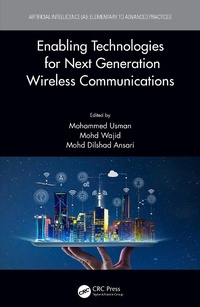
Enabling Technologies for Next Generation Wireless Communications
1st Edition
Published on 28. December 2020
295 pages
978-1-000-32894-3 (ISBN)
Description

Enabling Technologies for Next Generation Wireless Communications provides up-to-date information on emerging trends in wireless systems, their enabling technologies and their evolving application paradigms.
This book includes the latest trends and developments toward next generation wireless communications. It highlights the requirements of next generation wireless systems, limitations of existing technologies in delivering those requirements and the need to develop radical new technologies. It focuses on bringing together information on various technological developments that are enablers vital to fulfilling the requirements of future wireless communication systems and their applications. Topics discussed include spectrum issues, network planning, signal processing, transmitter, receiver, antenna technologies, channel coding, security and application of machine learning and deep learning for wireless communication systems. The book also provides information on enabling business models for future wireless systems.
This book is useful as a resource for researchers and practitioners worldwide, including industry practitioners, technologists, policy decision-makers, academicians, and graduate students.
This book includes the latest trends and developments toward next generation wireless communications. It highlights the requirements of next generation wireless systems, limitations of existing technologies in delivering those requirements and the need to develop radical new technologies. It focuses on bringing together information on various technological developments that are enablers vital to fulfilling the requirements of future wireless communication systems and their applications. Topics discussed include spectrum issues, network planning, signal processing, transmitter, receiver, antenna technologies, channel coding, security and application of machine learning and deep learning for wireless communication systems. The book also provides information on enabling business models for future wireless systems.
This book is useful as a resource for researchers and practitioners worldwide, including industry practitioners, technologists, policy decision-makers, academicians, and graduate students.
More details
Series
Edition
1. Auflage
Language
English
Place of publication
London
United Kingdom
Publishing group
Taylor & Francis Ltd
Target group
College/higher education
Professional and scholarly
Illustrations
18 Tables, black and white; 83 Line drawings, black and white; 21 Halftones, black and white; 104 Illustrations, black and white
ISBN-13
978-1-000-32894-3 (9781000328943)
Copyright in bibliographic data and cover images is held by Nielsen Book Services Limited or by the publishers or by their respective licensors: all rights reserved.
Schweitzer Classification
Other editions
Additional editions
Mohammed Usman | Mohd Wajid | Mohd Dilshad Ansari
Enabling Technologies for Next Generation Wireless Communications
Book
10/2024
1st Edition
CRC Press
€79.90
Shipment within 15-20 days
Book
02/2021
CRC Press
Unfortunately, price unknown
Available (delivery time upon request)
Mohammed Usman | Mohd Wajid | Mohd Dilshad Ansari
Enabling Technologies for Next Generation Wireless Communications
Book
12/2020
1st Edition
CRC Press
€231.20
Shipment within 15-20 days
Persons
Dr. Usman received B.E in Electronics and Communications from Madras University, India in 2002. He received his M.Sc and PhD from University of Strathclyde, UK in 2003 and 2008 respectively. He is the recipient of the University scholarship from Strathclyde for his PhD. He has more than a decade of experience in academics and academic administration. He is a senior member of IEEE and IEEE Communications Society. He has been TPC chair and organizing chair for IEEE conferences and actively involved in IEEE activities. He is currently working as Assistant Professor in the department of Electrical Engineering at King Khalid University, Saudi Arabia. He received the 'academic excellence' award from the College of Engineering at King Khalid University and also received the award for best project in 2016. A senior design project under his supervision received the 'talent and innovation' award in 2018. His research is focused on technologies for next generation wireless networks, signal processing for biomedical application, probabilistic modeling and channel coding.
Dr. Mohd Dilshad Ansari is currently working as Assistant Professor in the Department of Computer Science & Engineering at CMR College of Engineering & Technology, Hyderabad, India. He received B.Tech in Information Technology from Uttar Pradesh Technical University, Lucknow, UP in 2009. He received his M.Tech and Ph.D. in Computer Science & Engineering from Jaypee University of Information Technology, Waknaghat, Solan, HP, India in 2011 and 2018 respectively. He has more than 7 years of Academic Experience as well as published more than 30 papers in International Journals (SCIE/Scopus) and conferences (IEEE/Springer). He is the Member of various Technical/Professional societies such as IEEE, UACEE and IACSIT. He has been appointed as Editorial/Reviewer Board and Technical Programme Committee member in various reputed Journals/Conferences. He is also Guest Editor of Special Issues from Reputed Journals and Organized Special Sessions in IEEE/Springer Conferences. His research interest includes Digital & Fuzzy Image Processing, Machine Learning, IoT, and Cloud Computing.
Dr. Mohd Wajid is currently working as Assistant Professor in Electronic & Communication Dept., Aligarh Muslim University, Aligarh, India. He did his B.Tech (Electronics) from AMU - Aligarh and M.Tech (VLSI and Embedded Systems) from IIIT Hyderabad. He obtained PhD degree in Signal Processing from Indian Institute of Technology Delhi, India. His doctoral work was on Design and Analysis of Microphone based Acoustic Vector Sensor for 2D Direction of Arrival Estimation. Before joining Aligarh Muslim University, he was associated with Jaypee University of Information Technology - Solan, Texas Instruments - Bangalore, Xilinx India Technology Services Private Limited - Hyderabad, and also he served as a Senior Engineer in the "Professional Electronics and Industrial System Division" of Blue Star Limited - New Delhi.
Dr. Mohd Dilshad Ansari is currently working as Assistant Professor in the Department of Computer Science & Engineering at CMR College of Engineering & Technology, Hyderabad, India. He received B.Tech in Information Technology from Uttar Pradesh Technical University, Lucknow, UP in 2009. He received his M.Tech and Ph.D. in Computer Science & Engineering from Jaypee University of Information Technology, Waknaghat, Solan, HP, India in 2011 and 2018 respectively. He has more than 7 years of Academic Experience as well as published more than 30 papers in International Journals (SCIE/Scopus) and conferences (IEEE/Springer). He is the Member of various Technical/Professional societies such as IEEE, UACEE and IACSIT. He has been appointed as Editorial/Reviewer Board and Technical Programme Committee member in various reputed Journals/Conferences. He is also Guest Editor of Special Issues from Reputed Journals and Organized Special Sessions in IEEE/Springer Conferences. His research interest includes Digital & Fuzzy Image Processing, Machine Learning, IoT, and Cloud Computing.
Dr. Mohd Wajid is currently working as Assistant Professor in Electronic & Communication Dept., Aligarh Muslim University, Aligarh, India. He did his B.Tech (Electronics) from AMU - Aligarh and M.Tech (VLSI and Embedded Systems) from IIIT Hyderabad. He obtained PhD degree in Signal Processing from Indian Institute of Technology Delhi, India. His doctoral work was on Design and Analysis of Microphone based Acoustic Vector Sensor for 2D Direction of Arrival Estimation. Before joining Aligarh Muslim University, he was associated with Jaypee University of Information Technology - Solan, Texas Instruments - Bangalore, Xilinx India Technology Services Private Limited - Hyderabad, and also he served as a Senior Engineer in the "Professional Electronics and Industrial System Division" of Blue Star Limited - New Delhi.
Content
1. Next Generation Wireless Systems - Introduction, Requirements, Challenges and Applications. 2. Signal Processing for Next Generation Wireless Systems. 3. Channel Coding for Future Wireless Communication. 4. Multi-Carrier and Multi-Antenna Systems - Massive MIMO. 5. Spectrum Management and Planning. 6. MM Wave Communication. 7. Visible Light Communication (VLC). 8. Channel Modeling. 9. Artificial Intelligence and Machine Learning for Wireless Communication. 10. Cloud Computing Paradigms. 11. Security. 12. Network Architecture and Protocols. 13. Internet of Things (IoT). 14. Vehicular Networks. 15. Case Studies on Application Scenarios.
