

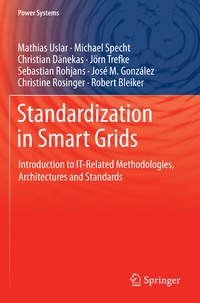
Standardization in Smart Grids
Description

The first successful finished Smart Grid Prototype Projects deliver new requirements and best practices to meet them. These solutions will be the base for the upcoming norms and standards in the near future.
This domain is not only part of one Standard developing Organization (SDO), but also of many different organizations like ITU, ISO, IEC and additionally for the electro mobility part the SAE. This results in many standards which are based on different aspects. Furthermore the European mirror organizations (ETSI,CEN, CENELEC) as well as the German mirror groups of these groups are involved, which are delivering further rules and adaption for the local market. Because of this diversity of organizations involved, it is difficult for the local companies (which includes energy utility, manufacturer and software producer specialized on integration) to identify the relevant trends, standardization groups and technologies necessary.
With the EU Mandate M490 to CEN/CNELEC and TESI and the Commission being a driving force (e.g. ftp://ftp.cencenelec.eu/CENELEC/Smartgrid/SmartGridFinalReport.pdf and http://www.cenelec.eu/aboutcenelec/whatwedo/technologysectors/smartgrids.html) standardization becomes more and more important - but it's complex and not easy to be understood. Here at OFFIS, we provide training but we are always asked for textbooks on our tranings. Based on our modules for the SG tranings, we would estimate the following chapters to be relevant to SG stakeholders in standardization (roughly 16-20 pages per chapter).
More details
Other editions
Additional editions
Persons
Mathias Uslar has studied computer science with a minor in legal informatics at the University Of Oldenburg, Germany form 1999 till 2004. In October 2004, he started working a scientific assistant at OFFIS - Institute for Information Systems in Oldenburg, later on working there as project leader and now as Group manager in the Energy branch of the institute, leading the largest group in OFFIS. Since 2008, he is head of the CISE, the Centre for IT Standards in the Energy Sector. In October 2009, he successfully defended his phd thesis on the Integration of heterogeneous standards in the electric utility domain and smart grids. Mr Uslar is leading OFFIS' national and international work packages with the scope of standardisation and interoperability. He is member of German GI, IEEE, ACM and IEC german mirror committee member DKE K 952, 952.0.10, 952.0.17 and international member of IE TC 57 WG 14 and 16. His research interests are with Semantic modeling and technical interoperability in smart grid architectures. Currently, he is working on modeling DER like CHP oder PHEV using the CIM (IEC 61968) and creating control structures for virtual power plants.
Sebastian Rohjans has joined the OFFIS -Institute for Information Systems in late 2008. He holds a computer science degree from the University of Oldenburg with a minor in business and wrote his thesis about ontology based integration. He is now working in industrial setting projects having the same scope. His research interests include semantic web services, the OPC uni?ed architecture and ontology based mediation.
Michael Specht works since August 2008 as a scienti?c assistant at the OFFIS institute. He wrote his diploma thesis about "Ontology based integration of quality codes in the electricity domain". His main working topics are CIM based XML messaging and CIM topology modeling.
Jose Manuel Gonzalez Vazquez works since January 2008 as a scienti?c assistant and PhD candidate at the OFFIS institute, Oldenburg. His research is on reference models and IT systems in the utility domain (electricity and gas). Further on he is actively involved in national and international standardization and is member of the IEC TC 57 Working Group 14, where he is part of the Common Information Model (CIM) modeling team.
Robert Bleiker works since July 2009 as a scienti?c assistant at the OFFIS institute. He wrote his diploma thesis about "The word problem for petri nets". His main working topics are automated testing of standard conformance and compliance for IEC 61850 and CIM.
