

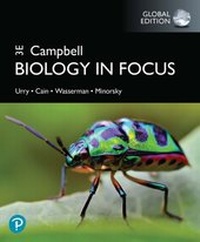
Campbell Biology in Focus, Global Edition
Description

The full text downloaded to your computer
With eBooks you can:
- search for key concepts, words and phrases
- make highlights and notes as you study
- share your notes with friends
eBooks are downloaded to your computer and accessible either offline through the Bookshelf (available as a free download), available online and also via the iPad and Android apps.
Upon purchase, you'll gain instant access to this eBook.
Time limit
The eBooks products do not have an expiry date. You will continue to access your digital ebook products whilst you have your Bookshelf installed.
All prices
More details
Other editions
New editions

Additional editions
Persons
Lisa A. Urry (Units 1 and 2) is Gibbons Young Professor of Biology at Mills College. After earning a B.A. at Tufts University, she completed her Ph.D. at the Massachusetts Institute of Technology (MIT). Lisa has conducted research on gene expression during embryonic and larval development in sea urchins. Deeply committed to promoting opportunities in science for women and underrepresented minorities, she has taught courses ranging from introductory and developmental biology to a nonmajors course called Evolution for Future Presidents.
Michael L. Cain (Chapter 1 and Units 3, 4, and 7) is an ecologist and evolutionary biologist who is now writing full-time. Michael earned an A.B. from Bowdoin College, an M.Sc. from Brown University, and a Ph.D. from Cornell University. As a faculty member at New Mexico State University, he taught introductory biology, ecology, evolution, botany, and conservation biology. Michael is the author of dozens of scientific papers on topics that include foraging behavior in insects and plants, long-distance seed dispersal, and speciation in crickets. He is also a coauthor of an ecology textbook.
Steven A. Wasserman (Unit 6) is Professor of Biology at the University of California, San Diego (UCSD). He earned an A.B. from Harvard University and a Ph.D. from MIT. Working on the fruit fly Drosophila, Steve has done research on developmental biology, reproduction, and immunity. Having taught genetics, development, and physiology to undergraduate, graduate, and medical students, he now focuses on introductory biology, for which he has been honored with UCSD's Distinguished Teaching Award.
Peter V. Minorsky (Unit 5) is Professor of Biology at Mercy College in New York, where he teaches introductory biology, ecology, and botany. He received his A.B. from Vassar College and his Ph.D. from Cornell University. Peter taught at Kenyon College, Union College, Western Connecticut State University, and Vassar College; he is also the science writer for the journal Plant Physiology. His research interests concern how plants sense environmental change. Peter received the 2008 Award for Teaching Excellence at Mercy College.
Rebecca B. Orr (Ready-to-Go Teaching Modules, eText Media Integration) is Professor of Biology at Collin College in Plano, Texas, where she teaches introductory biology. She earned her B.S. from Texas A&M University and her Ph.D. from University of Texas South-western Medical Center at Dallas. Rebecca has a passion for investigating strategies that result in more effective learning and retention, and she is a certified Team-Based Learning Collaborative Trainer Consultant. She enjoys focusing on the creation of learning opportunities that both engage and challenge students.
Neil A. Campbell (1946-2004) earned his M.A. from the University of California, Los Angeles, and his Ph.D. from the University of California, Riverside. His research focused on desert and coastal plants. Neil's 30 years of teaching included introductory biology courses at Cornell University, Pomona College, and San Bernardino Valley College, where he received the college's first Outstanding Professor Award. He was also a visiting scholar at the University of California, Riverside. Neil was the founding author of Campbell Biology, upon which this book is based.
Content
- 1 Introduction: Evolution and the Foundations of Biology
- UNIT 1 Chemistry and Cells
- 2 The Chemical Context of Life
- 3 Carbon and the Molecular Diversity of Life
- 4 A Tour of the Cell
- 5 Membrane Transport and Cell Signaling
- 6 An Introduction to Metabolism
- 7 Cellular Respiration and Fermentation
- 8 Photosynthesis
- 9 The Cell Cycle
- UNIT 2 Genetics
- 10 Meiosis and Sexual Life Cycles
- 11 Mendel and the Gene Idea
- 12 The Chromosomal Basis of Inheritance
- 13 The Molecular Basis of Inheritance
- 14 Gene Expression: From Gene to Protein
- 15 Regulation of Gene Expression
- 16 Development, Stem Cells, and Cancer
- 17 Viruses
- 18 Genomes and Their Evolution
- UNIT 3 Evolution
- 19 Descent with Modification
- 20 Phylogeny
- 21 The Evolution of Populations
- 22 The Origin of Species
- 23 Broad Patterns of Evolution
- UNIT 4 The Evolutionary History of Life
- 24 Early Life and the Diversification of Prokaryotes
- 25 The Origin and Diversification of Eukaryotes
- 26 The Colonization of Land
- 27 The Rise of Animal Diversity
- UNIT 5 Plant Form and Function
- 28 Vascular Plant Structure and Growth
- 29 Resource Acquisition, Nutrition, and Transport in Vascular Plants
- 30 Reproduction and Domestication of Flowering Plants
- 31 Plant Responses to Internal and External Signals
- UNIT 6 Animal Form and Function
- 32 The Internal Environment of Animals: Organization and Regulation
- 33 Animal Nutrition
- 34 Circulation and Gas Exchange
- 35 The Immune System
- 36 Reproduction and Development
- 37 Neurons, Synapses, and Signaling
- 38 Nervous and Sensory Systems
- 39 Motor Mechanisms and Behavior
- UNIT 7 Ecology
- 40 Population Ecology and the Distribution of Organisms
- 41 Ecological Communities
- 42 Ecosystems and Energy
- 43 Conservation Biology and Global Change
