

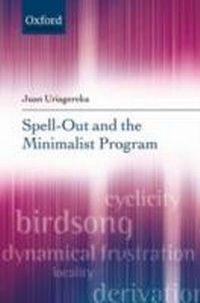
Spell-Out and the Minimalist Program
1st Edition
Published on 8. December 2011
360 pages
978-0-19-163558-8 (ISBN)
Description

In this book Juan Uriagereka explores important consequences of the multiple spell-out hypothesis and of the linked notion of cyclicity. He combines the latest thinking in linguistics with perspectives drawn from physics, biology, and animal behaviour.
More details
Other editions
Additional editions
Juan Uriagereka
Spell-Out and the Minimalist Program
Book
12/2011
Oxford University Press
€74.80
Shipment within 15-20 days
Juan Uriagereka
Spell-Out and the Minimalist Program
Book
12/2011
Oxford University Press
€135.40
Shipment within 15-20 days
Content
- Cover
- Contents
- Acknowledgments
- Introduction
- 1. Derivations
- 2. The extension of computational theories
- 3. The main argument for bottom-up systems
- 4. How the cycle colors the orthogonality of computations
- 5. Three factors of language design
- 6. What sort of computational complexity?
- 7. Evo-devo considerations
- 8. Dynamical frustration as a third factor
- 9. The CLASH model
- 10. Ultrametricity in syntax?
- 11. The Multiple Spell-out attempt to rationalize the cycle
- 1 Linearization
- 1.1. Conceptualizing the Squeezing Problem
- 1.2. The Finite State Limit on phrase structure
- 1.3. Context-sensitive dependencies
- 1.4. Context-sensitive asymmetries
- 1.5. Incremental parsing and information flow
- 1.6. Linearizing complex branchings
- 1.7. LCA vs. MLCA parsing of complex structures
- 1.8. Conclusions
- 2 Sub-extraction
- 2.1. A summary of the MSO proposal based on the LCT
- 2.2. Off-line information
- 2.3. Possible subject sub-extractions?
- 2.4. Genuine subject sub-extractions
- 2.5. A careful experiment
- 2.6. Adjunct sub-extraction
- 2.7. Conclusions
- 3 C-command
- 3.1. An architecture based on c-command
- 3.2. C-command throughout
- 3.3. C-command in construal
- 3.4. C-command in morpho-phonemics
- 3.5. Is c-command derived or eliminated?
- 3.6. Beyond c-command
- 3.7. Conclusions
- 4 Cyclicity
- 4.1. Multiple cyclicity conditions
- 4.2. Cyclicity within compounds
- 4.3. Is compounding recursive?
- 4.4. Compounding as atomization and the notion 'head of the compound'
- 4.5. Parametric differences in Spell-out?
- 4.6. Reconstruction effects
- 4.7. Adjunct deactivation and linearization
- 4.8. Adjunct opacity
- 4.9. Conclusions
- 5 Antecedents and Consequents
- 5.1. Antecedents
- 5.2. Phases
- 5.3. Repair
- 5.4. Is linearization represented?
- 5.5. Interfacing currents
- 5.6. Reprojections
- 5.7. Psycholinguistic consequences
- 5.8. Conclusions
- 6 The Frustrating Equation
- 6.1. Dynamical frustration
- 6.2. 3rd factor considerations
- 6.3. Systemic memory
- 6.4. A biophysics of language?
- 6.5. Parsing birdsongs?
- 6.6. A physics for birdsong?
- 6.7. Frustration in birdsong patterns?
- 6.8. Effective recursion
- 6.9. The Transfer Hypothesis
- 6.10. Conclusions
- 7 A CLASH Model
- 7.1. Taking stock
- 7.2. The dual nature of language
- 7.3. A formal system
- 7.4. Reversing the flow of PF
- 7.5. Fibonacci patterns in grammar
- 7.6. Predicting the properties of the Merge operation
- 7.7. On the periodicity of phases
- 7.8. Bottom-up syntax at a higher dimension
- 7.9. 3rd factor redux
- 7.10. Conclusions
- References
- Index
- A
- B
- C
- D
- E
- F
- G
- H
- I
- J
- K
- L
- M
- N
- O
- P
- Q
- R
- S
- T
- U
- V
- W
- Y
- Z
