

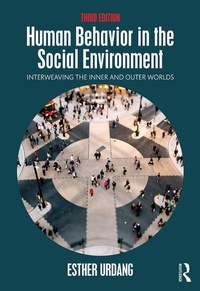
Human Behavior in the Social Environment
Interweaving the Inner and Outer Worlds
3rd Edition
Published on 5. October 2015
488 pages
978-1-317-69946-0 (ISBN)
Description

Human Behavior in the Social Environment: Interweaving the Inner and Outer Worlds is an essential human behavior textbook for social work students. The third edition emphasizes the biopsychosocial framework within a psychodynamic, developmental and life-course perspective and includes a brand new chapter on the psychosocial complexities of technological advances.
Written by an experienced classroom teacher, faculty advisor and clinician, the text approaches development through the life cycle, discussing the challenges, tasks, and problems of each stage. Presenting complex concepts in a clear and understandable way, Human Behavior in the Social Environment:
Includes 16 chapters which cover the diverse nature of the circumstances that practicing social workers will be exposed to, including cultural differences, mental health issues, and disability;
Analyses several different theories, including psychoanalytic, ego psychology, cognitive-behavioral, and postmodern theories in a manner that enables students to engage critically with the subject matter;
Includes case vignettes and material from literary works, biographies and newspapers, intertwined with learning exercises and suggestions for additional readings, forming an engaging and practical volume.
Written specifically for social work students undertaking courses and modules on human behavior in the social environment, this book is also a valuable resource for beginning and advanced readers in human services, including nursing, medicine, public health, clinical psychology and counseling.
Written by an experienced classroom teacher, faculty advisor and clinician, the text approaches development through the life cycle, discussing the challenges, tasks, and problems of each stage. Presenting complex concepts in a clear and understandable way, Human Behavior in the Social Environment:
Includes 16 chapters which cover the diverse nature of the circumstances that practicing social workers will be exposed to, including cultural differences, mental health issues, and disability;
Analyses several different theories, including psychoanalytic, ego psychology, cognitive-behavioral, and postmodern theories in a manner that enables students to engage critically with the subject matter;
Includes case vignettes and material from literary works, biographies and newspapers, intertwined with learning exercises and suggestions for additional readings, forming an engaging and practical volume.
Written specifically for social work students undertaking courses and modules on human behavior in the social environment, this book is also a valuable resource for beginning and advanced readers in human services, including nursing, medicine, public health, clinical psychology and counseling.
Reviews / Votes
Urdang has written a truly ecological text, dynamically describing the interrelations of outer and inner worlds - from cyberspace to neurobiology. This 3rd edition weaves current issues (e.g., immigration, bullying, social media, caregiving for those with mental illness and physical disabilities, expanded understandings of living as an older adult) into the core structure: a synthesis of psychodynamic and family theories with social system and sociocultural concepts. Developing a deep understanding of people's lived experiences is the heart of social work practice, yet often presents complex ambiguities and paradoxes. Urdang's clear discussion of theoretical ideas and frequent insertion of practice illustrations make this an engaging read that competently guides readers to such an understanding. Elizabeth King Keenan, PhD, Professor, Department of Social Work, Southern Connecticut State University, USAProfessor Urdang's book captures the many different theoretical and practical dimensions that face social work practice in our current world. Based in historical theoretical models that inform the understandng of individuals, families, groups and societies, as well as intervention approaches, Professor Urdang also integrates newer conceptual frameworks that enrich the traditional ones. Jack Wall, PhD, Director of the School of Social Work, San Jose State University, USA
This book presents a broad range of concepts that are relevant to the core knowledge of students who are preparing for careers in social work. Unlike many books on human behavior that have been published in recent years, this book includes a discussion of psychoanalytic and derivative theories, such as those focused on the ego and the self. That distinctive feature is responsive to the needs of students who are planning to become clinical social workers. Richard Mackey, Professor Emeritus, School of Social Work, Boston College
As a professor of social work I find it challenging to identify textbooks that adequately explain the complexities of human behavior across the biological. psychological, and social domains over the course of lifespan development. Esther Urdang's text is that book. In it she offers a deep. rich, and textured understanding of psychological development through the lenses of traditional psychoanalytic theory, ego psychology, object relations theory, self psychology, postmodernism, and cognitive theory. Suzanne Brown, PhD, LMSW, Assistant Professor, Wayne State University, excerpted from full review, AAPCSW Newsletter, Winter 2017.
More details
Edition
3rd edition
Language
English
Place of publication
London
United Kingdom
Publishing group
Taylor & Francis Ltd
Target group
College/higher education
Edition type
Revised edition
File size
2,15 MB
ISBN-13
978-1-317-69946-0 (9781317699460)
Copyright in bibliographic data and cover images is held by Nielsen Book Services Limited or by the publishers or by their respective licensors: all rights reserved.
Schweitzer Classification
Other editions
New editions
E-Book
07/2017
6th Edition
Routledge
€64.49
Available for download
Additional editions
Book
10/2015
3rd Edition
Routledge
€170.84
Shipment within 10-20 days
Book
10/2015
3rd Edition
Routledge
€255.50
Shipment within 10-20 days
Previous edition
E-Book
07/2019
2nd Edition
Routledge
€52.49
Available for download
Person
Esther Urdang has practiced for many years in mental health and family agencies, hospitals, and private practice. At Boston College Graduate School of Social Work, USA, for twenty-seven years, she taught clinical courses as Adjunct Associate Professor and was Assistant Director of Field Education. She was Research Thesis Advisor at Smith College School for Social Work, USA, for ten years. Her book, Parallels Between Writing Biographies and Clinical Practice, was recently published by NASW Press. Her published papers include "In Defense of Process Recording," "The Discipline of Faculty Advising," "The Video Lab: Mirroring Reflections of Self and the Other," "Becoming a Field Instructor: A Key Experience in Professional Development," and "Awareness of Self - a Critical Tool."
Content
Part 1: The Biopsychosocial Perspective 1. Overview 2. Psychoanalytic and Ego Psychology Theories 3. Object Relations, Self Psychology, and Cognitive-Behavioral Theories 4. Postmodern Theories: Constructivism, Relational Therapy, Narrative Therapy, and Resilience 5. Social Systems and the Community 6. Culture and Diversity 7. The Family: Forms and Organization 8. The Family: Internal Structures and Special Family Problems Part 2: The Life Cycle 9. Reproductive Issues, Infancy and Early Childhood Development 10. Middle Childhood and Adolescence 11. Adult Development Part 3: Special Issues 12. Life Transitions, Turning Points, Crises and Loss 13. Illness and Disability 14. Mental Health Problems 15. Psychosocial Complexities of Technological Advances Part 4: Integration 16. Conclusion
