

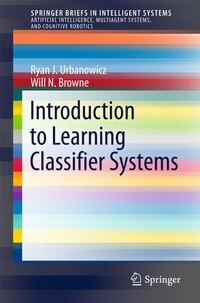
Introduction to Learning Classifier Systems
Description

This accessible introduction shows the reader how to understand, implement, adapt, and apply Learning Classifier Systems (LCSs) to interesting and difficult problems. The text builds an understanding from basic ideas and concepts. The authors first explore learning through environment interaction, and then walk through the components of LCS that form this rule-based evolutionary algorithm. The applicability and adaptability of these methods is highlighted by providing descriptions of common methodological alternatives for different components that are suited to different types of problems from data mining to autonomous robotics.
The authors have also paired exercises and a simple educational LCS (eLCS) algorithm (implemented in Python) with this book. It is suitable for courses or self-study by advanced undergraduate and postgraduate students in subjects such as Computer Science, Engineering, Bioinformatics, and Cybernetics, and by researchers, data analysts, andmachine learning practitioners.
Reviews / Votes
"Introduction to Learning Classifier Systems is an excellent textbook and introduction to Learning Classifier Systems. . The book is completed with Python code available through a link included in the book. . Urbanowicz and Browne recommend their book for undergraduate and postgraduate students, data analysts, and machine learning practitioners alike." (Analía Amandi, Genetic Programming and Evolvable Machines, Vol. 19 (4), December, 2018)More details
Other editions
Additional editions
Persons
Ryan Urbanowicz is a postdoctoral research associate in the Dept. of Biostatistics, Epidemiology, and Informatics in the Perelman School of Medicine at the University of Pennsylvania. He received his PhD in Genetics from Dartmouth College, and a B.S. and M.Eng. in Biological Engineering from Cornell University. His areas of research include bioinformatics, data mining, machine learning, evolutionary algorithms, learning classifier systems, data visualization, and epidemiology. He has cochaired the Intl. Workshop on Learning Classifier Systems and presented LCS tutorials at GECCO.
Will Browne is an Associate Professor in the School of Engineering and Computer Science of Victoria University of Wellington. He received his Eng.D. from Cardiff University. His main area of research is applied cognitive systems, in particular cognitive robotics, Learning Classifier Systems (LCSs), and modern heuristics for industrial application. He has cochaired the Intl. Workshop on Learning Classifier Systems, and chaired the Genetics-Based Machine Learning track and copresented the LCS tutorial at GECCO.
Content
