

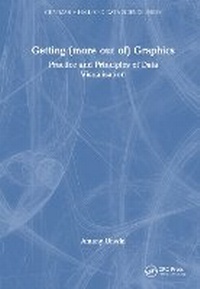
Getting (more out of) Graphics
Practice and Principles of Data Visualisation
1st Edition
Published on 13. September 2024
446 pages
978-1-040-03547-4 (ISBN)
Description

Data graphics are used extensively to present information. Understanding graphics is a lot about understanding the data represented by the graphics, having a feel not just for the numbers themselves, the reliability and uncertainty associated with them, but also for what they mean. This book presents a practical approach to data visualisation with real applications front and centre.
The first part of the book is a series of case studies, each describing a graphical analysis of a real dataset. The second part pulls together ideas from the case studies and provides an overview of the main factors affecting understanding graphics.
Key Features:
Explains how to get insights from graphics.
Emphasises the value of drawing many graphics.
Underlines the importance for analysis of background knowledge and context.
Readers may be data scientists, statisticians or people who want to become more visually literate. A knowledge of Statistics is not required, just an interest in data graphics and some experience of working with data. It will help if the reader knows something of basic graphic forms such as barcharts, histograms, and scatterplots.
The first part of the book is a series of case studies, each describing a graphical analysis of a real dataset. The second part pulls together ideas from the case studies and provides an overview of the main factors affecting understanding graphics.
Key Features:
Explains how to get insights from graphics.
Emphasises the value of drawing many graphics.
Underlines the importance for analysis of background knowledge and context.
Readers may be data scientists, statisticians or people who want to become more visually literate. A knowledge of Statistics is not required, just an interest in data graphics and some experience of working with data. It will help if the reader knows something of basic graphic forms such as barcharts, histograms, and scatterplots.
Reviews / Votes
"For both novice and experienced analysts, this book offers valuable insights into the interpretation and creation of effective data visualizations. It stands out for its emphasis on real-world complexity and data quality issues, making it particularly valuable for practitioners working with actual datasets rather than idealized examples."-McKenzie Lamb, in The UMAP Journal, June 2025
"The author approaches this book like a skilled sculptor rather than a traditional statistician. The data sets used are mostly observational, with no clear plan to analyze a priori. The author treats each data set like a fine marble, and he uses the graphics
as chisels to uncover the hidden patterns and gain insights. This book is more suitable for professionals working in the social
sciences and epidemiology. Statisticians working in real-world evidence (RWE) and meta-analyses may also find it helpful."
-Wei Zhao, in Pharmaceutical Statistics, February 2025
"I'm glad Unwin has taken the time to write this book and publish the code. It rewards the serious reader with skills that are not commonly covered in other textbooks."
-Kaiser Fung on https://junkcharts.typepad.com
"The book is wonderful in unique ways. It is not a graphics book but a statistics book, and I mean high praise by that. "Graphics" books can be great at art or clever at display, but this book teaches statistical reasoning, albeit with graphics. Most of the displays are familiar in form but wielded with new and insightful purpose."
-Stephen Stigler, University of Chicago
"Congratulations on the new book. It looks excellent - and just what is needed as we move more into the world of data science."
-David Hand, Imperial College
"In this substantial contribution to the field, Antony leads by examining a number of real datasets with specific questions in mind. Through this, the reader gets to understand how an experienced statistician approaches data visualisation. He then provides a description of the challenges associated with real data and more on the theory behind why certain choices are made during the process. I found the data sets used interesting in their own right. They are presented in such a way that a reader can take something out of each chapter separately and this work will be of use to practitioners whether they are new to visualisation or have many years experience."
-Cathal Walsh, Trinity College Dublin
"Books on visualization abound, even on statistical visualization, but there is always scope for something different. Antony Unwin's latest book stems from his long experience and deep expertise as a statistician with a major interest in graphical approaches. This isn't a book with over-simplified advice or trite examples or rants on what you should or should not do. Rather read and watch the master at work on a great variety of datasets, thinking aloud about what is needed and what works well -- and what not so well. And then be inspired to go back to your own projects with different ideas on what to try."
-Nick Cox, Durham University
"What a fabulous book, full of fascinating examples and sage advice. I enjoyed it immensely, and really appreciated the close attention to the data, the thoughtful explorations, and the interesting insights."
-Rob Hyndman, Monash University
More details
Series
Edition
1. Auflage
Language
English
Place of publication
London
United Kingdom
Publishing group
Taylor & Francis Ltd
Target group
Professional and scholarly
Illustrations
319 Line drawings, color; 34 Line drawings, black and white; 319 Illustrations, color; 34 Illustrations, black and white
ISBN-13
978-1-040-03547-4 (9781040035474)
Copyright in bibliographic data and cover images is held by Nielsen Book Services Limited or by the publishers or by their respective licensors: all rights reserved.
Schweitzer Classification
Other editions
Additional editions
Book
09/2024
1st Edition
Chapman & Hall/CRC
€228.30
Shipment within 15-20 days
Book
09/2024
1st Edition
Chapman & Hall/CRC
€116.10
Shipment within 15-20 days
Person
Antony Unwin was the first Professor of Computer-oriented Statistics and Data Analysis at the University of Augsburg in Germany. He is a fellow of the American Statistical Society, author of Graphical Data Analysis with R, co-author of Graphics of Large Datasets, and co-editor of the Handbook of Data Visualization.
Content
Preface
1. Introduction
Part 1: Graphics in Action
2. Graphics and Gapminder
3. Looking at the movies
4. Voting 46 times to choose a Presidential candidate
5. Measuring the speed of light
6. The modern Olympic Games in numbers
7. Re-viewing Bertin's main example
8. Comparing chess players across the board
9. Results from surveys on gay rights
10. Who went up in space for how long?
11. Data in the sky at night
12. Psoriasis and the Quality of Life
13. Charging electric cars
14. Darwin's Finches
15. Home or away: where do soccer players play?
16. Watching soccer-the English leagues
17. Fuel efficiency of cars in the USA
18. Differences amongst the Palmer penguins
19. Comparing tests for malaria
20. Are swimmers swimming faster?
21. Over 90 years running 90 km
22. Comparing software for facial recognition
23. Distinguishing shearwaters
24. When do road accidents with deer happen in Bavaria?
25. The Titanic Disaster
26. German Election 2021-what happened?
Part 2: Advice on Graphics
27. Provenance and quality
28. Wrangling
29. Colour
30. Setting the scene
31. Ordering, sorting, and arranging
32. What affects interpretation?
33. Varieties of plots, developing plots
34. Conclusions and recommendations
References
1. Introduction
Part 1: Graphics in Action
2. Graphics and Gapminder
3. Looking at the movies
4. Voting 46 times to choose a Presidential candidate
5. Measuring the speed of light
6. The modern Olympic Games in numbers
7. Re-viewing Bertin's main example
8. Comparing chess players across the board
9. Results from surveys on gay rights
10. Who went up in space for how long?
11. Data in the sky at night
12. Psoriasis and the Quality of Life
13. Charging electric cars
14. Darwin's Finches
15. Home or away: where do soccer players play?
16. Watching soccer-the English leagues
17. Fuel efficiency of cars in the USA
18. Differences amongst the Palmer penguins
19. Comparing tests for malaria
20. Are swimmers swimming faster?
21. Over 90 years running 90 km
22. Comparing software for facial recognition
23. Distinguishing shearwaters
24. When do road accidents with deer happen in Bavaria?
25. The Titanic Disaster
26. German Election 2021-what happened?
Part 2: Advice on Graphics
27. Provenance and quality
28. Wrangling
29. Colour
30. Setting the scene
31. Ordering, sorting, and arranging
32. What affects interpretation?
33. Varieties of plots, developing plots
34. Conclusions and recommendations
References
