

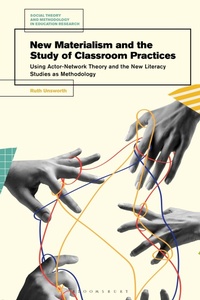
New Materialism and the Study of Classroom Practices
Using Actor-Network Theory and the New Literacy Studies as Methodology
1st Edition
Published on 19. March 2026
266 pages
978-1-350-52099-8 (ISBN)
Description

This book illustrates the application of socio-materialist theory to educational research contexts focused on the study of classroom practices.
It explores the methodological opportunities, challenges and tensions the researcher faces in designing, conducting and analysing socio-materialist education research. Ruth Unsworth draws together two theoretical perspectives, actor-network theory (ANT) and the (new) literacy studies (LS), to offer a socio-material 'way in' to studying the complexity and dynamism of classroom practices. Drawing on an ethnographic study of teachers' classroom practices in an English primary school, the author offers advice around research design, collecting and analysing data and the writing of ANT-LS accounts. This book contributes to the field of education research offering an in-depth exploration of the challenges and opportunities of social theory application, examining critical epistemological, practical and analytical aspects of socio-materialist theory as method.
It explores the methodological opportunities, challenges and tensions the researcher faces in designing, conducting and analysing socio-materialist education research. Ruth Unsworth draws together two theoretical perspectives, actor-network theory (ANT) and the (new) literacy studies (LS), to offer a socio-material 'way in' to studying the complexity and dynamism of classroom practices. Drawing on an ethnographic study of teachers' classroom practices in an English primary school, the author offers advice around research design, collecting and analysing data and the writing of ANT-LS accounts. This book contributes to the field of education research offering an in-depth exploration of the challenges and opportunities of social theory application, examining critical epistemological, practical and analytical aspects of socio-materialist theory as method.
More details
Series
Edition
1. Auflage
Language
English
Place of publication
London
United Kingdom
Publishing group
Bloomsbury Publishing PLC
Target group
Professional and scholarly
Illustrations
10 bw illus
ISBN-13
978-1-350-52099-8 (9781350520998)
Copyright in bibliographic data and cover images is held by Nielsen Book Services Limited or by the publishers or by their respective licensors: all rights reserved.
Schweitzer Classification
Other editions
Additional editions
Ruth Unsworth
New Materialism and the Study of Classroom Practices
Using Actor-Network Theory and the New Literacy Studies as Methodology
Book
approx. 04/2026
Bloomsbury Academic
€123.30
Not yet published
Person
Ruth Unsworth is Lecturer in Education Studies at the University of Glasgow, Scotland.
Content
Series Editor's Introduction
Introduction: Classroom Practices in England as a Dynamic and Complex Research Context
Part I: Research Design
1. A Socio-Materialist Perspective: Classroom Practices as an Actor-Network
2. ANT-LS as a Unified Framework: Epistemological Opportunities and Challenges
3. Designing an ANT-LS study: Methodological Concerns In Research Design (Planning, Doing, Writing And Theorising)
4. Collecting and Analysing Data in an ANT-LS Account
Part II: ANT-LS in Practice: Examples From Fieldwork
5. Unblackboxing the Influence of Digital Technologies with ANT-LS
6. Exploring Policy-Based Reform of Classroom Practices Using ANT-LS
7. Tracing Power and Agency Through Network Literacy Practices
Part III: Fieldwork Reflections
8. Socio-Materialist Theory As Method: Reflections From The Field
Conclusion
References
Index
Introduction: Classroom Practices in England as a Dynamic and Complex Research Context
Part I: Research Design
1. A Socio-Materialist Perspective: Classroom Practices as an Actor-Network
2. ANT-LS as a Unified Framework: Epistemological Opportunities and Challenges
3. Designing an ANT-LS study: Methodological Concerns In Research Design (Planning, Doing, Writing And Theorising)
4. Collecting and Analysing Data in an ANT-LS Account
Part II: ANT-LS in Practice: Examples From Fieldwork
5. Unblackboxing the Influence of Digital Technologies with ANT-LS
6. Exploring Policy-Based Reform of Classroom Practices Using ANT-LS
7. Tracing Power and Agency Through Network Literacy Practices
Part III: Fieldwork Reflections
8. Socio-Materialist Theory As Method: Reflections From The Field
Conclusion
References
Index
