

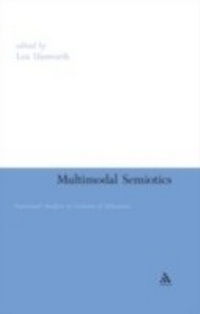
Multimodal Semiotics
Functional Analysis in Contexts of Education
1st Edition
Published on 7. November 2008
270 pages
978-1-4411-0375-8 (ISBN)
Description

This volume presents an overview of new developments and applications of social semiotic theory. Pioneered by M.A.K. Halliday, social semiotic theory sees meaning as created through the interaction of texts (including writing, images, sound and space) within a given context. Divided into five sections, the contributors use social semiotic theory to analyse a range of contexts, including the classroom, the museum and cinema. The case studies show the range and scope of this method of analysis, and include: the school curriculum; literacy; print media; online resources; film; and advertising.
Multimodal Semiotics will be of interest to academics researching social semiotic theory, systemic functional linguistics and applied linguistics.
Multimodal Semiotics will be of interest to academics researching social semiotic theory, systemic functional linguistics and applied linguistics.
Reviews / Votes
"Our research in linguistics is currently facing a challenge of developing effective tools for analysing ever varying modes of communication in our global societies. Multimodal Semiotics further enhances the traditional systemic-functional ways of studying discourses in contexts. It shows how we can pursue full accounts of meaning-making by taking into consideration the new ways that recent technologies enable us to combine resources and modes of communication in three dimensional social spaces, in film, in discourses of news and public media and in educational contexts. The articles in this volume are inspiring and thought-provoking for all readers interested in enhancing their knowledge in the interrelatedness of linguistics, multimodality and semiotics. The book offers a highly recommendable reading experience." - Professor Eija Ventola, Department of English, University of Helsinki, Finland. Briefly reviewed in the Year's work in English Studies journal, vol 89, No. 1 'A collection of essays that extends the application of systematic functional principles to semiotics systems other than language with an added underlying concern for pedagogical issues'More details
Edition
1. Auflage
Language
English
Place of publication
New York
United States
Target group
Professional and scholarly
ISBN-13
978-1-4411-0375-8 (9781441103758)
Copyright in bibliographic data and cover images is held by Nielsen Book Services Limited or by the publishers or by their respective licensors: all rights reserved.
Schweitzer Classification
Other editions
Additional editions
Book
12/2011
Continuum Publishing Corporation
€56.30
Shipment within 15-20 days
Book
11/2008
Continuum International Publishing Group Ltd.
€231.80
Shipment within 15-20 days
Person
Len Unsworth is Professor in English and Literacies Education at the University of New England in Armidale, Australia.
Content
Contents
Introduction
1. Multimodal semiotic analyses and education, Len Unsworth (University of New England, Australia)
Part I: Semiotics and 3D Space
2. Analysing space, Louise Ravelli (University of New South Wales, Australia)
3. The discursive construction of social space, Theo Van Leeuwen (University of Technology, Sydney, Australia)
4. Interpersonal meaning in 3D space: How a Bonding icon gets its 'charge', Maree Stenglin (University of Sydney, Australia)
5. The interplay of discourse, place and space in pedagogic relations, Pauline Jones (University of Wollongong, Australia)
Part II: Semiotics in Film
6. Cohesive harmony in filmic text, Chiaoi Tseng (University of Bremen, Germany)
7. Metafunctional analyses of sound in film communication, Betty Pun (University of New South Wales, Australia)
Part III: Semiotics in News and Public Media
8. Intermodal relations in image nuclear news stories, Helen Caple (University of Sydney, Australia)
9. Online newspapers and TESOL classrooms: A multimodal perspective, John Knox (Macquarie University, Australia)
10. Symbolic constructions in global public visuals: A Pedagogic Framework for Critical Visual Literacy, Jan Connelly (University of New England, Armidale, Australia)
Part IV: Semiotics in School Curricula
11. Literacy across the school subjects: A multimodal approach, Kristina Love (University of Melbourne, Australia)
12. Time visuals in history text books: some pedagogic issues (Beverly Derewianka (University of Wollongong, Australia) and Caroline Coffin (The Open University, UK)
13. Multimodal representation of educational meanings in Montessori pedagogy, Susan Feez (University of New England, Australia)
14. Children's website structure and navigation, Emilia Djonov (Macquarie University, Australia)
15. Metaphor in art education products, Ulla Oksanen (University of Helsinki, Finland)
Introduction
1. Multimodal semiotic analyses and education, Len Unsworth (University of New England, Australia)
Part I: Semiotics and 3D Space
2. Analysing space, Louise Ravelli (University of New South Wales, Australia)
3. The discursive construction of social space, Theo Van Leeuwen (University of Technology, Sydney, Australia)
4. Interpersonal meaning in 3D space: How a Bonding icon gets its 'charge', Maree Stenglin (University of Sydney, Australia)
5. The interplay of discourse, place and space in pedagogic relations, Pauline Jones (University of Wollongong, Australia)
Part II: Semiotics in Film
6. Cohesive harmony in filmic text, Chiaoi Tseng (University of Bremen, Germany)
7. Metafunctional analyses of sound in film communication, Betty Pun (University of New South Wales, Australia)
Part III: Semiotics in News and Public Media
8. Intermodal relations in image nuclear news stories, Helen Caple (University of Sydney, Australia)
9. Online newspapers and TESOL classrooms: A multimodal perspective, John Knox (Macquarie University, Australia)
10. Symbolic constructions in global public visuals: A Pedagogic Framework for Critical Visual Literacy, Jan Connelly (University of New England, Armidale, Australia)
Part IV: Semiotics in School Curricula
11. Literacy across the school subjects: A multimodal approach, Kristina Love (University of Melbourne, Australia)
12. Time visuals in history text books: some pedagogic issues (Beverly Derewianka (University of Wollongong, Australia) and Caroline Coffin (The Open University, UK)
13. Multimodal representation of educational meanings in Montessori pedagogy, Susan Feez (University of New England, Australia)
14. Children's website structure and navigation, Emilia Djonov (Macquarie University, Australia)
15. Metaphor in art education products, Ulla Oksanen (University of Helsinki, Finland)
