

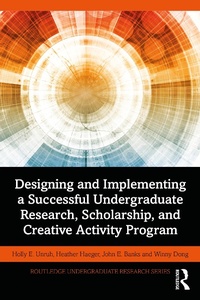
Designing and Implementing a Successful Undergraduate Research, Scholarship and Creative Activity Program
1st Edition
Published on 6. September 2024
190 pages
978-1-040-12333-1 (ISBN)
Description

Designing and Implementing a Successful Undergraduate Research, Scholarship and Creative Activity Program is designed as a resource for faculty, administrators, and university leaders interested in developing new, or expanding existing, undergraduate research programs. The book provides a practical handbook addressing the many "how to" questions associated with running a successful undergraduate research enterprise - ranging from how to organize an undergraduate research office, to how to find funding, foster cross-campus relationships, and develop learning outcomes for students in order to maximize the benefits of the research experience. It also addresses best practices in mentoring, how faculty mentorship fits within the discussion of tenure and promotion, and the basics of assessment, for both funder reporting and program improvement.
Containing a series of vignettes offering specific advice from program directors, faculty mentors, and university administrators from a diverse array of universities and colleges, this book showcases their hands-on tips, advice, and lessons learned. Addressing key issues through real-world experience, the authors show how to build effective cross-disciplinary undergraduate research programs with positive impacts for students and faculty.
Containing a series of vignettes offering specific advice from program directors, faculty mentors, and university administrators from a diverse array of universities and colleges, this book showcases their hands-on tips, advice, and lessons learned. Addressing key issues through real-world experience, the authors show how to build effective cross-disciplinary undergraduate research programs with positive impacts for students and faculty.
More details
Series
Edition
1. Auflage
Language
English
Place of publication
London
United Kingdom
Publishing group
Taylor & Francis Ltd
Target group
Professional and scholarly
Illustrations
3 Line drawings, black and white; 16 Halftones, black and white; 19 Illustrations, black and white
ISBN-13
978-1-040-12333-1 (9781040123331)
Copyright in bibliographic data and cover images is held by Nielsen Book Services Limited or by the publishers or by their respective licensors: all rights reserved.
Schweitzer Classification
Other editions
Additional editions
Holly Unruh | Heather Haeger | John Banks
Designing and Implementing a Successful Undergraduate Research, Scholarship and Creative Activity Program
Book
09/2024
1st Edition
Routledge
€50.80
Shipment within 15-20 days
Holly Unruh | Heather Haeger | John Banks
Designing and Implementing a Successful Undergraduate Research, Scholarship and Creative Activity Program
Book
09/2024
1st Edition
Routledge
€185.80
Shipment within 15-20 days

Holly Elizabeth Unruh
Designing and Implementing a Successful Undergraduate Research, Scholarship and Creative Activity Program
Book
09/2024
Taylor & Francis
Unfortunately, price unknown
Available (delivery time upon request)
Persons
Dr. Holly E. Unruh is Executive Director of the Arts Research Institute at the University of California, Santa Cruz. She previously served as Associate Director of the Undergraduate Research Opportunities Center at California State University, Monterey Bay.
Dr. Heather Haeger is Research Director of the STEM Learning Center at the University of Arizona, and Assistant Professor of Educational Policy Studies and Practice. She served as the inaugural Assessment and Research Coordinator for the Council on Undergraduate Research from 2016 to 2020.
Dr. John E. Banks is Director of the Undergraduate Research Opportunities Center at California State University, Monterey Bay.
Dr. Winny Dong is Faculty Director of the Office of Undergraduate Research at Cal Poly Pomona and Professor of Chemical and Materials Engineering.
Dr. Heather Haeger is Research Director of the STEM Learning Center at the University of Arizona, and Assistant Professor of Educational Policy Studies and Practice. She served as the inaugural Assessment and Research Coordinator for the Council on Undergraduate Research from 2016 to 2020.
Dr. John E. Banks is Director of the Undergraduate Research Opportunities Center at California State University, Monterey Bay.
Dr. Winny Dong is Faculty Director of the Office of Undergraduate Research at Cal Poly Pomona and Professor of Chemical and Materials Engineering.
Content
Acknowledgements
Notes on Contributors
Series Foreword
Jenny Olin Shanahan, Bridgewater State University
Gregory Young, Montana State University
Foreword to the volume
Ken O'Donnell, Vice Provost, California State University Dominguez Hills
Editor-in-Chief, Experiential Learning and Teaching in Higher Education
Chapter 1: The importance of undergraduate research, scholarship and creative activity
Chapter 2: So you want to start an undergraduate research office?
Chapter 3: Staffing and office structure
Chapter 4: Ready, set, go! Goals for the first year
Chapter 5: Finding funding to support students, mentors and your programmatic needs
Chapter 6: Beyond the lab/studio/archive: professional development support for student researchers from across the disciplines
Chapter 7: Facilitating the mentor/mentee relationship
Chapter 8: Top down, bottom up: Tenure, promotion, and other faculty and mentor support strategies
Chapter 9: Navigating institutional bureaucracy: risk management, research supplies, travel, and other administrative concerns
Chapter 10: Getting the word out to students
Chapter 11: Assessment and educational research
Chapter 12: Scaling up access and reducing barriers to undergraduate research: course-based undergraduate research experiences and faculty mentor development
Chapter 13: Intersecting impact: aligning meaning-making for undergraduate researchers
Chapter 14: Resources to Engage in the Community of URSCA Scholars and Practitioners
Bibliography and Additional Readings
Index
Notes on Contributors
Series Foreword
Jenny Olin Shanahan, Bridgewater State University
Gregory Young, Montana State University
Foreword to the volume
Ken O'Donnell, Vice Provost, California State University Dominguez Hills
Editor-in-Chief, Experiential Learning and Teaching in Higher Education
Chapter 1: The importance of undergraduate research, scholarship and creative activity
Chapter 2: So you want to start an undergraduate research office?
Chapter 3: Staffing and office structure
Chapter 4: Ready, set, go! Goals for the first year
Chapter 5: Finding funding to support students, mentors and your programmatic needs
Chapter 6: Beyond the lab/studio/archive: professional development support for student researchers from across the disciplines
Chapter 7: Facilitating the mentor/mentee relationship
Chapter 8: Top down, bottom up: Tenure, promotion, and other faculty and mentor support strategies
Chapter 9: Navigating institutional bureaucracy: risk management, research supplies, travel, and other administrative concerns
Chapter 10: Getting the word out to students
Chapter 11: Assessment and educational research
Chapter 12: Scaling up access and reducing barriers to undergraduate research: course-based undergraduate research experiences and faculty mentor development
Chapter 13: Intersecting impact: aligning meaning-making for undergraduate researchers
Chapter 14: Resources to Engage in the Community of URSCA Scholars and Practitioners
Bibliography and Additional Readings
Index
