

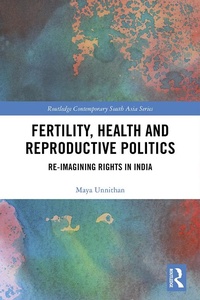
Fertility, Health and Reproductive Politics
Re-imagining Rights in India
1st Edition
Published on 5. April 2019
248 pages
978-0-429-87877-0 (ISBN)
Description

Set in the context of the processes and practices of human reproduction and reproductive health in Northern India, this book examines the institutional exercise of power by the state, caste and kin groups.
Drawing on ethnographic research over the past eighteen years among poor Hindu and Muslim communities in Rajasthan and among development and health actors in the state, this book contributes to developing analytic perspectives on reproductive practice, agency and the body-self as particular and novel sites of a vital power and politic. Rajasthan has been among the poorest states in the country with high levels of maternal and infant mortality and morbidity. The author closely examines how social and economic inequalities are produced and sustained in discursive and on the ground contexts of family-making, how authoritative knowledge and power in the domain of childbirth is exercised across a landscape of development institutions, how maternal health becomes a category of citizenship, how health-seeking is socially and emotionally determined and political in nature, how the health sector operates as a biopolitical system, and how diverse moral claims over the fertile, infertile and reproductive body-self are asserted, contested and often realised.
A compelling analysis, this book offers both new empirical data and new theoretical insights. It draws together the practices, experiences and discourse on fertility and reproduction (childbirth, infertility, loss) in Northern India into an overarching analytical framework on power and gender politics. It will be of interest to academics in the fields of medical anthropology, medical sociology, public health, gender studies, human rights and sociolegal studies, and South Asian studies.
Drawing on ethnographic research over the past eighteen years among poor Hindu and Muslim communities in Rajasthan and among development and health actors in the state, this book contributes to developing analytic perspectives on reproductive practice, agency and the body-self as particular and novel sites of a vital power and politic. Rajasthan has been among the poorest states in the country with high levels of maternal and infant mortality and morbidity. The author closely examines how social and economic inequalities are produced and sustained in discursive and on the ground contexts of family-making, how authoritative knowledge and power in the domain of childbirth is exercised across a landscape of development institutions, how maternal health becomes a category of citizenship, how health-seeking is socially and emotionally determined and political in nature, how the health sector operates as a biopolitical system, and how diverse moral claims over the fertile, infertile and reproductive body-self are asserted, contested and often realised.
A compelling analysis, this book offers both new empirical data and new theoretical insights. It draws together the practices, experiences and discourse on fertility and reproduction (childbirth, infertility, loss) in Northern India into an overarching analytical framework on power and gender politics. It will be of interest to academics in the fields of medical anthropology, medical sociology, public health, gender studies, human rights and sociolegal studies, and South Asian studies.
Reviews / Votes
"The scholarship that the manuscript imbibes is outstanding. It engages with critical debates in the field of citizenship, rights, social justice, equality, modernity and the state from a bottom-up approach... Drawing on ethnographic material from North India...it offers both new empirical data and new theoretical insights." - Jeevan R. Sharma, University of Edinburgh, UK"This rich and nuanced book draws upon a long ethnographic engagement in North India to skilfully situate finely observed accounts of women's reproductive experiences within a wider field of development and state agencies, power and politics. It constitutes a powerful and unique empirical and theoretical contribution - of relevance to medical anthropology but speaking also to vital debates in public health and development practice about framings, evidence and social justice." - Hayley MacGregor, Institute for Development Studies, UK "The scholarship that the manuscript imbibes is outstanding. It engages with critical debates in the field of citizenship, rights, social justice, equality, modernity and the state from a bottom-up approach... Drawing on ethnographic material from North India...it offers both new empirical data and new theoretical insights." - Jeevan R. Sharma, University of Edinburgh, UK
"This rich and nuanced book draws upon a long ethnographic engagement in North India to skilfully situate finely observed accounts of women's reproductive experiences within a wider field of development and state agencies, power and politics. It constitutes a powerful and unique empirical and theoretical contribution - of relevance to medical anthropology but speaking also to vital debates in public health and development practice about framings, evidence and social justice." - Hayley MacGregor, Institute for Development Studies, UK
More details
Series
Edition
1. Auflage
Language
English
Place of publication
London
United Kingdom
Publishing group
Taylor & Francis Ltd
Target group
College/higher education
Illustrations
7 Halftones, black and white; 9 Illustrations, black and white
File size
6,28 MB
ISBN-13
978-0-429-87877-0 (9780429878770)
Copyright in bibliographic data and cover images is held by Nielsen Book Services Limited or by the publishers or by their respective licensors: all rights reserved.
Schweitzer Classification
Other editions
Additional editions
Book
03/2021
1st Edition
Routledge
€65.40
Shipment within 15-20 days
Book
04/2019
1st Edition
Routledge
€205.60
Shipment within 10-20 days
Person
Maya Unnithan is Professor of Social and Medical Anthropology and Director of the Centre for Cultures of Reproduction, Technologies and Health (CORTH) in the School of Global Studies, University of Sussex, UK.
Content
Chapter 1. Fertile subjects: Global reproductive politics at the intersections of caste, class and gender, Chapter 2. State empowerment and reproductive control, Chapter 3. Infertility and other reproductive anxieties: An ontological challenge to 'reproductive health' and 'rights', Chapter 4. Sex selective abortion and reproductive morality: Technology and the discourse on rights, Chapter 5. Maternal risk and its mediation: Learning from health-worker vulnerabilities, Chapter 6. Altruism and the politics of legislating reproductive labour: Why surrogacy matters, Chapter 7. Making Rights Real: Legal activism and social responsibility, Chapter 8. Re-imagining rights: Reproductive politics and the quest for justice
