


Understanding Research for Social Policy and Social Work
Themes, Methods and Approaches
1st Edition
Published on 14. March 2012
448 pages
978-1-4473-1453-0 (ISBN)
Description

It is vital for students, policy makers and practitioners engaged in social policy, social work and other related academic disciplines and fields of practice to understand the importance of research and how to interpret research evidence and findings. They also need to know how to effectively carry out and report good quality research of their own. This thoroughly revised and expanded second edition of the acclaimed international best-seller will enable readers to meet all these challenges. Comprehensive in scope, and written expertly by 80 leading contributors in an accessible and engaging style, this landmark book from The Policy Press' Understanding Welfare series includes dozens of new sections which highlight developments since the first edition. It also combines theoretical and applied discussions and case examples to provide the essential one-stop guide to research methods, approaches and debates. The book is essential reading for students and teachers of social policy, social work, public policy, criminology, nursing and health sciences, education and other applied social sciences, policy makers and practitioners who would like to improve their use of research evidence, and those who want to conduct high quality research of their own.
More details
Other editions
Additional editions
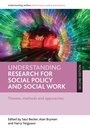
Saul Becker | Alan Bryman | Harry Ferguson
Understanding Research for Social Policy and Social Work
Themes, Methods and Approaches
Book
03/2012
2nd Edition
Policy Press
€46.80
Shipment within 15-20 days
Saul Becker | Alan Bryman | Harry Ferguson
Understanding Research for Social Policy and Social Work (Second Edition)
Themes, Methods and Approaches
E-Book
03/2012
1st Edition
Policy Press
€52.49
Available for download
Content
- Intro
- UNDERSTANDING RESEARCH FOR SOCIAL POLICY AND SOCIAL WORK
- Contents
- List of contributors
- Acknowledgements
- Introduction
- Audiences
- Aims
- Structure
- Special features
- 1. Research for social policy and social work
- What is social policy?
- Policy, implementation and practice
- What is social work?
- Debates in social work
- What is policy?
- What is research?
- Methods and approaches in policy research
- Attributes of 'good' policy research
- 'Evidence'
- 'Ways of knowing' and knowledge
- Evidence, 'proof' and the provisional nature of knowledge
- From a 'hierarchy' to a 'continuum' of evidence
- 'Evidence-based everything'?
- Research and policy making
- Research and professional practice
- The impact of research on policy and practice
- Limits to evidence-based policy and practice
- A dynamic research process
- A model of the research cycle
- Stages of the research cycle
- 2. Ethical conduct and research practice
- Being systematic
- Respect
- Protection
- Public and professional responsibility
- Honesty
- Developing ethical competence
- Who are the vulnerable?
- Accessibility to vulnerable groups
- Reciprocity and respect for the participants
- Compensation and incentive: a form of respect
- Moral concerns
- 3. Formulating research ideas and questions
- Research topics, issues and questions
- Why conduct a literature review?
- Evaluating sources for a literature review
- Writing the literature review
- 4. Methodological issues and approaches
- Defining the research problem
- Choosing cases
- Data collection and analysis
- What is secondary analysis?
- Advantages and disadvantages of doing secondary analysis
- Methods for conducting reviews of research evidence
- Conducting a synthesis
- An overview of the evidence review process
- Approaches to synthesis in diverse evidence reviews
- Conclusion
- Where are data archived?
- Preparing data for archiving
- Accessing and using data
- 5. Quantitative research
- Quality criteria in quantitative research
- Experimental design
- Cross-sectional design
- Longitudinal design
- Case study
- Why sample?
- Probability sampling
- Sample designs
- Non-probability sampling
- Interviewer-mediated surveys
- Self-completion methods
- Identifying the information you want to collect
- Question design
- Different types of question
- Question wording
- Sensitive questions
- Question order and context
- Question filtering
- Pre-testing
- Data collection
- Data preparation
- Web surveys
- Internet samples
- Problems with internet samples
- Setting up a web survey
- Sampling
- What to count?
- Qualifying criteria
- Coding
- Analysis
- New directions: 'Push Button' content analysis
- Conclusion
- International statistics
- Qualitative and quantitative variables
- Descriptive statistics
- Correlation
- Tests of statistical significance
- Computer analysis
- 6. Qualitative research
- Quality criteria in qualitative research
- Empirical research on qualitative telephone interviews
- Conclusion
- When are focus groups appropriate?
- Conducting focus groups
- Analysis of focus groups
- New ways of using focus groups
- Conclusion
- Narrative methods
- Oral history
- Biographical interpretive method
- Historical documents
- Contemporary documents
- Grounded theory
- Other analytic approaches
- Computer-assisted qualitative data analysis
- 7. Dissemination, knowledge transfer and making an impact
- Defining dissemination, knowledge transfer and impact
- Locating dissemination and knowledge transfer in the research cycle
- Guidance for writing up research
- Organising research writing
- Flow and comprehension
- Writing style
- Adoption, utilisation and change
- Glossary
- Index
