

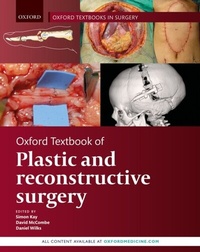
Oxford Textbook of Plastic and Reconstructive Surgery
1st Edition
Published on 11. August 2021
1500 pages
978-0-19-150538-6 (ISBN)
Description

The Oxford Textbook of Plastic and Reconstructive Surgery is a comprehensive reference text detailing all aspects of plastic surgery pertinent to a surgeon in training for specialisation and suitable to use in preparation for the Intercollegiate Examination as all aspects of the curriculum are covered. It is part of the Oxford Textbooks in Surgery series, edited by Professor Sir Peter Morris. This volume is also the perfect resource for practicing plastic surgeons, summarising contemporary trial knowledge as well as discussing anatomy, examination and techniques. Chapters are divided into those that detail basic principles and technique, and those that, on a regional basis, describe the conditions and their treatments that form the wide spectrum of reconstructive and aesthetic plastic surgery. The book is split into 13 comprehensive sections, these include General Principles, Burns, Nerve, Limbs, Facial Trauma, Cosmetic surgery, and Ethics among other key areas in the field. This highly illustrated full colour textbook has an innovative and user-friendly style, including over 1000 photographs, clinical images, and line drawings. Bringing together the expertise of almost 200 specialist contributors in the field, the Oxford Textbook of Plastic and Reconstructive Surgery is a highly valuable source of information.
More details
Other editions
Additional editions
Simon Kay | David McCombe | Daniel Wilks
Oxford Textbook of Plastic and Reconstructive Surgery
Book
08/2021
Oxford University Press
€500.50
Article exhausted; check different version
Content
- cover
- Series
- Oxford Textbook of Plastic and Reconstructive Surgery
- Copyright
- Contents
- Section editors
- Contributors
- Symbols and abbreviations
- Section 1 General principles and techniques
- 1.1 General principles and techniques
- 1.2 Tissue healing
- 1.3 Infections
- 1.4 Structure and function of the skin
- 1.5 Vascular anatomy
- 1.6 Anaesthesia
- 1.7 Skin grafts
- 1.8 Skin flaps
- 1.9 Microsurgery
- 1.10 Benign skin conditions and tumours
- 1.11 Non-?melanoma skin cancer and premalignant conditions
- 1.12 Pigmented lesions and melanoma including premalignant conditions
- 1.13 Wound dressings
- 1.14 Sarcoma
- 1.15 Vascularized composite allotransplantation
- Section 2 Burns surgery
- 2.1 Mechanisms of burn injury: thermal, chemical, electrical, and radiation
- 2.2 The burned patient: physiology and pathology
- 2.3 Adult thermal burns
- 2.4 The burnt child
- 2.5 Electrical injury and burns and their management
- 2.6 Chemical burns
- 2.7 Cold-?induced injury to the skin and deep tissues
- 2.8 Radiation injury to the skin and deep tissues
- Section 3 Nerve surgery
- 3.1 Surgical anatomy and physiology of the intact peripheral nervous system including cranial nerves
- 3.1.1 Macroscopic and microscopic anatomy of the peripheral nervous system
- 3.1.2 Blood supply of the peripheral nerve
- 3.1.3 The Schwann cell
- 3.1.4 Physiological requirements for action potential conduction, sensory awareness, and motor control
- 3.1.5 Tactile sensory control of the human hand
- 3.2 Neurobiology of injury (compression, traction, laceration) and repair, and grading of injuries
- 3.3 Clinical features of nerve injuries and their diagnosis
- 3.3.1 Clinicopathological correlates with theoretical grades
- 3.3.2 Tinel-?Hoffman sign
- 3.3.3 Neurophysiological assessments for peripheral nerve injury
- 3.3.4 Adult brachial plexus injury
- 3.3.5 Brachial plexus injury in the child
- 3.4 Surgical management of the divided nerve and nerve grafts and transfers
- 3.4.1 Surgical management of the divided nerve
- 3.4.2 Nerve grafts and transfers
- 3.5 Hand therapy after peripheral nerve injury
- 3.6 Chronic postsurgical pain and complex regional pain syndrome
- 3.7 Compression or mechanical neuropathy
- 3.7.1 Pathophysiology
- 3.7.2 Compression neuropathies
- 3.7.3 Thoracic outlet syndrome
- 3.8 Mass lesions of the peripheral nervous system
- Section 4 Upper limb
- 4.1 Clinical assessment and imaging of the upper limb
- 4.2 Anthropological, behavioural, and cultural characteristics of the human hand
- 4.3 Applied biomechanics of the hand, wrist, and forearm
- 4.4 Soft tissue infections of the hand and upper limb
- 4.5 Dupuytren's disease
- 4.6 Soft tissue reconstruction of the hand
- 4.7 Microsurgical reconstruction of the upper limb
- 4.8 Hand therapy, rehabilitation, and rehabilitation following tendon injury
- 4.9 Amputations
- 4.10 Fractures of the hand and wrist
- 4.11 Ligamentous injuries of the hand and wrist
- 4.12 Osteoarthritis of the wrist and hand
- 4.13 Soft tissue inflammatory disorders of the hand
- 4.14 Inflammatory arthritis of the hand and wrist
- 4.15 The flexor tendons
- 4.16 The extensor tendons
- 4.17 Tendon transfers in the hand and wrist
- 4.18 Reanimation in the upper limb: free functioning and pedicled muscle transfer
- 4.19 Pain syndromes
- 4.20 Embryology of the upper limb
- 4.21 Management of children's hand disorders
- 4.22 Traumatic injury to the child's hand
- 4.23 Upper limb spasticity
- 4.24 Soft tissue swellings of the hand and upper limb
- 4.25 Bone lesions in the upper limb and hand
- 4.26 Systemic disorders reflected in the hand
- Section 5 Lower limb
- 5.1 Classification of lower limb trauma
- 5.2 Principles of acute management of lower limb trauma
- 5.3 The devascularized limb
- 5.4 Management of soft tissue loss without microsurgery
- 5.5 Microvascular cover in the lower limb: indications and timing, flap types, and technique
- 5.6 Management of bone loss
- 5.7 Lower limb replantation
- 5.8 Amputations in the lower limb
- 5.9 Lower limb trauma outcome measures: limb salvage and amputation
- 5.10 Lower limb osteomyelitis
- 5.11 Management of congenital limb deficiency
- 5.12 Orthopaedic management of congenital pseudarthrosis of the tibia
- 5.13 How the foot and ankle works (mechanics of the foot)
- 5.14 The skeletal consequences of meningococcal septicaemia
- Section 6 Craniofacial and cleft
- 6.1 Classification of craniofacial anomalies
- 6.2 Embryology of craniofacial skeleton
- 6.3 Genetics of craniofacial anomalies
- 6.4 Assessment of patients with craniosynostosis
- 6.5 Non-?syndromic craniosynostosis
- 6.6 Syndromic craniosynostosis
- 6.7 Hypertelorism and orbital dystopia
- 6.8 Orofacial clefts: embryology, epidemiology, and genetics
- 6.9 Classification, evaluation, and management of the neonate with a cleft
- 6.10 Primary management of cleft lip and palate
- 6.11 Outcome assessment in cleft lip and palate surgery
- 6.12 Secondary surgery in cleft lip and palate
- 6.13 Velopharyngeal dysfunction
- Section 7 Maxillofacial trauma
- 7.1 Assessment of the maxillofacial patient: maxillofacial trauma and ATLS®
- 7.2 Fractures of the mandible
- 7.3 Zygomatic complex fractures
- 7.4 Orbital fractures
- 7.5 Fractured nasal bones
- 7.6 Management of midface fractures: maxilla
- 7.7 Frontal sinus and nasoethmoidal injuries
- 7.8 Sequencing of panfacial fracture repair
- 7.9 Introduction to orthognathic surgery, the assessment of facial disproportion, and orthognathic treatment planning
- 7.10 First and second branchial arch anomalies
- 7.11 Common orthognathic procedures
- Section 8 Head and neck surgery
- 8.1 The head and neck multidisciplinary team
- 8.2 Anatomy and embryology of the head and neck
- 8.3 Tumours of the oral cavity
- 8.4 Tumours of the nasopharynx, oropharynx, and hypopharynx
- 8.5 Tumours of the larynx
- 8.6 Tumours of the thyroid gland
- 8.7 Tumours of the salivary glands
- 8.8 Tracheostomy
- 8.9 Assessment and management of metastatic neck disease
- 8.10 Scalp, forehead, and calvarial reconstruction
- 8.11 Eyelid reconstruction
- 8.12 Lip reconstruction
- 8.13 Cheek reconstruction
- 8.14 Nasal reconstruction
- 8.15 Reconstruction of the pharynx
- 8.16 Reconstruction of the mandible and maxilla
- 8.17 Anatomy and physiology of the facial nerve and aetiology of facial nerve palsy
- 8.18 Management of facial palsy
- 8.19 Radiology of the head and neck
- 8.20 Adjuvant therapy for head and neck cancers
- Section 9 The chest and breast
- 9.1 Embryology and development of the chest wall and breast
- 9.2 Deformities of the chest
- 9.3 Surgical anatomy of the breast
- 9.4 Congenital deformities of the breast
- 9.5 Preoperative imaging for autologous breast reconstruction
- 9.6 Breast malignancy: diagnosis and management
- 9.7 Breast reconstruction: patient assessment
- 9.8 Tissue expander and implant breast reconstruction
- 9.9 Latissimus dorsi breast reconstruction
- 9.10 TRAM flap breast reconstruction
- 9.11 DIEP flap breast reconstruction
- 9.12 Alternative flaps for microsurgical breast reconstruction
- 9.13 The tissue-?engineered breast
- 9.14 Management of complications of microvascular abdominal flap breast reconstruction
- 9.15 The nipple-?areolar complex
- 9.16 Ancillary considerations in breast surgery
- 9.17 Anaesthesia and analgesia considerations in breast surgery
- 9.18 Measuring outcomes in plastic surgery of the breast
- Section 10 Abdomen
- 10.1 Functional anatomy of the abdominal wall
- 10.2 The open abdomen
- 10.3 The principles of complex abdominal hernia repair
- 10.4 Local and free flap abdominal wall repair
- 10.5 Necrotizing fasciitis of the abdomen
- 10.6 Functional anatomy of the pelvis and gluteal region
- 10.7 Pilonidal disease
- 10.8 Pressure ulcers
- 10.9 Perineal reconstruction following anorectal excision
- 10.10 Vulval and vaginal reconstruction
- Section 11 Urogenital surgery and gender dysphoria
- 11.1 Hypospadias
- 11.2 Bladder exstrophy and epispadias: functional and surgical challenges
- 11.3 Penile reconstruction
- 11.4 Differences in sex development: surgical challenges
- 11.5 Gender reassignment
- Section 12 Cosmetic surgery
- 12.1 Psychological assessment
- 12.2 Avoiding patient dissatisfaction: the consultation, preoperative preparation, and postoperative care
- 12.3 Lasers and flashlamps in the treatment of skin disorders
- 12.4 Botulinum toxins
- 12.5 Lipomodelling
- 12.6 Fillers and dermabrasive therapies
- 12.7 Treatment of large and ptotic breasts
- 12.8 Hair restoration
- 12.9 Periorbital, lower face, and neck
- 12.10 Primary aesthetic rhinoplasty
- 12.11 Modification of the facial skeleton in aesthetic facial surgery
- 12.12 Gynaecomastia
- 12.13 Treatment of small breasts and inverted nipples
- 12.14 Asymmetry of the breast
- 12.15 Abdominal wall anatomy
- 12.16 Anatomy, physiology, and pathology of body fat
- 12.17 Abdominoplasty
- 12.18 Liposculpture
- 12.19 Buttock augmentation
- 12.20 Aesthetic surgery of the genitalia
- 12.21 Bariatric surgery
- 12.22 Upper trunk and breast surgery after massive weight loss
- 12.23 Lower body lift and abdominal surgery after massive weight loss
- 12.24 Thigh lift
- 12.25 Brachioplasty
- 12.26 Aesthetic surgery of the leg
- 12.27 The ageing breast
- Section 13 The legal, ethical, and behavioural components of plastic surgery
- 13.1 The ethics of gender reassignment surgery
- 13.2 Psychological consequences of the birth of a child with a congenital hand anomaly
- 13.3 Psychological assessment of cosmetic surgery patients
- 13.4 Factitious injury and related conditions
- 13.5 Legal aspects of consent to treatment and the nature of malpractice claims in the United Kingdom
- 13.6 Consulting with children
- Index
