

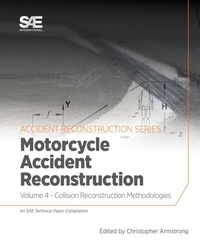
Motorcycle Accident Reconstruction
1st Edition
Published on 30. November 2018
280 pages
978-0-7680-9521-0 (ISBN)
Description

The last ten years have seen explosive growth in the technology available to the collision analyst, changing the way reconstruction is practiced in fundamental ways. The greatest technological advances for the crash reconstruction community have come in the realms of photogrammetry and digital media analysis. The widespread use of scanning technology has facilitated the implementation of powerful new tools to digitize forensic data, create 3D models and visualize and analyze crash vehicles and environments.The introduction of unmanned aerial systems and standardization of crash data recorders to the crash reconstruction community have enhanced the ability of a crash analyst to visualize and model the components of a crash reconstruction. Because of the technological changes occurring in the industry, many SAE papers have been written to address the validation and use of new tools for collision reconstruction.Collision Reconstruction Methodologies Volumes 1-12 bring together seminal SAE technical papers surrounding advancements in the crash reconstruction field. Topics featured in the series include: Night Vision Study and Photogrammetry, Vehicle Event Data Recorders, Motorcycle, Heavy Vehicle, Bicycle and Pedestrian Accident Reconstruction.The goal is to provide the latest technologies and methodologies being introduced into collision reconstruction - appealing to crash analysts, consultants and safety engineers alike.
More details
Other editions
New editions

Nathan Rose
Motorcycle Accident Reconstruction
E-Book
01/2022
1st Edition
SAE International
€193.99
Available for download
Additional editions
Christopher D. Armstrong
Collision Reconstruction Methodologies Volume 4
Motorcycle Accident Reconstruction
Book
11/2018
SAE International
€239.58
Withdrawn from sale
Content
- Cover
- Table of Contents
- Introduction
- CHAPTER 1 Technical Parameters for the Determination of Impact Speed for Motorcycle Accidents and the Importance of Relative Speed on Injury Severity
- Introduction and Objectives
- Historical View on In-Depth Studies Describing the Injury Situation of Motorcyclists
- Possibilities of In-Depth Research
- Basis for Reconstruction
- Basis for Statistics
- Basis for the Study
- Kinematics of Motorcycle Accidents
- Collision and Injury Situations of Motorcyclists
- Throwing Distance, Relative Speed, and Severity of Injury
- Severity of Secondary Collision
- Conclusions
- References
- CHAPTER 2 Driver-Control Interaction of a Curve-Safe Braking Control for Motorcycles
- Introduction
- Simulator
- Vehicle Model
- Steering Model
- Brake-Control Strategy
- Analysis
- Tractability
- Stability
- Conclusion
- References
- CHAPTER 3 Motorcycle Rider Trajectory in Pitch-Over Brake Applications and Impacts
- Introduction
- Crash Test
- Test Design
- Results
- Video Analysis
- Sled Tests
- Test Fixture Design
- Braking Simulation Development
- Results
- Video Analysis
- Analysis
- Conclusions
- Acknowledgments
- References
- CHAPTER 4 Occupant Trajectory Model using Case-Specific Accident Reconstruction Data for Vehicle Position, Roll, and Yaw
- Introduction
- Methods
- Vehicle Model
- Reference Frames
- Initial Conditions
- Equations of Motion
- Occupant Model
- Occupant in Vehicle
- Occupant in Air
- Occupant on Ground
- Results
- Discussion
- Conclusion
- References
- CHAPTER 5 Motorcycle Tire/Road Friction
- Introduction
- Review of Previous Investigations
- Test Procedure
- Results
- Effects of Severe Wear
- Conclusions and Discussion
- References
- Acknowledgments
- Appendix
- Data From Dry-Urface Tests
- Data From Wet-Surface Tests
- CHAPTER 6 Full-Scale Moving-Motorcycle-into-Moving-Car Crash Testing for Use in Safety Design and Accident Reconstruction
- Introduction
- Crash Test Methodology
- Test Facility
- Motorcycle Dolly
- Speed Control
- Impact Control
- Test Design
- Test 1
- Test 2
- Test 3
- Test 4
- Analysis
- Impact
- Deformation and Motion
- Moving Motorcycle into Stationary Car
- Moving Motorcycle into Moving Car-Test 1
- Moving Motorcycle into Moving Car-Test 2
- Moving Motorcycle into Moving Car-Test 3
- Moving Motorcycle into Moving Car-Test 4
- Summary
- Conclusion
- References
- Acknowledgments
- CHAPTER 7 Simulating Moving Motorcycle to Moving Car Crashes
- Introduction
- Simulation Software
- Crash Tests
- Crash Test Simulations
- Test 1 Analysis
- Vehicle Models
- Environment
- Test 1 Simulations
- Test 1 Simulation Summary
- Test 2 Analysis
- Vehicle Models
- Environment
- Test 2 Simulation
- Test 2 Simulation Summary
- Test 3 Analysis
- Vehicle Models
- Environment
- Test 3 Simulation
- Test 3 Simulation Summary
- Test 4 Analysis
- Vehicle Models
- Environment
- Test 4 Simulation
- Test 4 Simulation Summary
- Discussion & Conclusions
- References
- Acknowledgments
- Appendix
- Vehicle Data
- CHAPTER 8 Time and Distance Required for a Motorcycle to Turn Away from an Obstacle
- Introduction
- Literature Review
- Daily, Shigemura, and Daily
- Lofgren, Mitchell, and Bonnett
- Limpert
- Watanabe and Yoshida
- Schibalski, Seeman, Weber, and Wolfer
- Rauscher
- Gilsdorf
- Shuman, Husher, Varat, and Armstrong
- Kasanický, Kohút, and Priester
- Benedikt et al.
- Giovannini, Savino, and Peirini
- Wright and Baxter
- Current Work: 2 m Lateral Excursion
- Riders and Motorcycles
- Test Area
- Test Methodology
- Results
- Conclusion
- References
- Acknowledgments
- CHAPTER 9 Validation of Equations for Motorcycle and Rider Lean on a Curve
- Introduction
- Motorcycle Lean on a Curve
- Assumptions
- Physical Testing-April 28, 2014
- Physical Testing-July 7, 2014
- Analysis and Results
- Conclusions
- References
- Acknowledgments
- Appendix
- CHAPTER 10 Accident Characteristics and Influence Parameters of Severe Motorcycle Accidents in Germany
- Introduction and Objectives
- Legal Regulation of Motorcycles in Germany
- Accident Studies Based on GIDAS (German In-Depth Accident Study)
- Database
- Evaluation Structure of the Study
- Injury Severity
- Accident Situation and Causes of Injury by Types of Accidents
- Collision Partners of Heavy Motorcycles and Closing Speed
- Cubic Capacity of Motorcycles
- Rider Individual Parameters (Age, Body Weight, Body Height, BMI)
- Collision Type and Injury Severity
- Multivariate Analysis
- Conclusion and Discussion
- References
- Acknowledgments
- CHAPTER 11 The Effects of Power Interruption on Electronic Needle-Display Motorcycle Speedometers
- Introduction
- Testing Details
- Power Interruption Testing
- Speedometer Drop Testing
- Test Results
- 1999 Harley Davidson FXDX
- 2013 Harley Davidson FLTRU
- 2015 Honda GL1800 Gold Wing
- 2015 BMW R1200GS
- 2014 Triumph T100 Bonneville
- 2012 Kawasaki ZX-14R Ninja
- Discussion
- Conclusion
- References
- Appendix
- Appendix A Motorcycle VIN and Photographs
- Appendix B Speedometers Used in Drop Testing
- Appendix C Speedometers Used in Drop Testing after Disassembly
- CHAPTER 12 Testing Methodology to Evaluate Reliability of a "Frozen" Speedometer Reading in Motorcycle/Scooter Impacts with Preimpact Braking
- Introduction
- History of Speedometer Technology
- Literature Review
- Traffic Accident Investigation Manual, JS Baker, 1975
- Speedometer Examination: An Aid in Accident Investigation, FBI Law Enforcement Bulletin, 65920, 1980
- Post-Collision Speedometer Readings and Vehicle Impact Speeds, Collision Magazine, 2010
- Reliable Determination of Impact Velocity on the Basis of Indications of the Speedometer Stopped After the Collision, International Scientific Conference, 2009
- A Review of Speedometers and the Criteria to be Considered Before Accepting 'Frozen' Readings and Other Marks, EVU 2013-27, 2011
- An Assessment of Speedometers Using Stepper Motors to Hold Their Position during High Speed Impact Testing, ITAI Conference Proceedings, 2014
- The Behaviour of Instrument Clusters during High-Speed Crash Testing, EVU 2015
- Accuracy of Retained Speedometer Readings, ITAI Conference Proceedings, 2014
- Testing Process for Evaluating the Reliability of a "Frozen" Motorcycle Speedometer Needle Reading
- Step 1-Identification of Gauge Needle Motor Type
- Step 2-Evaluation of Speedometer Needle Resistance
- Step 3-Gauge Needle Latency
- Confirmed Stepper Motor Results
- 1. 2008 Harley Davidson Heritage Softail Classic FLSTCI
- 2. 2014 Harley Davidson Heritage Softail FLSTC103
- 3. 2015 Harley Davison Street Glide Special FLHXS
- 4. 2014 Triumph Bonneville
- 5. 2015 BMW R1200RT
- 6. 2015 Indian Chieftain
- 7. 2014 Triumph Tiger Explorer
- Needle Movement at Power Loss
- Indeterminate Stepper Motor Results
- 8. 2006 Kawasaki Vulcan 900 Classic LT
- 9. 2007 Kawasaki Ninja EX250
- 10. 2012 Kawasaki Ninja EX250
- 11. 2009 Honda Silver Wing FSC600 (Scooter
- 12. 2015 Honda Gold Wing 1800
- Antilock Braking Systems (ABS) and Traction Control
- Conclusions and Recommendations
- References
- Acknowledgments
- Appendix
- Appendix A: 2008 Harley Davidson Softail Classic FLSTCI
- Appendix B: 2014 Harley Davidson Heritage Softail FLSTC103
- Appendix C: 2015 Harley Davidson Street Glide Special FLHXS
- Appendix D: 2014 Triumph Bonneville
- Appendix E: BMW R1200RT
- Appendix F: Indian Chieftain
- CHAPTER 13 Video Analysis of Motorcycle and Rider Dynamics During High-Side Falls
- Introduction
- Site Inspection
- Case #1
- Case #2
- Case #3
- Case #4
- Speed Analysis from Audio Data
- Discussion and Conclusions
- References
- Acknowledgments
- About the Author
