

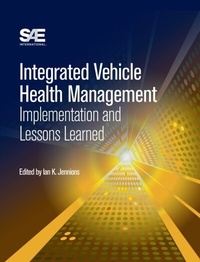
Integrated Vehicle Health Management
Implementation and Lessons Learned
1st Edition
Published on 30. November 2014
222 pages
978-0-7680-8089-6 (ISBN)
Available for download
Description

Integrated Vehicle Health Management: Implementation and Lessons Learned is the fourth title in the IVHM series published by SAE International. This new book introduces a variety of case studies, lessons learned, and insights on what it really means to develop, implement, or manage an integrated system of systems. Integrated Vehicle Health Management: Implementation and Lessons Learned brings to the reader a wide set of hands-on stories, made possible by the contribution of twenty-three authors, who agreed to share their experience and wisdom on how new technologies are developed and put to work. This effort was again coordinated by Dr. Ian K. Jennions, Director of the IVHM Centre at Cranfield University (UK), and editor of the previous books in the series. Integrated Vehicle Health Management: Implementation and Lessons Learned, with seventeen, fully illustrated chapters, covers diverse areas of expertise such as the impact of trust, human factors, and evidential integrity in system development. They are complemented by valuable insights on implementing APU health management, aircraft health trend monitoring, and the historical perspective of how rotorcraft HUMS (Health and Usage Monitoring Systems) opened doors for the adoption of this cutting-edge technology by the global commercial aviation industry.
More details
Other editions
Additional editions
Book
10/2014
SAE International
€158.95
Withdrawn from sale
Content
- Intro
- Table of Contents
- Acknowledgments
- Chapter 1 Introduction
- 1.1 Background
- 1.2 Book Structure
- 1.3 References
- Chapter 2 Human Factors
- 2.1 Introduction
- 2.2 In the Beginning.
- 2.3 What Are Human Factors?
- 2.4 How Do Humans Deal with Information?
- 2.5 Effects of Human Factors on System Concepts and Intended Use
- 2.6 Human Interaction with the System and Surrounding Use Environment
- 2.7 Solutions?
- 2.8 References
- Chapter 3 Trust
- 3.1 Why Is Trust Important inIVHM?
- 3.1.1 An Illustration of Irrational Aspects of Trust and Quality
- 3.1.2 Lessons Learned from EHM System Failures
- 3.2 What Is Trust in an IVHM Context?
- 3.2.1 Enhancing the Ability to Act
- 3.3 The STRAPP Project
- 3.3.1 The Hypothesis of Trust
- 3.3.2 Architectural Lessons Learned
- 3.3.2.1 The Existing EHM System
- 3.3.2.2 EHM Design and Architecture
- 3.3.2.3 Agnosticism of the STRAPP System
- 3.3.2.4 The Treatment of Risk in the STRAPP Trust Service
- 3.3.2.5 The Treatment of Personalization in the STRAPP Trust Service
- 3.4 What Does Provenance Look Like?
- 3.5 Conclusions
- 3.6 References
- Chapter 4 Looking After Planes, Trains, Clean Energy, and Human Health: 23 Important Lessons I've Learned the Hard Way
- 4.1 Introduction
- 4.2 The Lessons
- 4.3 Examples and Stories
- 4.4 Conclusions
- 4.5 Acknowledgments
- 4.6 References
- Chapter 5 IVHM Systems-The Road to Innovation
- 5.1 Overview
- 5.2 The Ahead-Pro System
- 5.3 IVHM Technology Development
- 5.4 Important Aspects and Lessons Learned
- 5.4.1 Technology Development Process
- 5.4.2 Development Characteristics
- 5.4.3 Customer Engagement
- 5.4.4 Funding
- 5.4.5 Continuous Monitoring of New IVHM Developments Globally
- 5.4.6 Project Management
- 5.4.7 Intellectual Property
- 5.4.8 Organizational
- 5.4.9 Technology Transfer
- 5.4.10 Incorporating Lessons Learned
- 5.5 Conclusion
- 5.6 References
- Chapter 6 Lessons Learned in Developing and Implementing APU Health Management
- 6.1 Introduction
- 6.2 The Need for APU Health Management
- 6.3 Implementation Challenges
- 6.3.1 Onboard Implementation Challenges
- 6.3.1.1 Certification
- 6.3.1.2 Sensors
- 6.3.2 Offboard Implementation Challenges
- 6.4 Lessons Learned During Implementation
- 6.4.1 APU Health Management-1st Implementation
- 6.4.1.1 Combustion Chamber Failure
- 6.4.2 APU Health Management-2nd Implementation
- 6.5 Making the Business Case
- 6.6 Changing the Culture
- 6.7 References
- Chapter 7 IVHM Automated APU In-Flight Start Program
- 7.1 Introduction
- 7.2 Regulatory Requirements
- 7.3 Brief Overview of the AHM Automated APU In-Flight Start Program
- 7.4 Lessons Learned: Planning Manually
- 7.5 Implementation: IVHM Modeling of the Process through Boeing's AHM
- 7.6 Performance Metrics
- 7.7 Conclusions
- 7.8 References
- Chapter 8 The RASSC Project
- 8.1 Project Goals
- 8.2 Structural Health Monitoring
- 8.3 SHM as a Service
- 8.4 Contractual and Legal Relationships
- 8.5 Repository Characteristics
- 8.6 The Submission Agreement
- 8.7 The Service Model
- 8.8 Economic, Business, and Cost Models
- 8.9 Summary
- 8.10 References
- Chapter 9 Computer Forensics: Challenges to Evidential Integrity
- 9.1 Introduction
- 9.2 Seizure
- 9.3 Preservation or Evidence Management
- 9.3.1 Factors in Evidence Management
- 9.3.1.1 Evidence Management at Seizure
- 9.3.1.2 Continuity and Integrity
- 9.3.2 Methods of Ensuring Continuity
- 9.4 Data Acquisition and Reproducibility
- 9.4.1 Write-Blocker
- 9.4.2 Hashing Algorithms
- 9.4.3 Software
- 9.4.4 Contemporaneous Notes
- 9.5 Case Study-Acquisition of a USB Memory Stick
- 9.6 Case Study-Data Acquisition of a Cell Phone
- 9.7 Conclusions
- 9.8 References
- Chapter 10 Reproducible Biotechnology: Playing Catch-Up in Mass-Manufacturing
- 10.1 Introduction
- 10.2 The Humble Pipette
- 10.3 Industrial Examples
- 10.4 Design in the Healthy State. For When It Goes Wrong
- 10.5 Instrumentation Case Study
- 10.6 Summary
- 10.7 References
- Chapter 11 Rotorcraft HUMS: Lessons Learned From a Historical Perspective
- 11.1 Introduction
- 11.2 The V-22 Osprey CIC/VSLED-The First IVHM System?
- 11.2.1 A Few Lessons Learned from CIC/VSLED's Implementation
- 11.3 The North Sea FDR/HUMS Developments
- 11.3.1 A Few of the Lessons Learned from the North Sea HUMS Developments
- 11.4 Helicopter OEM Branded Systems
- 11.4.1 Lessons Learned from Rotorcraft OEM HUMS Developments
- 11.5 The U.S. Federal Aviation Administration
- 11.5.1 Lessons Learned
- 11.6 HUMS/CBM in the Military
- 11.6.1 Lessons Learned
- 11.7 Current Research and Recent Developments
- 11.8 Ongoing Sources of Technical Data Covering All Aspects of Rotorcraft HUMS
- 11.9 References
- Chapter 12 Implementation of THUMS and CBM in the Israeli Air Force-Lessons Learned
- 12.1 Background
- 12.2 The Beginning of the Story in the Israeli Air Force-The "Start-Up" Vision
- 12.3 The First Full-Scale Program-The Apache THUMS
- 12.3.1 THUMS Architecture
- 12.3.2 Data Flow
- 12.3.3 Flight Regime Recognition
- 12.3.4 The Apache THUMS Performance
- 12.3.5 Success Stories
- 12.3.6 Diagnostic Events
- 12.4 Condition-Based Maintenance
- 12.5 Lessons Learned
- 12.6 The New Vision
- 12.6.1 Improved Modeling Capabilities
- 12.6.2 Improved Sensing Capabilities
- 12.6.3 Improved Prognostic Tools
- 12.6.4 Data Mining
- 12.7 Summary
- 12.8 Acknowledgments
- 12.9 References
- Chapter 13 Short History of IVHM in Honeywell
- 13.1 Overview
- 13.2 Example Products and Solutions
- 13.2.1 Health and Usage Monitoring System
- 13.2.2 Process Equipment Monitoring
- 13.2.3 Onboard Maintenance Systems
- 13.2.4 Performance Trend Monitoring
- 13.3 Closing Remarks
- 13.4 References
- Chapter 14 Insights on IVHM Implementation at Airbus
- 14.1 Introduction
- 14.2 Airborne Segment
- 14.2.1 Assessing Health Status in Early Airbus Years-A300/A310
- 14.2.1.1 Assessing Operational Impact
- 14.2.1.2 Assessing System and Equipment Health Status by the Ground Crew
- 14.2.1.3 Assessing Aircraft Performance-Trend Monitoring
- 14.2.2 First-Generation Centralized Ground Crew Maintenance Systems (A320 to A330/340)
- 14.2.2.1 Early Centralized Fault Display System
- 14.2.2.2 Aircraft Condition Monitoring System
- 14.2.3 Extended Centralized Maintenance System and Approaching Seamless Workflow (A380 and A350XWB)
- 14.2.3.1 Managing More Data and Time-Limited Failures
- 14.2.3.2 Addressing Next Dispatch
- 14.2.3.3 Improving Workflow for Maintainer
- 14.2.3.4 Increasing Air/Ground Connectivity
- 14.2.4 Challenging Design and Verification
- 14.3 Ground Segment
- 14.3.1 Historical Perspectives
- 14.3.1.1 Early Beginnings
- 14.3.1.2 From Storage to Support
- 14.3.2 Current Product Implementation
- 14.3.2.1 IT Implementation
- 14.3.2.2 Functional Capabilities
- 14.3.2.3 Users Targeted
- 14.4 Perspectives
- 14.4.1 From Unplanned to Predictive Maintenance
- 14.4.2 From Scheduled to Condition-Based Maintenance
- 14.4.3 From Manual/Semi-Automated to Automated Processes
- 14.4.4 From Local On-Aircraft Maintenance to Remote Maintenance
- Chapter 15 Aircraft Health and Trend Monitoring: IVHM Experiences from the Gulfstream G650 Aircraft
- 15.1 An Introduction to G650 Aircraft Health and Trend Monitoring
- 15.2 AHTMS Overview
- 15.3 System Functionality
- 15.3.1 In-Air Functionality
- 15.3.2 On-Ground Functionality
- 15.4 Data Analysis and Ground Support Network
- 15.5 Data Transmission
- 15.5.1 Priority 1 Data
- 15.5.2 Priority 2 Data
- 15.5.3 Priority 3 Data
- 15.5.4 Priority 4 Data
- 15.6 AHTMS in Service
- 15.6.1 High-Priority CAS Event Over the Pacific
- 15.6.2 Flight Control Issue on Ground
- 15.6.3 Landing Gear Maintenance Messages
- 15.6.4 Fuel Fluctuation
- 15.7 Summary and Conclusions
- Chapter 16 The Road to Vehicle Health Management
- 16.1 GE Aviation's Vehicle and Health Management History
- 16.2 Data Acquisition and Recorders
- 16.3 Rotorcraft IVHM
- 16.4 Aircraft Health Management Systems
- 16.5 Future Perspectives and Lessons Learned
- 16.6 References
- Chapter 17 Summary and Conclusion
- 17.1 Human Factors
- 17.2 Trust
- 17.3 HUMS
- 17.4 Fielded Systems
- 17.5 Conclusion
- Index
- About the Authors

