

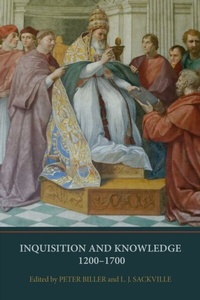
Inquisition and Knowledge, 1200-1700
1st Edition
Published on 1. February 2022
360 pages
978-1-80010-388-7 (ISBN)
Description

Essays considering how information could be used and abused in the service of heresy and inquisition.The collection, curation, and manipulation of knowledge were fundamental to the operation of inquisition. Its coercive power rested on its ability to control information and to produce authoritative discourses from it - a fact not lost on contemporaries, or on later commentators. Understanding that relationship between inquisition and knowledge has been one of the principal drivers of its long historiography. Inquisitors and their historians have always been preoccupied with the process by which information was gathered and recirculated as knowledge. The tenor of that question has changed over time, but we are still asking how knowledge was made and handed down - to them and to us - and how their sense of what was interesting or useful affected their selection.This volume approaches the theme by looking at heresy and inquisition in the Middle Ages, and also at how they were seen in the sixteenth and seventeenth centuries. The contributors consider a wide range of medieval texts, including papal bulls, sermons, polemical treatises and records of interrogations, both increasing our knowledge of medieval heresy and inquisition, and at the same time delineating the twisting of knowledge. This polarity continues in the early modern period, when scholars appeared to advance learning by hunting for medieval manuscripts and publishing them, or ensuring their preservation through copying them, but at the same time, as some of the chapters here show, these were proof texts in the service of Catholic or Protestant polemic. As a whole, the collection provides a clear view of - and invites readers' reflection on - the shading of truth and untruth in medieval and early modern "e,knowledge"e, of heresy and inquisition.Contributors: Jessalynn Lea Bird, Harald Bollbuck, Irene Bueno, Jorg Feuchter, Richard Kieckhefer, Pawel Kras, Adam Poznanski, Luc Racaut, Alessandro Sala, Shelagh Sneddon, Michaela Valente, Reima Valimaki
More details
Other editions
Additional editions
Peter Biller | L. J. Sackville
Inquisition and Knowledge, 1200-1700
Book
06/2024
York Medieval Press
€67.20
Shipment within 3-4 weeks
Peter Biller | L. J. Sackville
Inquisition and Knowledge, 1200-1700
Book
02/2022
York Medieval Press
€200.90
Shipment within 3-4 weeks
Content
- Front Cover
- Table of Contents
- List of Illustrations
- List of Contributors
- Acknowledgements
- Introduction
- Overture
- York
- The theme
- The chapters
- Post-medieval: the sixteenth and seventeenth centuries
- Coda
- PART I: Medieval
- 1 - Inquisitorial identity and authority in thirteenth-century exegesis and sermons
- Sources and discourses: sermons on ideal preachers and good and bad shepherds
- Discernment of shepherds, sheep, dogs, and wolves
- Detection and rehabilitation: the image of the heretic as leper
- Masters and mendicants: sermons and inquests against heresy
- 2 - Shaping the image of the heretics: The narratio in Gregory IX's letters
- 3 - Nepos of Montauban, assistant to inquisition and defender of the accused
- 1. Nepos and his part in the Liber fugitivus: redactor, not author
- 2. Biographical information in Nepos's redaction of the Liber fugitivus
- 3. Nepos as judge of the Toulousan Albigeois
- 4. Nepos of Montauban and his home town
- 5. Nepos as donatus of the abbey of St Théodard
- 6. Nepos as inquisitor's assistant and scribe in the 1240s
- 7. A sketch of Nepos's life
- 8. Discussion of heretics and heresy in Nepos's version of the Liber fugitivus
- 4 - The hunt for the Heresy of the Free Spirit
- The 1332 inquisitorial records and past research
- The 'cowled nuns' of Swidnica
- John of Schwenkenfeld and his 1332 investigation
- Conclusion
- 5 - Late medieval heresiography and the categorisation of Eastern Christianity
- Anti-heresy writing and the reception of Greeks and Armenians
- Conclusions
- 6 - The portrayal of the Waldensian Brethren in the De vita et conversacione
- Manuscripts and versions
- The slippery slope from holy men to heresiarchs
- Conclusion
- Appendix
- 7 - Means of persuasion in medieval anti-heretical texts
- 8 - Constructing narratives of witchcraft
- PART II: Early Modern
- 9 - Matthias Flacius Illyricus and his use of inquisition registers and manuals
- 1. The formation of a Lutheran concept of history
- 2. Matthias Flacius and his concept of truth witnesses
- 3. Networking: the collection of inquisition manuals and registers
- 4. Inquisition records and manuals in the library of Flacius: an overview
- 5. Techniques and aims of the use of inquisition protocols and manuals by Flacius
- Conclusion
- 10 - The 'Cathars as Protestant' myth and the formation of heterodox identity
- 11 - The seventeenth-century introductions to medieval inquisition records
- 12 - History in the Dominican Convent in Toulouse in 1666 and 1668
- i. The medieval archive
- ii. Mid-seventeenth century: the convent
- iii. 1666: Antonin Réginald's Chronicon Inquisitorum
- iv. 1668: Jean de Doat's visit
- Appendix
- 13 - The Roman Inquisition: between reality and myth
- Index
- Heresy and Inquisition in the Middle Ages
