

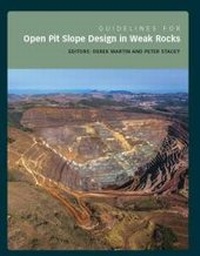
Guidelines for Open Pit Slope Design in Weak Rocks
1st Edition
Published on 10. January 2018
416 pages
978-1-4863-0348-9 (ISBN)
Description

Weak rocks encountered in open pit mines cover a wide variety of materials, with properties ranging between soil and rock. As such, they can provide a significant challenge for the slope designer. For these materials, the mass strength can be the primary control in the design of the pit slopes, although structures can also play an important role. Because of the typically weak nature of the materials, groundwater and surface water can also have a controlling influence on stability.Guidelines for Open Pit Slope Design in Weak Rocks is a companion to Guidelines for Open Pit Slope Design, which was published in 2009 and dealt primarily with strong rocks. Both books were commissioned under the Large Open Pit (LOP) project, which is sponsored by major mining companies. These books provide summaries of the current state of practice for the design, implementation and assessment of slopes in open pits, with a view to meeting the requirements of safety, as well as the recovery of anticipated ore reserves.This book, which follows the general cycle of the slope design process for open pits, contains 12 chapters. These chapters were compiled and written by industry experts and contain a large number of case histories. The initial chapters address field data collection, the critical aspects of determining the strength of weak rocks, the role of groundwater in weak rock slope stability and slope design considerations, which can differ somewhat from those applied to strong rock. The subsequent chapters address the principal weak rock types that are encountered in open pit mines, including cemented colluvial sediments, weak sedimentary mudstone rocks, soft coals and chalk, weak limestone, saprolite, soft iron ores and other leached rocks, and hydrothermally altered rocks. A final chapter deals with design implementation aspects, including mine planning, monitoring, surface water control and closure of weak rock slopes.As with the other books in this series, Guidelines for Open Pit Slope Design in Weak Rocks provides guidance to practitioners involved in the design and implementation of open pit slopes, particularly geotechnical engineers, mining engineers, geologists and other personnel working at operating mines.
More details
Other editions
Additional editions
Derek Martin | Peter Stacey
Guidelines for Open Pit Slope Design in Weak Rocks
Book
01/2018
CSIRO Publishing
€221.72
Shipment within 3-4 weeks
Content
- Cover
- Contents
- Preface and acknowledgements
- About the editors
- 1 Introduction
- 1.1 Background
- 1.2 General descriptions and definitions for weak rocks
- 1.2.1 Cemented sediments
- 1.2.2 Weak sedimentary rocks
- 1.2.3 Saprolites: weathered rock and residual soil
- 1.2.4 Soft iron ores and leached rocks
- 1.2.5 Hydrothermally altered rocks
- 1.3 Slope design terminology
- 1.3.1 Slope configurations
- 1.3.2 Instability
- 1.4 Design implications
- 1.5 Design implementation
- 2 Field data collection and methodology
- 2.1 Introduction
- 2.2 General field descriptions
- 2.2.1 Field estimate of strength
- 2.2.2 Weathering and alteration
- 2.2.3 Moisture-sensitive weak rocks
- 2.2.4 Residual soils and weathered rocks
- 2.3 Field mapping
- 2.4 Core logging, sampling and sample preservation
- 2.4.1 Core boxing and photography
- 2.4.2 Core logging
- 2.4.3 Discontinuities and bedding plane shears
- 2.4.4 Sampling
- 2.5 Laboratory testing
- 2.5.1 Routine test methods
- 2.5.2 Characterisation tests
- 2.5.3 Strength testing
- 2.6 In-situ borehole characterisation
- 2.6.1 Borehole strength and stiffness methods
- 2.6.2 Geophysical methods
- 2.6.3 Geochemical testing
- 2.7 Summary
- 3 Weak rock strength models
- 3.1 Introduction
- 3.2 Geological and structural models
- 3.2.1 Lithology and alteration
- 3.2.2 Major structures
- 3.2.3 Structural fabric
- 3.2.4 Seismicity
- 3.3 Role of rock mass classifications systems
- 3.4 Shear strength and failure criteria of weak rocks in laboratory tests
- 3.4.1 Shear strength and failure envelopes
- 3.4.2 Stresses and stress path during open pit excavation
- 3.4.3 Factors affecting weak rock strength
- 3.4.4 Laboratory testing of weak rock
- 3.4.5 Weak rock behaviour
- 3.4.6 Anisotropic shear strength
- 3.4.7 Partially saturated strength
- 3.4.8 Coupled hydromechanical response during mining
- 3.5 Erodibility/degradability
- 4 The role of water in slope design for weak rocks
- 4.1 Introduction
- 4.2 Hydrogeological background
- 4.2.1 General classification
- 4.2.2 Discussion of basic parameters
- 4.2.3 Unconfined and confined groundwater
- 4.2.4 Pore pressure
- 4.2.5 Hydromechanical coupling
- 4.2.6 Piping
- 4.2.7 Fault gouge
- 4.3 Groundwater characterisation
- 4.3.1 General
- 4.3.2 Defining the goals
- 4.3.3 Data collection and compilation
- 4.4 Development of a conceptual hydrogeological model
- 4.4.1 General
- 4.4.2 Regional- and mine-scale model
- 4.4.3 Sector-scale model
- 4.5 Analysis and modelling of pore pressure
- 4.5.1 Defining the goals
- 4.5.2 Pore pressure input to the geotechnical analysis
- 4.5.3 Analysis of pore pressures
- 4.5.4 Planning of numerical models
- 4.5.5 Inclusion of hydromechanical coupling
- 4.5.6 Development of numerical models
- 4.6 Depressurisation of weak rocks
- 4.6.1 Importance of time
- 4.6.2 Importance of recharge
- 4.6.3 Methods for depressurisation of weak rock units
- 4.7 Characterisation of surface water
- 4.7.1 Sources of surface water
- 4.7.2 Estimating flow rates
- 5 Slope design considerations
- 5.1 Introduction
- 5.2 Modes of failure
- 5.2.1 Primary modes
- 5.2.2 Secondary modes
- 5.3 Instability mechanisms
- 5.3.1 Cohesion-loss processes
- 5.3.2 Weak planes in bedded deposits
- 5.3.3 Collapse in high porosity weak rocks
- 5.3.4 Summary of instability mechanisms
- 5.4 Stability analyses and predictions
- 5.4.1 Approaches
- 5.4.2 Seismic analysis
- 5.5 Limit equilibrium analyses
- 5.5.1 LEM methods
- 5.5.2 Role of Factor of Safety
- 5.5.3 Deformations and Factor of Safety
- 5.5.4 The postulated slip surface
- 5.5.5 Anisotropy
- 5.6 Numerical approaches
- 5.6.1 Role of numerical models
- 5.6.2 Continuum models
- 5.6.3 Discontinuum models
- 5.6.4 Simulating common behaviour modes in numerical models
- 5.6.5 Pore water pressures
- 5.6.6 Shear strength reduction
- 5.6.7 Application of numerical models
- 5.6.8 Summary of numerical approaches
- 5.7 Role of back analyses
- 5.8 Acceptance criteria
- 5.8.1 Limit-based design (pre-feasibility)
- 5.8.2 Performance-based design during operations
- 5.9 Summary
- 6 Cemented sediments
- 6.1 Introduction
- 6.2 General geological setting
- 6.2.1 Geology
- 6.2.2 Structural geology
- 6.3 Hydrogeology
- 6.3.1 Basin and range deposits
- 6.3.2 Cemented bedded sediments: Carlin Formation
- 6.4 General geotechnical properties
- 6.4.1 Cemented bedded sediments
- 6.4.2 Cemented gravels
- 6.5 Slope design considerations
- 6.6 Goldstrike Betze-Post open pit, Nevada: instability in the Carlin Formation
- 6.6.1 Introduction
- 6.6.2 Geology
- 6.6.3 East wall development history
- 6.6.4 Engineering geology
- 6.6.5 Hydrogeology
- 6.6.6 Laboratory testing and material and strength properties
- 6.6.7 North-east layback slope analysis and design
- 6.6.8 Numerical modelling of deep-seated slope deformation
- 6.6.9 Carlin Formation instability
- 6.6.10 Continued instability, monitoring, and remediation
- 6.6.11 Control of slope movement in the Carlin Formation
- 6.6.12 Conclusions
- 6.7 Nine Points slope failure at Newmont's Gold Quarry open pit
- 6.7.1 Introduction
- 6.7.2 Geology
- 6.7.3 Hydrogeology
- 6.7.4 Midway slope instability
- 6.7.5 April 2009 Nine Points slope instability
- 6.7.6 Post-April 2009 Nine Points instability behaviour
- 6.7.7 December 2009 failure event
- 6.7.8 Geological investigation and model update
- 6.7.9 Initial slope modelling results
- 6.7.10 Geotechnical drilling results
- 6.7.11 Hydrogeology results
- 6.7.12 Material strength results
- 6.7.13 Slope remediation design
- 6.7.14 Summary of lessons learned
- 6.8 Overview of open pit experience in cemented (alluvium) gravels found in south-western United States
- 6.8.1 General
- 6.8.2 Geological setting for cemented gravels of the south-western United States
- 6.8.3 Material properties characterisation
- 6.8.4 Hydrogeology
- 6.8.5 Pit slope performance
- 6.8.6 Design considerations
- 6.8.7 Operational considerations
- 6.8.8 Slope performance
- 6.9 Ministro Hales Mine, Codelco: bench failure in massive gravels
- 6.9.1 Background
- 6.9.2 Characterisation
- 6.9.3 Failure description
- 6.9.4 Back analysis
- 6.9.5 Proposed change in bench geometry
- 6.9.6 Conclusions and recommendations
- Acknowledgements
- 7 Weak sedimentary mudrocks
- 7.1 Introduction
- 7.2 General geological setting
- 7.2.1 Geology
- 7.2.2 Structural geology
- 7.3 Hydrogeology
- 7.3.1 Mudrocks
- 7.3.2 Borates
- 7.4 General geotechnical properties
- 7.4.1 Terminology
- 7.4.2 Micro-fabric, macro-fabric, fissures and bedding plane shears
- 7.4.3 Mineralogy and plasticity
- 7.4.4 Strength, modulus and moisture
- 7.4.5 Swelling, softening and time-dependent deformations
- 7.4.6 Classification parameters
- 7.5 Slope design considerations
- 7.5.1 Failure kinematics
- 7.5.2 Design process
- 7.6 Voorspoed Mine, South Africa: open pit diamond mining in weak mudrock
- 7.6.1 Introduction
- 7.6.2 Geological setting
- 7.6.3 Slope performance
- 7.6.4 Feasibility study and current geotechnical domains
- 7.6.5 Laboratory testing database and core logging information
- 7.6.6 Precipitation and groundwater
- 7.6.7 Hypothesised failure mechanisms
- 7.6.8 Summary of Voorspoed failure mechanisms and consequence on design
- 7.6.9 Risk management strategy
- 7.6.10 Future design and mining strategy
- 7.6.11 Conclusions
- 7.7 Rio Tinto Minerals Boron operation: design considerations for weak lakebed sedimentary rocks
- 7.7.1 Introduction
- 7.7.2 Geology
- 7.7.3 Hydrogeology
- 7.7.4 Rock mass strengths and design considerations
- 7.7.5 Design considerations
- 7.7.6 Conclusions
- Acknowledgements
- 8 Weak sedimentary coal, chalk and limestone
- 8.1 Introduction
- 8.2 General geological setting
- 8.2.1 Geology
- 8.2.2 Structural geology
- 8.2.3 Material properties
- 8.3 Slope design considerations
- 8.3.1 Typical failure modes
- 8.3.2 Slope designs
- 8.4 Weak coal measures
- 8.4.1 Overview
- 8.4.2 Derivation of empirical rock mass shear strength models
- 8.4.3 Interpretation of groundwater conditions with coal measures rock masses
- 8.4.4 Large-scale open pit mining in low-strength rock masses at the PT Kaltim Prima Coal Sangatta and Bengalon Projects
- 8.4.5 Geotechnical conditions for mining the coal measures rocks of the Western Canada Sedimentary Basin
- 8.5 Chalk and weak limestones
- 8.5.1 Introduction
- 8.5.2 General geology and classification
- 8.5.3 Sampling
- 8.5.4 Material properties
- 8.5.5 Hydrogeology
- 8.5.6 Case histories
- 8.5.7 Slope designs
- 8.5.8 Design implementation
- 9 Saprolite: weathered rock and residual soil
- 9.1 Introduction
- 9.2 Terminology
- 9.2.1 Saprolith
- 9.2.2 Pedolith
- 9.3 Weathering processes and geology
- 9.3.1 Chemical weathering
- 9.3.2 Physical weathering
- 9.3.3 Weathering rates
- 9.3.4 Influence of parent rock
- 9.3.5 Weathering profile examples
- 9.4 General geotechnical properties
- 9.4.1 Weathering descriptions
- 9.4.2 Composition and structure withdepth
- 9.4.3 Effect of weathering on strength
- 9.5 Hydrogeology
- 9.5.1 Typical hydrogeology profiles
- 9.5.2 Dewatering
- 9.5.3 Hydrogeology observations at Rosebel Gold Mine
- 9.6 Slope design considerations
- 9.6.1 Failure kinematics
- 9.6.2 Design process
- 9.6.3 Design implementation
- 9.7 Cowal Gold Mine: back analysis
- 9.7.1 Introduction
- 9.7.2 Geology
- 9.7.3 Slope stability assessments (pre-mining)
- 9.7.4 Mining
- 9.7.5 East wall instability
- 9.7.6 Back analysis
- 9.7.7 Discussion of back analysis results
- 9.7.8 Conclusions
- 9.8 Newmont Boddington Gold: slope design optimisation in oxide/saprolite
- 9.8.1 Introduction
- 9.8.2 Site condition
- 9.8.3 Oxide material at NBG
- 9.8.4 Historical slope failures in oxide slopes at NBG
- 9.8.5 Laboratory testing of oxide/saprolite at NBG
- 9.8.6 Groundwater conditions
- 9.8.7 Geotechnical assessment for oxide/saprolite slope design
- 9.8.8 Slope design optimisation for oxide/saprolite slopes at NBG
- 9.8.9 Surface drainage in oxide slopes
- 9.8.10 Summary
- Acknowledgements
- 10 Soft iron ores and other leached rocks
- 10.1 Introduction
- 10.2 Background
- 10.3 Soft iron ores: geology
- 10.3.1 Lithology
- 10.3.2 Alteration
- 10.3.3 Structure
- 10.4 Soft iron ores: geotechnical characteristics
- 10.4.1 Definitions
- 10.4.2 Field characterisation
- 10.4.3 Laboratory characterisation and testing
- 10.4.4 Conclusions
- 10.5 Weathered country rocks
- 10.5.1 Weathering and strength
- 10.5.2 Characterisation
- 10.5.3 Strength parameters
- 10.6 Hydrogeology of soft iron ores and associated rocks
- 10.6.1 Hydrogeology in the Iron Quadrangle of Brazi
- 10.6.2 Dewatering and slope depressurisation
- 10.6.3 Carajás hydrogeology
- 10.7 Leached quartzites and quartzitic sediments
- 10.8 Slope performance and case histories
- 10.8.1 Introduction
- 10.8.2 Patrimônio: back analysis
- 10.8.3 Carajás: failures of the south and south-east walls of the N4E pit
- 10.8.4 Pau Branco Mine - Iron Quadrangle, State of Minas Gerais: weathered phyllites associated with soft iron ores
- 10.8.5 Pico Mine: an assessment of the mechanism of flexural toppling in weak phyllite
- 11 Hydrothermally altered rocks
- 11.1 Introduction
- 11.2 General geological setting
- 11.2.1 Igneous deposits
- 11.2.2 Epithermal deposits
- 11.2.3 Structural geology
- 11.3 Geotechnical properties
- 11.3.1 Description and classification
- 11.3.2 Strength and deformation
- 11.4 Hydrogeology
- 11.5 Slope stability and engineering geology at the Pierina Mine
- 11.5.1 Introduction
- 11.5.2 Engineering geology
- 11.5.3 Slope stability experience
- 11.5.4 Stability analysis and disturbance factor (D)
- 11.5.5 Surface runoff and hydrogeology
- 11.5.6 Pit slope monitoring
- 11.5.7 Results and conclusions
- 11.6 Instability in weak rocks, El Tapado Pit north wall, Yanacocha Operation
- 11.6.1 Introduction
- 11.6.2 Site conditions
- 11.6.3 Phase 2 El Tapado Pit
- 11.6.4 Deep-seated instability in north wall
- 11.6.5 Completion of mining
- Acknowledgements
- 11.7 Lihir Open Pit Mine in argillic materials
- 11.7.1 Introduction
- 11.7.2 Engineering properties of argillic materials
- 11.7.3 Gw28 slope
- 11.7.4 Western Stockpile
- 11.7.5 Conclusions
- 12 Design implementation and operational considerations
- 12.1 Introduction
- 12.2 Mine planning
- 12.2.1 Pre-mining (Levels 1 and 2)
- 12.2.2 Feasibility level and detailed design
- 12.3 Design implementation
- 12.3.1 Excavation and scaling
- 12.3.2 Blasting
- 12.4 Surface water control
- 12.4.1 Surface water diversion
- 12.4.2 Collection of runoff water on catch benches and haul ramps
- 12.4.3 Control of recharge
- 12.4.4 Managing large surface flow volumes
- 12.4.5 Maintenance of surface water management systems
- 12.4.6 Case history
- 12.5 Slope protection
- 12.6 Performance assessment andmonitoring
- 12.6.1 Geotechnical model validation
- 12.6.2 Slope performance
- 12.6.3 Slope movement monitoring
- 12.6.4 Mine water monitoring
- 12.7 Ground control management plans
- 12.8 Mine closure
- 12.8.1 Slope stability considerations
- 12.8.2 Hydrogeological considerations
- 12.8.3 Post-closure monitoring
- References
- Index
