

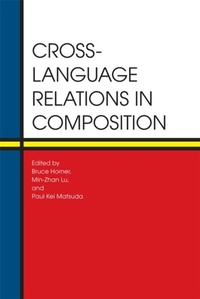
Cross-Language Relations in Composition
1st Edition
Published on 9. May 2010
274 pages
978-0-8093-8575-1 (ISBN)
Description

Cross-Language Relations in Composition brings together the foremost scholars in the fields of composition, second language writing, education, and literacy studies to address the limitations of the tacit English-only policy prevalent in composition pedagogy and research and to suggest changes for the benefit of writing students and instructors throughout the United States. Recognizing the growing linguistic diversity of students and faculty, the ongoing changes in the English language as a result of globalization, and the increasingly blurred categories of native, foreign, and second language English speakers, editors Bruce Horner, Min-Zhan Lu, and Paul Kei Matsuda have compiled a groundbreaking anthology of essays that contest the dominance of English monolingualism in the study and teaching of composition and encourage the pursuit of approaches that embrace multilingualism and cross-language writing as the norm for teaching and research. The nine chapters comprising part 1 of the collection focus on the origins of the "e,English only"e, bias dominating U.S. composition classes and present alternative methods of teaching and research that challenge this monolingualism. In part 2, nine composition teachers and scholars representing a variety of theoretical, institutional, and professional perspectives propose new, compelling, and concrete ways to understand and teach composition to students of a "e,global,"e, plural English, a language evolving in a multilingual world. Drawing on recent theoretical work on genre, complexity, performance and identity, as well as postcolonialism, Cross-Language Relations in Composition offers a radically new approach to composition teaching and research, one that will prove invaluable to all who teach writing in today's multilingual college classroom.
More details
Other editions
Additional editions
Bruce Horner | Min-Zhan Lu | Paul Matsuda
Cross-Language Relations in Composition
Book
05/2010
Southern Illinois University Press
€59.62
Article not available at the moment
Content
- Cover
- Book Title
- Copyright
- Contents
- Acknowledgments
- Introduction: From "English Only" to Cross-Language Relations in Composition
- Part One: Struggling with "English Only" in Composition
- 1. Linguistic Memory and the Uneasy Settlement of U.S. English
- 2. Living-English Work
- 3. Globalization, Guanxi, and Agency: Designing and Redesigning the Literacies of Cyberspace
- 4. The Myth of Linguistic Homogeneity in U.S. College Composition
- 5. "English Only," African American Contributions to Standardized Communication Structures, and the Potential for Social Transformation
- 6. Spanglish as Alternative Discourse: Working against Language Demarcation
- 7. There's No Translation for It: The Rhetorical Sovereignty of Indigenous Languages
- 8. Discourse Tensions, Englishes, and the Composition Classroom
- 9. A Rhetoric of Shuttling between Languages
- Part Two: Responses to Struggling with "English Only" in Composition
- 10. Ownership of Language and the Teaching of Writing
- 11. Why Don't We Speak with an Accent? Practicing Interdependence-in-Difference
- 12. The Challenges and Possibilities of Taking Up Multiple Discursive Resources in U.S. College Composition
- 13. Mapping the Cultural Ecologies of Language and Literacy
- 14. Language Diversity and the Responsibility of the WPA
- 15. Resistance to the "English Only" Movement: Implications for Two-Year College Composition
- 16. In Praise of Incomprehension
- 17. Sustainable Writing
- 18. Reflections
- Contributors
- Index
- Back Cover
