

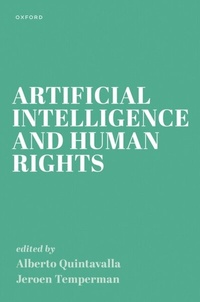
Artificial Intelligence and Human Rights
1st Edition
Published on 17. August 2023
656 pages
978-0-19-288249-3 (ISBN)
Description

The scope of Artificial Intelligence's (AI) hold on modern life is only just beginning to be fully understood. Academics, professionals, policymakers, and legislators are analysing the effects of AI in the legal realm, notably in human rights work. Artificial Intelligence technologies and modern human rights have lived parallel lives for the last sixty years, and they continue to evolve with one another as both fields take shape.
Human Rights and Artificial Intelligence explores the effects of AI on both the concept of human rights and on specific topics, including civil and political rights, privacy, non-discrimination, fair procedure, and asylum. Second- and third-generation human rights are also addressed. By mapping this relationship, the book clarifies the benefits and risks for human rights as new AI applications are designed and deployed.
Its granular perspective makes Human Rights and Artificial Intelligence a seminal text on the legal ramifications of machine learning. This expansive volume will be useful to academics and professionals navigating the complex relationship between AI and human rights.
More details
Other editions
Additional editions
Alberto Quintavalla | Jeroen Temperman
Artificial Intelligence and Human Rights
Book
09/2023
Oxford University Press
€212.50
Shipment within 15-20 days
Person
Dr. Alberto Quintavalla is Assistant Professor at the Department of Law & Markets of the Erasmus University Rotterdam and Associated Fellow of the Jean Monnet Centre of Excellence on Digital Governance. He has been a visiting researcher at the Hebrew University of Jerusalem (recipient of the Guidetti Prize) and the European University Institute. He has been awarded the prize for the best 'new voice' published in the European Journal of Legal Studies (2020/2021). He is admitted to the Italian Bar. His research interests are at the intersection of environmental governance, human rights, and digital technologies.
Jeroen Temperman is Professor of International Law at Erasmus School of Law at Erasmus University Rotterdam. He specialises in international human rights law. He is the Editor-in-Chief of Religion & Human Rights: An International Journal. He served as member of the Organization for Security and Cooperation in Europe's Panel of Experts on Freedom of Religion or Belief from 2016-2022. He has authored, among other books, Religious Hatred and International Law and State-Religion Relationships and Human Rights Law, and edited Blasphemy and Freedom of Expression and The Lautsi Papers.
Content
- Table of International Law
- Table of Domestic Law
- Table of International Cases
- Table of Domestic Cases
- Acknowledgements
- About the Contributors
- Part I: AI-Based Human Rights Violations: A Technical Perspective
- 1: Alberto Quintavalla and Jeroen Temperman: Introduction
- 2: Martina %Smuclerová, LuboS Král, and Jan Drchal: AI Life Cycle and Human Rights: Risks and Remedies
- Part II: Artificial Intelligence and Assorted First Generation Civil and Political Rights
- 3: Valentina Golunova: Artificial Intelligence and the Right to Liberty and Security
- 4: Jeroen Temperman: Artificial Intelligence and Religious Freedom
- 5: Giovanni De Gregorio and Pietro Dunn: Artificial Intelligence and Freedom of Expression
- 6: Margaret Warthon: Artificial Intelligence and Freedom of Assembly
- 7: Letizia Tomada and Raphaële Xenidis: Artificial Intelligence and the Right to Property: The Human Rights Dimension of Intellectual Property
- Part III: Artificial Intelligence and Privacy
- 8: Alessia Zornetta and Ignacio Cofone: Artificial Intelligence and the Right to Privacy
- 9: Natalia Menéndez González: The Rights to Privacy and Data Protection and Facial Recognition Technology in the Global North
- 10: Malcolm Katrak and Ishita Chakrabarty: Privacy, Political Participation and Dissent: Facial Recognition Technologies and the Risk of Digital Authoritarianism in the Global South
- 11: Bart van der Sloot: The Production of and Control Over Data in the AI-Era: The Two Failing Approaches to Privacy Protection
- 12: Andrea Pin: Artificial Intelligence, the Public Space, and the Right to Be Ignored
- Part IV: Artificial Intelligence and Non-Discrimination
- 13: Louis Koen and Kgomotso Mufamadi: Artificial Intelligence and Racial Discrimination
- 14: Fabian Lütz: Artificial Intelligence and Gender-Based Discrimination
- 15: Masuma Shahid: Artificial Intelligence and LGBTQ+ Rights
- 16: Marília Papaléo Gagliardi: Artificial Intelligence and Women's Rights: Deepfake Technology
- 17: Antonella Zarra, Silvia Favalli, and Matilde Ceron: Artificial Intelligence and Disability Rights
- Part V: Artificial Intelligence and Fair Procedure
- 18: Helga Molbæk-Steensig and Alexandre Quemy: Artificial Intelligence and Fair Trial Rights
- 19: Migle Laukyte: Artificial Intelligence and Data Analytics: A Recipe for Human Rights Violations
- 20: Sarah de Heer: Artificial Intelligence and the Right to an Effective Remedy
- Part VI: Artificial Intelligence and Asylum
- 21: Raimy Reyes: Artificial Intelligence Technologies and the Right to Seek and Enjoy Asylum
- 22: Dhruv Somayajula: Artificial Intelligence Screening and the Right of Asylum
- Part VII: Artificial Intelligence and Second Generation Rights
- 23: Adekemi Omotubora: Artificial Intelligence and the Right to Food
- 24: Caroline Compton and Jessie Hohmann: Artificial Intelligence and the Right to Housing
- 25: Joe Atkinson and Philippa Collins: Artificial Intelligence and Human Rights at Work
- 26: Enrique Santamaría Echeverría: Artificial Intelligence and the Right to Health
- Part VIII: Artificial Intelligence and Third Generation Rights
- 27: Shu Li, Béatrice Schütte, and Lotta Majewski: Artificial Intelligence and Consumer Protection Rights
- 28: Alberto Quintavalla: Artificial Intelligence and the Right to a Healthy Environment
- Part IX: Artificial Intelligence and Human Rights: Reflections
- 29: Kostina Prifti, Alberto Quintavalla, and Jeroen Temperman: Artificial Intelligence and Human Rights: Understanding and Governing Common Risks and Benefits
- 30: Klaus Heine: Human Rights, Legal Personality and Artificial Intelligence: What Can Epistemology and Moral Philosophy Teach Law?
- 31: David Gunkel: Robot Rights / Human Responsibility
- 32: Florian Gamper: The Limits of AI Decision-Making: Are There Decisions Artificial Intelligence Should Not Make?
- 33: Sofia Ranchordás: Smart Cities, Artificial Intelligence and Public Law: An Unchained Melody
- 34: Isabel Ebert and Lisa Hsin: Putting Private Sector Responsibility in the Mix: A Business and Human Rights Approach to Artificial Intelligence
- 35: Alessandro Ortalda and Paul De Hert: Artificial Intelligence Human Rights Impact Assessment
- 36: Elizaveta Gromova and Evert Stamhuis: Real Life Experimentation with Artificial Intelligence
- Part X: Conclusion
- 37: Alberto Quintavalla and Jeroen Temperman: Conclusion
- Bibliography
- Index
