

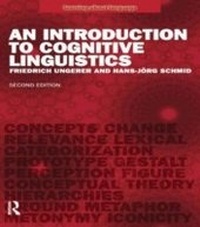
An Introduction to Cognitive Linguistics
2nd Edition
Published on 12. November 2013
400 pages
978-1-317-86774-6 (ISBN)
Description

Learning About Language is an exciting and ambitious series of introductions to fundamental topics in language, linguistics and related areas. The books are designed for students of linguistics and those who are studying language as part of a wider course.
Cognitive Linguistics explores the idea that language reflects our experience of the world. It shows that our ability to use language is closely related to other cognitive abilities such as categorization, perception, memory and attention allocation. Concepts and mental images expressed and evoked by linguistic means are linked by conceptual metaphors and metonymies and merged into more comprehensive cognitive and cultural models, frames or scenarios. It is only against this background that human communication makes sense. After 25 years of intensive research, cognitive-linguistic thinking now holds a firm place both in the wider linguistic and the cognitive-science communities.
An Introduction to Cognitive Linguistics carefully explains the central concepts of categorizaA-tion, of prototype and gestalt perception, of basic level and conceptual hierarchies, of figure and ground, and of metaphor and metonymy, for which an innovative description is provided. It also brings together issues such as iconicity, lexical change, grammaticalization and language teaching that have profited considerably from being put on a cognitive basis.
The second edition of this popular introduction provides a comprehensive and accessible up-to-date overview of Cognitive Linguistics:
Clarifies the basic notions supported by new evidence and examples for their application in language learning
Discusses major recent developments in the field: the increasing attention paid to metonymies, Construction Grammar, Conceptual Blending and its role in online-processing.
Explores links with neighbouring fields like Relevance Theory
Uses many diagrams and illustrations to make the theoretical argument more tangible
Includes extended exercises
Provides substantial updated suggestions for further reading.
Cognitive Linguistics explores the idea that language reflects our experience of the world. It shows that our ability to use language is closely related to other cognitive abilities such as categorization, perception, memory and attention allocation. Concepts and mental images expressed and evoked by linguistic means are linked by conceptual metaphors and metonymies and merged into more comprehensive cognitive and cultural models, frames or scenarios. It is only against this background that human communication makes sense. After 25 years of intensive research, cognitive-linguistic thinking now holds a firm place both in the wider linguistic and the cognitive-science communities.
An Introduction to Cognitive Linguistics carefully explains the central concepts of categorizaA-tion, of prototype and gestalt perception, of basic level and conceptual hierarchies, of figure and ground, and of metaphor and metonymy, for which an innovative description is provided. It also brings together issues such as iconicity, lexical change, grammaticalization and language teaching that have profited considerably from being put on a cognitive basis.
The second edition of this popular introduction provides a comprehensive and accessible up-to-date overview of Cognitive Linguistics:
Clarifies the basic notions supported by new evidence and examples for their application in language learning
Discusses major recent developments in the field: the increasing attention paid to metonymies, Construction Grammar, Conceptual Blending and its role in online-processing.
Explores links with neighbouring fields like Relevance Theory
Uses many diagrams and illustrations to make the theoretical argument more tangible
Includes extended exercises
Provides substantial updated suggestions for further reading.
More details
Series
Edition
2nd edition
Language
English
Place of publication
London
United Kingdom
Publishing group
Taylor & Francis Ltd
Target group
Professional and scholarly
Edition type
Revised edition
File size
2,31 MB
ISBN-13
978-1-317-86774-6 (9781317867746)
Copyright in bibliographic data and cover images is held by Nielsen Book Services Limited or by the publishers or by their respective licensors: all rights reserved.
Schweitzer Classification
Other editions
Additional editions
Friedrich Ungerer | Hans-Jorg Schmid
An Introduction to Cognitive Linguistics
Book
11/2015
2nd Edition
Routledge
€207.50
Shipment within 10-20 days
Friedrich Ungerer | Hans-Jorg Schmid
An Introduction to Cognitive Linguistics
Book
11/2006
2nd Edition
Longman
€90.70
Shipment within 10-20 days
Persons
Friedrich Ungerer is Professor of English Linguistics at the University of Rostock, Germany, but also has a background in applied linguistics and language teaching.
Hans-Joerg Schmid is Professor of Modern English Linguistics at the University of Munich, where he is currently initiating the foundation of an Interdisciplinary Centre for Cognitive Language Studies.
Both authors have published extensively in the field.
Hans-Joerg Schmid is Professor of Modern English Linguistics at the University of Munich, where he is currently initiating the foundation of an Interdisciplinary Centre for Cognitive Language Studies.
Both authors have published extensively in the field.
Content
Introduction
1. Prototypes and Categories
2. Levels of categorization
3. Conceptual metaphors and metonymies
4. Figure and ground
5. Frames and constructions
6. Blending and relevance
7. Other issues in cognitive linguistics
Conclusion
1. Prototypes and Categories
2. Levels of categorization
3. Conceptual metaphors and metonymies
4. Figure and ground
5. Frames and constructions
6. Blending and relevance
7. Other issues in cognitive linguistics
Conclusion
