

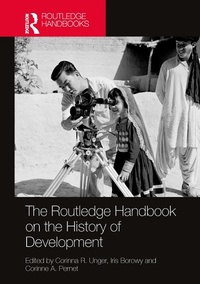
The Routledge Handbook on the History of Development
1st Edition
Published on 23. June 2022
386 pages
978-1-000-60198-5 (ISBN)
Description

This bold and ambitious handbook is the first systematic overview of the history of development ideas, themes, and actors in the twentieth century. Taking stock of the field, the book reflects on blind spots, points out avenues for future research, and brings together a greater plurality of regions, actors, and approaches than other publications on the subject.
The book offers a critical reassessment of how historical experiences have shaped contemporary understandings of development, demonstrating that the seemingly self-evident concept of development has been contingent on a combination of material conditions, power structures, and policy choices at different times and in different places. Using a world history approach, the handbook highlights similarities in development challenges across time and space, and it pays attention to the meanings of ideological, cultural, and economic divides in shaping different understandings and practices of development. Taking a thematic approach, the book shows how different actors - governments, non-governmental organizations, individuals, corporations, and international organizations - have responded to concerns regarding the conditions in their own or other societies, such as the provision of education, health, or food; approaches to infrastructure development and industrialization; the adjustment of social conditions; population policies and migration; and the maintenance of stability and security.
Bringing together a range of voices from across the globe, this book will be perfect for advanced students and researchers of international development history.
The book offers a critical reassessment of how historical experiences have shaped contemporary understandings of development, demonstrating that the seemingly self-evident concept of development has been contingent on a combination of material conditions, power structures, and policy choices at different times and in different places. Using a world history approach, the handbook highlights similarities in development challenges across time and space, and it pays attention to the meanings of ideological, cultural, and economic divides in shaping different understandings and practices of development. Taking a thematic approach, the book shows how different actors - governments, non-governmental organizations, individuals, corporations, and international organizations - have responded to concerns regarding the conditions in their own or other societies, such as the provision of education, health, or food; approaches to infrastructure development and industrialization; the adjustment of social conditions; population policies and migration; and the maintenance of stability and security.
Bringing together a range of voices from across the globe, this book will be perfect for advanced students and researchers of international development history.
More details
Edition
1. Auflage
Language
English
Place of publication
London
United Kingdom
Publishing group
Taylor & Francis Ltd
Target group
College/higher education
Professional and scholarly
Illustrations
2 Tables, black and white; 4 Line drawings, black and white; 4 Illustrations, black and white
ISBN-13
978-1-000-60198-5 (9781000601985)
Copyright in bibliographic data and cover images is held by Nielsen Book Services Limited or by the publishers or by their respective licensors: all rights reserved.
Schweitzer Classification
Other editions
Additional editions
Corinna R. Unger | Iris Borowy | Corinne A. Pernet
The Routledge Handbook on the History of Development
Book
05/2024
1st Edition
Routledge
€69.40
Shipment within 10-20 days
Corinna R. Unger | Iris Borowy | Corinne A. Pernet
The Routledge Handbook on the History of Development
Book
06/2022
1st Edition
Routledge
€313.70
Shipment within 15-20 days
Persons
Corinna R. Unger is Professor of Global and Colonial History (nineteenth and twentieth centuries), European University Institute, Florence, Italy.
Iris Borowy is Distinguished Professor, Shanghai University, College of Liberal Arts, China.
Corinne A. Pernet is Director of the Department of International Educational Development at Zurich University of Teacher Education, Switzerland.
Iris Borowy is Distinguished Professor, Shanghai University, College of Liberal Arts, China.
Corinne A. Pernet is Director of the Department of International Educational Development at Zurich University of Teacher Education, Switzerland.
Content
Part 1: Introduction 1. Corinna R. Unger, Iris Borowy, and Corinne A. Pernet: The history of development: A critical overview Part 2: Concepts and Ideas of Development 2. Daniel Speich and Verena Halsmayer: Economic growth and the object of development 3. Alessandro Iandolo: Socialist approaches to development 4. Eija Ranta: Alternative Development Approaches: Utopias, Co-options, Transitions Part 3: Themes Part 3a: Developing People 5. Iris Borowy: Unravelling the Health-Development Nexus 6. Damiano Matasci: Education, Development and North-South Relations in the 20th Century Part 3b: Developing Societies 7. Michele Alacevich: Inequality 8. Gareth Austin: Industrialization 9. Teresa Huhle: Demographic Concerns and Interventions: The Changing Population - Development -Nexus in the 20th Century 10. Nicholas Micinski and Elaine McGregor: Multiple Faces of Migration and Development: Nation Building, Neoliberalism, and Multilateralism 11. Vincent Lagendijk: Infrastructure Part 3c: Developing the Material World 12. Nancy Kwak: Urban development 13. Harro Maat: Agriculture and food production 14. Roger Merino: Resource governance Part 4: Actors of Development 15. Liu Yi: Religious organizations 16. Kevin O'Sullivan: NGOs and Development: Small is Beautiful? 17. Verena Kroess, Corinne Pernet, Corinna Unger: International Organizations 18. Atul Kohli: State Intervention for Development: A Historical Perspective 19. Alex Gertschen and Olisa Moujama: Corporations Part 5:. Transversal Perspectives 20. Karen Garner: Gender and Development 21. Corinna R. Unger: Development Knowledge: A Twentieth-Century Perspective 22. Sara Lorenzini: Development and the Security Paradox. How development was born to grant security but failed to do so. 23. Matthew Clarke: History of Development Assistance
