

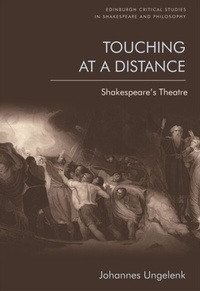
Touching at a Distance
Shakespeare's Theatre
1st Edition
Published on 25. January 2023
288 pages
978-1-4744-9784-8 (ISBN)
Description

Studies the capacity of Shakespeare's plays to touch and think about touch
Based on plays from all major genres: Hamlet, The Tempest, Richard III, Much Ado About Nothing and Troilus and Cressida
Centres on creative, close readings of Shakespeare's plays, which aim to generate critical impulses for the 21st century reader
Brings Shakespeare Studies into touch with philosophers and theoreticians from a range of disciplinary areas - continental philosophy, literary criticism, psychoanalysis, sociology, phenomenology, law, linguistics: Friedrich Nietzsche, Maurice Blanchot, Jacques Lacan, Luce Irigaray, Jacques Derrida, Roland Barthes, Niklas Luhmann, Hans Blumenberg, Carl Schmitt, J. L. Austin
Theatre has a remarkable capacity: it touches from a distance. The audience is affected, despite their physical separation from the stage. The spectators are moved, even though the fictional world presented to them will never come into direct touch with their real lives. Shakespeare is clearly one of the master practitioners of theatrical touch. As the study shows, his exceptional dramaturgic talent is intrinsically connected with being one of the great thinkers of touch. His plays fathom the complexity and power of a fascinating notion - touch as a productive proximity that is characterised by unbridgeable distance - which philosophers like Friedrich Nietzsche, Maurice Blanchot, Jacques Derrida, Luce Irigaray and Jean-Luc Nancy have written about, centuries later.
By playing with touch and its metatheatrical implications, Shakespeare raises questions that make his theatrical art point towards modernity: how are communities to form when traditional institutions begin to crumble? What happens to selfhood when time speeds up, when oneness and timeless truth can no longer serve as reliable foundations? What is the role and the capacity of language in a world that has lost its seemingly unshakeable belief and trust in meaning? How are we to conceive of the unthinkable extremes of human existence - birth and death - when the religious orthodoxy slowly ceases to give satisfactory explanations? Shakespeare's theatre not only prompts these questions, but provides us with answers. They are all related to touch, and they are all theatrical at their core: they are argued and performed by the striking experience of theatre's capacities to touch - at a distance.
Based on plays from all major genres: Hamlet, The Tempest, Richard III, Much Ado About Nothing and Troilus and Cressida
Centres on creative, close readings of Shakespeare's plays, which aim to generate critical impulses for the 21st century reader
Brings Shakespeare Studies into touch with philosophers and theoreticians from a range of disciplinary areas - continental philosophy, literary criticism, psychoanalysis, sociology, phenomenology, law, linguistics: Friedrich Nietzsche, Maurice Blanchot, Jacques Lacan, Luce Irigaray, Jacques Derrida, Roland Barthes, Niklas Luhmann, Hans Blumenberg, Carl Schmitt, J. L. Austin
Theatre has a remarkable capacity: it touches from a distance. The audience is affected, despite their physical separation from the stage. The spectators are moved, even though the fictional world presented to them will never come into direct touch with their real lives. Shakespeare is clearly one of the master practitioners of theatrical touch. As the study shows, his exceptional dramaturgic talent is intrinsically connected with being one of the great thinkers of touch. His plays fathom the complexity and power of a fascinating notion - touch as a productive proximity that is characterised by unbridgeable distance - which philosophers like Friedrich Nietzsche, Maurice Blanchot, Jacques Derrida, Luce Irigaray and Jean-Luc Nancy have written about, centuries later.
By playing with touch and its metatheatrical implications, Shakespeare raises questions that make his theatrical art point towards modernity: how are communities to form when traditional institutions begin to crumble? What happens to selfhood when time speeds up, when oneness and timeless truth can no longer serve as reliable foundations? What is the role and the capacity of language in a world that has lost its seemingly unshakeable belief and trust in meaning? How are we to conceive of the unthinkable extremes of human existence - birth and death - when the religious orthodoxy slowly ceases to give satisfactory explanations? Shakespeare's theatre not only prompts these questions, but provides us with answers. They are all related to touch, and they are all theatrical at their core: they are argued and performed by the striking experience of theatre's capacities to touch - at a distance.
More details
Other editions
Additional editions
Book
02/2023
Edinburgh University Press
€131.50
Shipment within 15-20 days
