

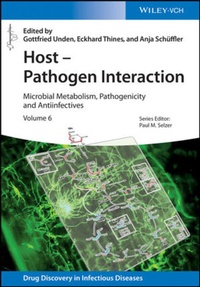
Host - Pathogen Interaction
Description

This is volume six of the book series on drug discovery in infectious diseases by Paul Selzer.
More details
Other editions
Additional editions
Persons
Gottfried Unden studied Biology and Chemistry at the Ludwig Maximilians University Munich where he received his Dr. rer. nat. Since 1993 he is Professor for Microbiology at the Department of Microbiology and Wine Research at the University of Mainz. The main areas of work is bacterial metabolism and its adaptation to changing environmental conditions like switching from aerobic to anaerobic metabolism, or the use of carboxylic acid as the substrate for growth, and the function of bacterial sensors.
Eckhard Thines studied Biology at the University of Kaiserslautern, Germany, where he received his PhD in Biotechnology. As a postdoctoral fellow he spent two years in Professor Nicholas Talbot's laboratory in Exeter, UK. He joined the Institute of Biotechnology and Drug Research (IBWF) in Kaiserslautern, Germany in 2006. Since 2009 he is CSO of the IBWF and since 2012 he is Professor for Biotechnology and Drug Research at the University of Mainz. His research focusses on fungicide research, mode of action research, target identification and validation as well as fungal secondary metabolism. Furthermore he is interested in host/pathogen-interactions in fungal plant diseases, e.g. Esca and grape black rot.
Anja Schüffler studied Biology at the University of Kaiserslautern. Her PhD focused on the characterisation of fungal natural products with antimicrobial activity. In 2010 she joined Professor William Fenical´s group at the Scripps Institute for Oceanography in San Diego, where she studied antibacterial natural products from streptomycetes. In 2011 she started a research fellowship at the Institute of Biotechnology and Drug Research (IBWF, Kaiserslautern). Her scientific work focuses on fungal bioactive natural products and assay development, the biosynthesis of secondary metabolites, as well as isolation and taxonomy of fungi.
Series Editor:
Paul M. Selzer studied biology, parasitology, and biochemistry at the University of Tübingen, Germany, where he also received his PhD in biochemistry. He spent three years at the Molecular Design Institute and the Parasitology and Tropical Disease Research Laboratory at the University of California, San Francisco. During his career he has worked as a researcher and scientific manager for several pharmaceutical companies, and is currently Head of Antiparasitics R&D at Boehringer Ingelheim Animal Health, Germany. He is also a visiting professor and teacher at the Biochemistry Institute of the University of Tübingen, and an honorary professor of the Department of Infection, Immunity, and Inflammation at the University of Glasgow, UK.
Content
Metabolic Adaption of Human Pathogenic Yersiniae
Crosstalk between Metabolism and Virulence of Legionella Pneumophila
Metabolism of Intracellular Salmonella Enterica
The human Microbiome in Health and Disease
Mechanisms of Dysbiosis in the Inflamed Gut
Strategies for Microbial Nutrient Acquisition during Infection of Rice by Magnaporthe Oryzae Introduction - Magnaporthe Oryzae Life Cycle
NEW INHIBITORS AND TARGETS OF INFECTIOUS DISEASES
Outer Membrane Proteins as Potential Anti-Infective Drug Targets in Mannheimia Haemolytica
Identification of Anti-Infective Compounds using Amoebae
Stress Biology in Fungi and "omic"-Approaches as Suitable Tools Analyzing Plant-Microbe Interactions
Targeting Plasmids: New Ways to Plasmid Curing
Regulation of Secondary Metabolism in the Grey Mould Fungus Botrytis Cinerea
Chapter 1
Metabolic Adaptation of Human Pathogenic Yersiniae
Ann Kathrin Heroven and Petra Dersch*
*Corresponding Author
Abstract
Colonization, subsequent penetration of epithelial layers as well as persistence and proliferation in subepithelial tissues of the host by bacterial pathogens demand the expression of special sets of virulence factors. In addition, the bacteria need to adapt their metabolism to survive and replicate within the specific host niches. Activated metabolic functions and physiological adaptation processes during their life cycle and the different stages of the infection reflect the complex and dynamic nutritional resources of their environments, interbacterial competition for energy sources and onslaught of bactericidal host responses. The enteric pathogenic Yersinia species Y. pseudotuberculosis and Y. enterocolitica and the causative agent of plague, Y. pestis, have adapted to grow in many different environmental reservoirs (e.g., soil, plants, insects) and in warm-blooded animals (e.g., rodents, pigs, humans) with a preference for lymphatic tissues. In the present book chapter, we discuss metabolic adaptations of human pathogenic yersiniae to successfully exploit available nutrients and metabolic functions during infection and illustrate the tight link between carbon metabolism and Yersinia virulence. Furthermore, current knowledge about the complex regulatory networks used to coordinate and fine-tune the control of metabolic and virulence functions are presented. Deciphering the mechanisms of the function and control of bacterial metabolism within host tissues will not only increase our understanding of host-pathogen interactions, it will also facilitate the identification of potential novel drug targets for future prevention and therapeutic strategies.
Introduction
Infections of human pathogenic yersiniae involves a large number of specific pathogenicity factors that mediate efficient resistance against the host defense systems and enable the bacteria to colonize, invade, and multiply successfully within host tissues. The structure, function, and expression of many of these classical virulence factors have been characterized, and their role in pathogenicity has been studied using different animal models. However, to become a successful pathogen, yersiniae must also adapt their metabolic functions to the nutrient/ion composition and the physical conditions (e.g., temperature, pH, oxygen tension) of their surrounding and coordinate their metabolism with their life cycle. These unspecific strategies were long neglected, but recent use of global omic-based profiling techniques, phenotypic microarrays, and the in vivo analysis of metabolic mutants allowed a deeper insight into nutrient sensing, sequestration, and utilization strategies that optimize the metabolism and biological fitness of Yersinia during infection.
Yersinia Life Cycles and Pathogenesis
Of the 17 species of the genus Yersinia only Y. pseudotuberculosis, Y. enterocolitica, and Y. pestis are known to cause diseases in mammals [1, 2]. The two enteric pathogens Y. pseudotuberculosis and Y. enterocolitica are the causative agents of yersiniosis, a gastrointestinal disease with a variety of symptoms such as enteritis, colitis, diarrhea, and mesenteric lymphadenitis, which becomes rarely systemic. Both enteropathogenic species are well adapted to survive long term in external habitats (e.g., ground water, soil, plants, and insects) and are able to persist and replicate in various wild and domestic animals [3, 4]. A recent study analyzing a large number of genomes revealed that they are heterotrophic pathogens that are able to utilize a large variety of C-/N-/energy sources [5]. In contrast, Y. pestis, the causal agent of plague, which has evolved as a separate clone from Y. pseudotuberculosis, shows a reduced metabolic flexibility based on functional gene loss. This may reflect its unique life cycle: (i) replication within the gastrointestinal tract (proventriculus) of infected fleas and (ii) proliferation in the lymphatic system, blood, or tissues of mammals, in particular rodents [6].
All yersiniae are zoonotic pathogens armored with diverse cell envelope-associated virulence structures that either promote host-pathogen interactions or contribute to Yersinia pathogenicity by suppression of the host immune response. In case of the enteric Yersinia species, initial attachment and invasion of the intestinal layer is mediated by the primary invasion factor invasin (InvA), but other adhesive surface-exposed proteins, for example, homologous Inv-type adhesins (InvB/Ifp, InvC), Ail, the autotransporter adhesin YadA and the PsaA (pH6 antigen)/Myf fimbriae appear to support the dissemination process at later stages of the infection [7, 8]. In Y. pestis mainly adhesins Ail and PsaA contribute to host-pathogen interactions, whereas other adhesin/invasin genes, for example, invA and yadA became unfunctional [9, 10]. Moreover, all pathogenic yersiniae evolved mechanisms that mediate resistance against the innate immune response. Several adhesins protect the bacteria against complement killing (e.g., Ail and YadA) or prevent phagocytosis (e.g., PsaA) [7]. Furthermore, they possess a 70-kDa virulence plasmid (pYV/pCD1) that encodes the Ysc (Yersinia secretion)-Yop type III secretion system (T3SS). This needle-like delivery machine (injectisome) enables the bacteria to inject different Yops (Yersinia outer proteins) effector toxins from the bacterial cytoplasm into the cytosol of host cells, in particular professional phagocytes [11]. Yersinia pathogenicity relies on the following crucial functions of translocated Yop effector proteins: (i) antiphagocytic activity by manipulation and destruction of the actin cytoskeleton; (ii) suppression of cytokine production by macrophages, dendritic cells, and neutrophils; and (iii) induction of host cell death [11].
Carbon Metabolism and Links to Yersinia Pathogenesis
External reservoirs, vector and animal environments colonized by Yersinia have likely driven the evolution of metabolic pathways to maximize present nutritional opportunities. Variations in certain metabolic functions might thus be a consequence of the adaptation to a specific host or host niche. A selective advantage can be gained either by acquisition of new metabolic functions, for example, by horizontal gene transfer, or by loss of function mutations that change the metabolic abilities of the pathogen. Furthermore, changes in the control mechanisms implicated in metabolic adaptation and regulatory strategies linking metabolic and virulence traits could manipulate the pathogen's response to varying nutrient availabilities in the environment.
Food Sources, Nutrient Sequestration, and Utilization
Animal tissues contain a large variety of different energy sources (e.g., sugars, amino acids, lipids, proteins) and can be regarded as a rich source of food for bacteria. In particular the digestive tract of mammals is nutrient rich and contains a large diversity of different nutritional substrates, which can be metabolized by enteric yersiniae. However, the pathogens have to compete successfully with the perfectly adapted resident microbiota. About 1014 bacteria form a complex microbial ecosystem of more than 400 species, in which strictly anaerobic bacteria degrade complex polysaccharides into simple carbohydrates, which are readily absorbed by the mammalian small intestine or used by other (facultative anaerobic) commensals such as Escherichia coli [12]. Furthermore, the host can rapidly change the availability of nutrients in host tissues based on the induction of inflammation and hypoxic conditions triggered by the immune response [13], and it can restrict access to essential ions such as magnesium, manganese, zinc, and iron [14, 15]. As a consequence, Yersinia needs to sense, retrieve, and metabolize nutrients more efficiently, or alternatively it must grow on available substrates, which are not used by other members of the competing microbiota. An important characteristic of many bacterial pathogens, including Yersinia, is their ability to sense and initiate use of readily digestible carbon sources by sophisticated global regulatory systems: (i) carbon catabolite repression (CCR) triggered in response of the availability of simple sugars, for example, glucose [16, 17] and (ii) the carbon storage regulator/regulator of secondary metabolites system (Csr/Rsm) [18, 19] (see also below: Coordinated control of carbon metabolism and virulence).
Metabolic Pathways of Yersinia Crucial for Virulence
All pathogenic Yersinia species possess a highly flexible and robust metabolic system with many redundant or alternative catabolic and biosynthetic pathways, which allow them to respond very rapidly and efficiently to changing nutrient concentrations. Simple sugars can be utilized via glycolysis (Embden-Meyerhof pathway), the pentose phosphate pathway and the Entner-Doudoroff pathway. They can further be catabolized by aerobic or anaerobic respiration via a complete tricarboxylic acid (TCA) cycle and a functional glyoxylate bypass, or via fermentation [20-22]. Many enzymes and metabolic pathways are conserved among the different Yersinia species, but several characteristic differences were also observed. Due to the loss of multiple metabolic genes, for example,...
