

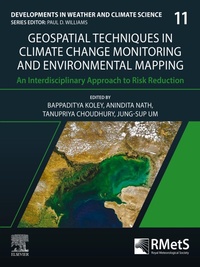
Geospatial Techniques in Climate Change Monitoring and Environmental Mapping
An Interdisciplinary Approach to Risk Reduction
Published on 29. May 2026
600 pages
978-0-443-33247-0 (ISBN)
Description

Geospatial Techniques in Climate Change Monitoring and Environmental Mapping: An Interdisciplinary Approach to Risk Reduction presents a comprehensive examination of innovative geospatial methods utilized to address the challenges posed by climate change across various sectors. The book encompasses a wide array of topics, including the application of remote sensing in agriculture, urban climate change mitigation, and the evaluation of land use effects on surface temperatures. It highlights the integration of advanced technologies such as machine learning and satellite imagery to enhance drought risk mapping, deforestation detection, and flood prediction, providing valuable insights into environmental sustainability. Moreover, the text emphasizes participatory approaches and the role of local communities in climate resilience. By synthesizing interdisciplinary perspectives, the book underscores the importance of collaborative efforts in developing effective mitigation and adaptation strategies. Ultimately, this work serves as a vital resource for researchers and practitioners committed to leveraging geospatial techniques for effective climate change risk reduction and environmental management.Members of the Royal Meteorological Society are eligible for a 35% discount on all Developments in Weather and Climate Science series titles. See the RMetS member dashboard for the discount code.
- Emphasizes an interdisciplinary approach to climate change impacts, risk reduction, and mitigation strategies
- Highlights the role of geospatial data, methods, and tools in monitoring climate change with advanced techniques in remote sensing and spatial analysis
- Examines practical applications of geospatial techniques and machine learning techniques in risk management
More details
Other editions
Additional editions
Jung-Sup Um | Anindita Nath | Bappaditya Koley
Geospatial Techniques in Climate Change Monitoring and Environmental Mapping: Volume 11
An Interdisciplinary Approach to Risk Reduction
Book
05/2026
Elsevier
€184.50
Shipment within 15-20 days
Content
1. Frontier Technology and Application of Remote Sensing in Agriculture for Combating Climate Change2. Evaluating Land Use Effects on Surface Temperatures with Remote Sensing: A Systematic Review3. A Comprehensive Review of Drought Risk Mapping: Harnessing Remote Sensing and Machine Learning Innovations4. Social Innovations in Urban Climate Change Mitigation and Adaptation: A Review Study on African Informal Settlements5. Understanding the effects of climate change in the Chhattisgarh State from stakeholder perspective6. Deforestation Detection: How Satellite Imagery Informs Conservation Laws.7. Addressing Urban Overheating in India: Best Practice from Key Cities8. Geospatial analysis of Health Facilities in IHIALA and Its Environs using Remote Sensing and GIS9. The Impact of Climate Change and Human Pressures on Water Resources in the Nefifikh Basin, Morocco: Diagnosis and Analysis Using Geomatics Techniques10. Assessment of Inherent Optical Properties in Chilika Lagoon Using Forel-Ule Index and In-Situ Observations11. Mapping and Monitoring of Climate Change Applications using LIDAR12. Participatory Approach to GIS Based Mapping and Monitoring of Urban Data Through Capacity Building13. Enhanced Cloud Burst Prediction Using Integrated Convolutional and Recurrent Neural Networks with Satellite Imagery and Meteorological Data14. Quantifying bi-seasonal intrabar grain roughness variations in the Himalayan Mountain Front River: A case study of the Gobarjyoti River, India15. Presenting the Climate-Informed Factor Model: A Framework for Evaluating the Environmental Unsustainability of Single-Family Residences in the Context of an Approaching Climate Crisis.16. Integrating Sentinel-1 SAR Data with Google Earth Engine for Enhanced Flood Detection in Lakhimpur District in Assam, India17. Trends and Impact of Climate Variability on Cereal Crops in Uttar Pradesh: A Spatial Analysis18. Vulnerability Assessment and Mitigation Strategies for Disaster-Resilient Urban Growth - Studies from Bhuvaneshwar, India19. Comparative Assessment of Landslide Susceptibility of West Sikkim using Three Machine Learning techniques20. Climate change mitigation, adaptation and future directions - Case Study21. Enhancing Runoff Prediction Accuracy by Integrating Soil Moisture Balance with the SCS-CN Model for Climate Change Monitoring: A Geospatial Approach in Watershed Management22. Climate Change Mitigation, Adaptation and Future Directions - A Case Study of Tokou Village, Ovalau Islands, Fiji23. Geospatial ANN-MATLAB Models for Mitigating Climate Changes: A Case Study of Vijayawada City, Andhra Pradesh, India24. Informal Settlements and Climate Vulnerability: Remote Sensing Approaches for Equitable Urban Planning25. Sustainable Approaches for Risk Reduction of Global Climate Change Issues Taking the Example of Uttarakhand26. Practice of Rat-Hole Mining and Its Impact on Environmental Degradation: A Case Study in Jaintia Hills, Meghalaya, India27. Monitoring and mapping river health for environmental sustainability with geospatial techniques- A case study of Catalunya28. Low Carbon Material for Flood Resilient Buildings29. Resilience Governance: A Concepts Analysis and Research Synthesis30. Climate Governance: A Multifaceted Analysis from Global to Local31. Artificial Intelligence (AI) at the Intersection of Urban Climate Change Adaptation32. Kenya's Green Belt Movement: A Case Study in Sustainable Risk Reduction and Climate Change Adaptation33. Climate Resilience in Fiji: Sustainable Strategies for Mitigating Global Climate Change Risks34. Sustainable Approaches for Risk Reduction of Global Climate Change Issues35. From Highways to Greenways: The Role of the Passante Verde di Mestre in Environmental Conservation and Climate Resilience
