

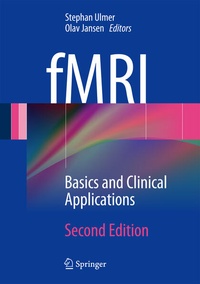
fMRI
Description

Over the past two decades, fMRI has evolved into an invaluable clinical tool for routine brain imaging. This book provides a state of the art overview of fMRI and its use in clinical practice. Experts in the field share their knowledge and explain how to overcome diverse potential technical barriers and problems. Starting from the very basics on the origin of the BOLD signal, the book covers technical issues, anatomical landmarks, the full range of clinical applications, methods of statistical analysis, and special issues in various clinical fields. Comparisons are made with other brain mapping techniques, such as DTI, PET, TMS, EEG, and MEG, and their combined use with fMRI is also discussed. Since the first edition, original chapters have been updated and new chapters added, covering both novel aspects of analysis and further important clinical applications.
More details
Other editions
Additional editions
Previous edition
Content
Introduction.- Neuroanatomy and cortical landmarks.- Spatial resolution of fMRI techniques.- The electrophysiological background of the fMRI signal.- fMRI data analysis using SPM.- Meta-analyses in basic and clinical neuroscience: State of the art and perspective.- Preoperative blood oxygen level dependent (BOLD) functional magnetic resonance imaging (fMRI) of motor and somatosensory functions.- The functional anatomy of speech processing: from auditory cortex to speech recognition and speech production.- Use of fMRI language lateralization for quantitative prediction of naming and verbal memory outcome in left temporal lobe epilepsy surgery.- Mapping of recovery from poststroke aphasia: comparison of Pet and fMRI.- Functional magnetic resonance-guided brain tumor resection.- Direct cortical stimulation and fMRI.- Imaging epilepsy and epileptic seizures using fMRI.- Multimodal brain mapping in patients with early brain lesions.- Special issues in fMRI involving children.- Modelling connectivity in health and disease: examples from the motor system.- fMRI in Parkinson's disease.- The perirhinal, entorhinal and parahippocampal cortices and hippocampus: an overview of functional anatomy and protocol for their segmentation in MR images.- Simultaneous EEG and fMRI recordings (EEG-fMRI).- Combining transcranial magnetic stimulation with fMRI.- Clinical magnetoencephalography and fMRI.- Incidental findings in neuroimaging research: Ethical considerations.
