

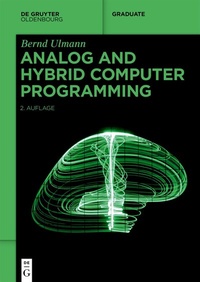
Analog and Hybrid Computer Programming
Description

As classic digital computers are about to reach their physical and architectural boundaries, interest in unconventional approaches to computing, such as quantum and analog computers, is rapidly increasing. For a wide variety of practical applications, analog computers can outperform classic digital computers in terms of both raw computational speed and energy efficiency. This makes them ideally suited a co-processors to digital computers, thus forming hybrid computers.
This second edition of "Analog and Hybrid Computer Programming" provides a thorough introduction to the programming of analog and hybrid computers. It contains a wealth of practical examples, ranging from simple problems such as radioactive decay, harmonic oscillators, and chemical reaction kinetics to advanced topics which include the simulation of neurons, chaotic systems such as a double-pendulum simulation and many more. In addition to these examples, it contains a chapter on special functions which can be used as "subroutines" in an analog computer setup.
Reviews / Votes
"Eine fundierte Einführung in die Welt der analogen Rechner, die in der heutigen Zeit des wiedererwachten Interesses besonders relevant ist." Radomír Novotný in: Bulletin Electrosuisse, https://www.bulletin.ch/de/news-detail/buch-analog-and-hybrid-computer-programming.html (16.12.2024)More details
Other editions
Additional editions
Previous edition
Person
Prof. Dr. Bernd Ulmann
Professor for business informatics, "Hochschule fur Oekonomie und Management" (FOM), Standort Frankfurt/Main.
1995 - 1999: IT consultant, freelancer, working mainly in process automation
in the petro chemical industry
1999 - 2005/2008 - today: Founder and CEO of Raven Information Technologies GmbH
2005 - 2007: IT specialist, Landesbank Rheinland-Pfalz, Mainz
2007 - 2008: Group manager, Landesbank Rheinland-Pfalz, Mainz
September 2009 - 14.04.2010: Lecturer for business informatics at "Hochschule fur Oekonomie und Management" (FOM), Standort Frankfurt/Main. ¨
Since 15.04.2010: Professor for business informatics, "Hochschule fur Oeko- ¨
nomie und Management" (FOM), Standort Frankfurt/Main.
Since 2019: Guest professor and lecturer at the Institute of Medical Systems
Biology at Ulm University.
2020: Founder and Analog Evanglist at anabrid (https://anabrid.com).
Content
- Intro
- Acknowledgments and disclaimer
- Preface to the 2⊃&nd&/sup& edition
- Contents
- Acronyms
- 1 Introduction
- 2 Computing elements
- 3 Analog computer operation
- 4 Basic programming
- 5 Special functions
- 6 Examples
- 7 Hybrid computing
- 8 Summary and outlook
- A The Laplace transform
- B Solving the heat equation with a passive network
- C A simple hybrid controller for THE ANALOG THING
- D An oscilloscope multiplexer
- E A log() function generator
- F A sine/cosine generator
- G A simple joystick interface
- H The Analog Paradigm bus system
- I HyCon commands
- Bibliography
- Index
