

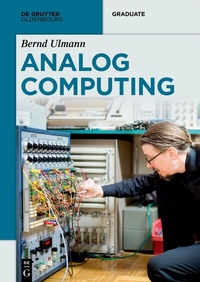
Analog Computing
Description

Analog computing is one of the main pillars of Unconventional Computing. Almost forgotten for decades, we now see an ever-increasing interest in electronic analog computing because it offers a path to high-performance and highly energy-efficient computing. These characteristics are of great importance in a world where vast amounts of electric energy are consumed by today's computer systems. Analog computing can deliver efficient solutions to many computing problems, ranging from general purpose analog computation to specialised systems like analog artificial neural networks.
The book "Analog Computing" has established itself over the past decade as the standard textbook on the subject and has been substantially extended in this second edition, which includes more than 300 additional bibliographical entries, and has been expanded in many areas to include much greater detail. These enhancements will confirm this book's status as the leading work in the field. It covers the history of analog computing from the Antikythera Mechanism to recent electronic analog computers and uses a wide variety of worked examples to provide a comprehensive introduction to programming analog computers. It also describes hybrid computers, digital differential analysers, the simulation of analog computers, stochastic computers, and provides a comprehensive treatment of classic and current analog computer applications. The last chapter looks into the promising future of analog computing.
More details
Other editions
New editions
Additional editions
Previous edition
Person
Prof. Dr. Bernd Ulmann
Professor for business informatics, "Hochschule fur Oekonomie und Management" (FOM), Standort Frankfurt/Main.
1995 - 1999: IT consultant, freelancer, working mainly in process automation
in the petro chemical industry
1999 - 2005/2008 - today: Founder and CEO of Raven Information Technologies GmbH
2005 - 2007: IT specialist, Landesbank Rheinland-Pfalz, Mainz
2007 - 2008: Group manager, Landesbank Rheinland-Pfalz, Mainz
September 2009 - 14.04.2010: Lecturer for business informatics at "Hochschule fur Oekonomie und Management" (FOM), Standort Frankfurt/Main. ¨
Since 15.04.2010: Professor for business informatics, "Hochschule fur Oeko- ¨
nomie und Management" (FOM), Standort Frankfurt/Main.
Since 2019: Guest professor and lecturer at the Institute of Medical Systems
Biology at Ulm University.
2020: Founder and Analog Evanglist at anabrid (https://anabrid.com).
Content
- Intro
- Acknowledgments
- Preface to the 2⊃&nd &/sup&edition
- Contents
- 1 Introduction
- 2 Mechanical analog computers
- 3 The first electronic analog computers
- 4 Basic computing elements
- 5 The anatomy of a classic analog computer
- 6 Some typical analog computers
- 7 Programming
- 8 Programming examples
- 9 Hybrid computers
- 10 Digital differential analysers
- 11 Stochastic computing
- 12 Simulation of analog computers
- 13 Applications
- 14 Future and opportunities
- Bibliography
- Index
