

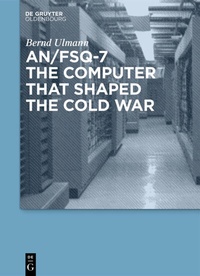
AN/FSQ-7: the computer that shaped the Cold War
Description

One of the most impressive computer systems ever was the vacuum tube based behemoth AN/FSQ-7, which was the heart of the ''Semi Automatic Ground Environment''. Machines of this type were children of the Cold War and had a tremendous effect in politics. They also generated a vast amount of spin-offs which still shape our world. This book focuses on the technological achievements and details of this marvelous machine and of its predecessor Whirlwind. The various developments, ranging from magnetic core memory to data transmission via telephone lines, are covered in detail with schematics, circuit descriptions and small programming examples.
This book is a treasure trove for those interested in the technology of early digital computers and those interested in the impact these machines had and still have on our current computer systems.
More details
Other editions
Additional editions
Person
Content
2 - 2 Setting the stage [Seite 15]
2.1 - 2.1 Computers until 1945 [Seite 15]
2.2 - 2.2 Basics of vacuum tube circuits [Seite 20]
2.3 - 2.3 Toward Whirlwind and beyond [Seite 24]
3 - 3 Whirlwind [Seite 33]
3.1 - 3.1 Basic architecture [Seite 33]
3.1.1 - 3.1.1 Arithmetic element [Seite 39]
3.1.2 - 3.1.2 Control [Seite 43]
3.2 - 3.2 Storage [Seite 45]
3.2.1 - 3.2.1 The Massachusetts Institute of Technology (MIT) Storage Tube [Seite 48]
3.2.2 - 3.2.2 Magnetic core storage [Seite 52]
3.3 - 3.3 Magnetic drums [Seite 59]
3.4 - 3.4 Magnetic tapes [Seite 63]
3.5 - 3.5 Paper tape readers, punches and typewriters [Seite 65]
3.6 - 3.6 Data transmission [Seite 66]
3.7 - 3.7 Oscilloscope displays and light guns [Seite 68]
3.8 - 3.8 Time register [Seite 70]
3.9 - 3.9 Reliability, power supplies and marginal checking [Seite 70]
3.10 - 3.10 Programming [Seite 74]
3.11 - 3.11 The end of Whirlwind [Seite 78]
4 - 4 SAGE [Seite 81]
4.1 - 4.1 The Cape Cod system [Seite 83]
4.2 - 4.2 SAGE and AN/FSQ-7 [Seite 84]
4.3 - 4.3 Control and direction centers [Seite 87]
4.4 - 4.4 AN/FSQ-7 overview [Seite 93]
5 - 5 Basic circuitry [Seite 101]
5.1 - 5.1 Introduction [Seite 101]
5.2 - 5.2 Cathode follower [Seite 104]
5.3 - 5.3 Pulse amplifier [Seite 105]
5.4 - 5.4 Register driver [Seite 106]
5.5 - 5.5 Relay drivers [Seite 108]
5.6 - 5.6 Level setter [Seite 110]
5.7 - 5.7 Diode AND and OR circuits [Seite 112]
5.8 - 5.8 Gate tube circuit [Seite 113]
5.9 - 5.9 DC inverter [Seite 114]
5.10 - 5.10 Flip-flops [Seite 115]
5.11 - 5.11 Single-shots [Seite 118]
5.12 - 5.12 Pulse generators [Seite 121]
5.13 - 5.13 Delay lines and delay line drivers [Seite 123]
5.14 - 5.14 Special circuits [Seite 124]
5.15 - 5.15 Pluggable units [Seite 125]
5.16 - 5.16 The FETRON [Seite 127]
5.17 - 5.17 Troubleshooting [Seite 128]
6 - 6 Central processor [Seite 131]
6.1 - 6.1 Memory element [Seite 134]
6.2 - 6.2 Instruction control element [Seite 138]
6.3 - 6.3 Selection and IO control element [Seite 140]
6.4 - 6.4 Program element [Seite 141]
6.5 - 6.5 Arithmetic element [Seite 143]
7 - 7 Drum system [Seite 151]
7.1 - 7.1 Magnetic drums [Seite 152]
7.2 - 7.2 Timing [Seite 156]
7.3 - 7.3 Status concept and time stamps [Seite 158]
7.4 - 7.4 Data flows [Seite 158]
8 - 8 Input/output system [Seite 161]
8.1 - 8.1 Input system [Seite 161]
8.1.1 - 8.1.1 Long-Range Input (LRI) element [Seite 162]
8.1.2 - 8.1.2 Gap-Filler Input (GFI) element [Seite 165]
8.1.3 - 8.1.3 Crosstell (XTL) element [Seite 168]
8.1.4 - 8.1.4 Test Pattern Generator (TPG) [Seite 169]
8.2 - 8.2 Manual data input element [Seite 169]
8.3 - 8.3 Output system [Seite 170]
8.4 - 8.4 Alarms and warning lights [Seite 174]
8.5 - 8.5 Tape drives and card machines [Seite 175]
9 - 9 Display system [Seite 177]
9.1 - 9.1 Situation display [Seite 179]
9.2 - 9.2 Light gun [Seite 183]
9.3 - 9.3 Area discriminators [Seite 185]
9.4 - 9.4 Digital display [Seite 186]
9.5 - 9.5 Photographic recorder-reproducer element [Seite 188]
10 - 10 Machine consoles [Seite 191]
11 - 11 Power supply [Seite 195]
11.1 - 11.1 The powerhouse [Seite 195]
11.2 - 11.2 Regulated power supplies [Seite 196]
11.3 - 11.3 Power distribution [Seite 198]
11.4 - 11.4 Marginal checking system [Seite 200]
12 - 12 Programming [Seite 203]
12.1 - 12.1 Instruction format [Seite 203]
12.2 - 12.2 Instruction set [Seite 204]
12.2.1 - 12.2.1 Miscellaneous class [Seite 205]
12.2.2 - 12.2.2 Add class [Seite 206]
12.2.3 - 12.2.3 Multiply class [Seite 207]
12.2.4 - 12.2.4 Store class [Seite 208]
12.2.5 - 12.2.5 Shift class [Seite 209]
12.2.6 - 12.2.6 Branch class [Seite 210]
12.2.7 - 12.2.7 Input/output class [Seite 210]
12.2.8 - 12.2.8 Reset class [Seite 211]
12.3 - 12.3 Indexed addressing [Seite 211]
12.4 - 12.4 Subroutines [Seite 212]
12.5 - 12.5 Examples [Seite 213]
12.5.1 - 12.5.1 Polynomial evaluation [Seite 214]
12.5.2 - 12.5.2 Coordinate transformation [Seite 214]
12.5.3 - 12.5.3 Finding the largest number [Seite 216]
12.5.4 - 12.5.4 Adding ten numbers [Seite 217]
12.5.5 - 12.5.5 Delaying [Seite 218]
12.5.6 - 12.5.6 Printing [Seite 219]
12.5.7 - 12.5.7 Trick programs [Seite 219]
13 - 13 Software [Seite 221]
13.1 - 13.1 Software development process [Seite 221]
13.2 - 13.2 Operational software [Seite 224]
14 - 14 Failure or Success? [Seite 227]
14.1 - 14.1 A failure? [Seite 227]
14.2 - 14.2 Success! [Seite 229]
14.2.1 - 14.2.1 Hardware [Seite 229]
14.2.2 - 14.2.2 Graphics [Seite 230]
14.2.3 - 14.2.3 Software [Seite 231]
14.2.4 - 14.2.4 Air Traffic Control (ATC) and SABRE [Seite 232]
14.2.5 - 14.2.5 Semi Automatic Ground Environment (SAGE) in popular culture [Seite 232]
15 - 15 Epilogue [Seite 233]
15.1 - A Whirlwind instruction set [Seite 235]
15.2 - B Programming cards [Seite 241]
16 - Bibliography [Seite 245]
17 - Acronyms [Seite 259]
18 - Index [Seite 263]
